

year
stringdate 1961-01-01 00:00:00
2025-01-01 00:00:00
⌀ | tier
stringclasses 5
values | problem_label
stringclasses 119
values | problem_type
stringclasses 13
values | exam
stringclasses 28
values | problem
stringlengths 87
2.77k
| solution
stringlengths 834
13k
| metadata
dict | problem_tokens
int64 50
903
| solution_tokens
int64 500
3.93k
|
|---|---|---|---|---|---|---|---|---|---|
1989
|
T1
|
2
| null |
APMO
|
Prove that the equation
$$
6\left(6 a^{2}+3 b^{2}+c^{2}\right)=5 n^{2}
$$
has no solutions in integers except $a=b=c=n=0$.
|
We can suppose without loss of generality that $a, b, c, n \geq 0$. Let $(a, b, c, n)$ be a solution with minimum sum $a+b+c+n$. Suppose, for the sake of contradiction, that $a+b+c+n>0$. Since 6 divides $5 n^{2}, n$ is a multiple of 6 . Let $n=6 n_{0}$. Then the equation reduces to
$$
6 a^{2}+3 b^{2}+c^{2}=30 n_{0}^{2}
$$
The number $c$ is a multiple of 3 , so let $c=3 c_{0}$. The equation now reduces to
$$
2 a^{2}+b^{2}+3 c_{0}^{2}=10 n_{0}^{2}
$$
Now look at the equation modulo 8:
$$
b^{2}+3 c_{0}^{2} \equiv 2\left(n_{0}^{2}-a^{2}\right) \quad(\bmod 8)
$$
Integers $b$ and $c_{0}$ have the same parity. Either way, since $x^{2}$ is congruent to 0 or 1 modulo 4 , $b^{2}+3 c_{0}^{2}$ is a multiple of 4 , so $n_{0}^{2}-a^{2}=\left(n_{0}-a\right)\left(n_{0}+a\right)$ is even, and therefore also a multiple of 4 , since $n_{0}-a$ and $n_{0}+a$ have the same parity. Hence $2\left(n_{0}^{2}-a^{2}\right)$ is a multiple of 8 , and
$$
b^{2}+3 c_{0}^{2} \equiv 0 \quad(\bmod 8)
$$
If $b$ and $c_{0}$ are both odd, $b^{2}+3 c_{0}^{2} \equiv 4(\bmod 8)$, which is impossible. Then $b$ and $c_{0}$ are both even. Let $b=2 b_{0}$ and $c_{0}=2 c_{1}$, and we find
$$
a^{2}+2 b_{0}^{2}+6 c_{1}^{2}=5 n_{0}^{2}
$$
Look at the last equation modulo 8:
$$
a^{2}+3 n_{0}^{2} \equiv 2\left(c_{1}^{2}-b_{0}^{2}\right) \quad(\bmod 8)
$$
A similar argument shows that $a$ and $n_{0}$ are both even.
We have proven that $a, b, c, n$ are all even. Then, dividing the original equation by 4 we find
$$
6\left(6(a / 2)^{2}+3(b / 2)^{2}+(c / 2)^{2}\right)=5(n / 2)^{2}
$$
and we find that $(a / 2, b / 2, c / 2, n / 2)$ is a new solution with smaller sum. This is a contradiction, and the only solution is $(a, b, c, n)=(0,0,0,0)$.
|
{
"problem_match": "# Problem 2",
"resource_path": "APMO/segmented/en-apmo1989_sol.jsonl",
"solution_match": "# Solution\n\n"
}
| 51
| 749
|
1989
|
T1
|
3
| null |
APMO
|
Let $A_{1}, A_{2}, A_{3}$ be three points in the plane, and for convenience,let $A_{4}=A_{1}, A_{5}=A_{2}$. For $n=1,2$, and 3 , suppose that $B_{n}$ is the midpoint of $A_{n} A_{n+1}$, and suppose that $C_{n}$ is the midpoint of $A_{n} B_{n}$. Suppose that $A_{n} C_{n+1}$ and $B_{n} A_{n+2}$ meet at $D_{n}$, and that $A_{n} B_{n+1}$ and $C_{n} A_{n+2}$ meet at $E_{n}$. Calculate the ratio of the area of triangle $D_{1} D_{2} D_{3}$ to the area of triangle $E_{1} E_{2} E_{3}$.
Answer: $\frac{25}{49}$.
|
Let $G$ be the centroid of triangle $A B C$, and also the intersection point of $A_{1} B_{2}, A_{2} B_{3}$, and $A_{3} B_{1}$ 。
By Menelao's theorem on triangle $B_{1} A_{2} A_{3}$ and line $A_{1} D_{1} C_{2}$,
$$
\frac{A_{1} B_{1}}{A_{1} A_{2}} \cdot \frac{D_{1} A_{3}}{D_{1} B_{1}} \cdot \frac{C_{2} A_{2}}{C_{2} A_{3}}=1 \Longleftrightarrow \frac{D_{1} A_{3}}{D_{1} B_{1}}=2 \cdot 3=6 \Longleftrightarrow \frac{D_{1} B_{1}}{A_{3} B_{1}}=\frac{1}{7}
$$
Since $A_{3} G=\frac{2}{3} A_{3} B_{1}$, if $A_{3} B_{1}=21 t$ then $G A_{3}=14 t, D_{1} B_{1}=\frac{21 t}{7}=3 t, A_{3} D_{1}=18 t$, and $G D_{1}=A_{3} D_{1}-A_{3} G=18 t-14 t=4 t$, and
$$
\frac{G D_{1}}{G A_{3}}=\frac{4}{14}=\frac{2}{7}
$$
Similar results hold for the other medians, therefore $D_{1} D_{2} D_{3}$ and $A_{1} A_{2} A_{3}$ are homothetic with center $G$ and ratio $-\frac{2}{7}$.
By Menelao's theorem on triangle $A_{1} A_{2} B_{2}$ and line $C_{1} E_{1} A_{3}$,
$$
\frac{C_{1} A_{1}}{C_{1} A_{2}} \cdot \frac{E_{1} B_{2}}{E_{1} A_{1}} \cdot \frac{A_{3} A_{2}}{A_{3} B_{2}}=1 \Longleftrightarrow \frac{E_{1} B_{2}}{E_{1} A_{1}}=3 \cdot \frac{1}{2}=\frac{3}{2} \Longleftrightarrow \frac{A_{1} E_{1}}{A_{1} B_{2}}=\frac{2}{5}
$$
If $A_{1} B_{2}=15 u$, then $A_{1} G=\frac{2}{3} \cdot 15 u=10 u$ and $G E_{1}=A_{1} G-A_{1} E_{1}=10 u-\frac{2}{5} \cdot 15 u=4 u$, and
$$
\frac{G E_{1}}{G A_{1}}=\frac{4}{10}=\frac{2}{5}
$$
Similar results hold for the other medians, therefore $E_{1} E_{2} E_{3}$ and $A_{1} A_{2} A_{3}$ are homothetic with center $G$ and ratio $\frac{2}{5}$.
Then $D_{1} D_{2} D_{3}$ and $E_{1} E_{2} E_{3}$ are homothetic with center $G$ and ratio $-\frac{2}{7}: \frac{2}{5}=-\frac{5}{7}$, and the ratio of their area is $\left(\frac{5}{7}\right)^{2}=\frac{25}{49}$.
|
{
"problem_match": "# Problem 3",
"resource_path": "APMO/segmented/en-apmo1989_sol.jsonl",
"solution_match": "\nSolution\n"
}
| 219
| 864
|
1989
|
T1
|
4
| null |
APMO
|
Let $S$ be a set consisting of $m$ pairs $(a, b)$ of positive integers with the property that $1 \leq a<$ $b \leq n$. Show that there are at least
$$
4 m \frac{\left(m-\frac{n^{2}}{4}\right)}{3 n}
$$
triples $(a, b, c)$ such that $(a, b),(a, c)$, and $(b, c)$ belong to $S$.
|
Call a triple $(a, b, c)$ good if and only if $(a, b),(a, c)$, and $(b, c)$ all belong to $S$. For $i$ in $\{1,2, \ldots, n\}$, let $d_{i}$ be the number of pairs in $S$ that contain $i$, and let $D_{i}$ be the set of numbers paired with $i$ in $S$ (so $\left|D_{i}\right|=d_{i}$ ). Consider a pair $(i, j) \in S$. Our goal is to estimate the number of integers $k$ such that any permutation of $\{i, j, k\}$ is good, that is, $\left|D_{i} \cap D_{j}\right|$. Note that $i \notin D_{i}$ and $j \notin D_{j}$, so $i, j \notin D_{i} \cap D_{j}$; thus any $k \in D_{i} \cap D_{j}$ is different from both $i$ and $j$, and $\{i, j, k\}$ has three elements as required. Now, since $D_{i} \cup D_{j} \subseteq\{1,2, \ldots, n\}$,
$$
\left|D_{i} \cap D_{j}\right|=\left|D_{i}\right|+\left|D_{j}\right|-\left|D_{i} \cup D_{j}\right| \leq d_{i}+d_{j}-n
$$
Summing all the results, and having in mind that each good triple is counted three times (one for each two of the three numbers), the number of good triples $T$ is at least
$$
T \geq \frac{1}{3} \sum_{(i, j) \in S}\left(d_{i}+d_{j}-n\right)
$$
Each term $d_{i}$ appears each time $i$ is in a pair from $S$, that is, $d_{i}$ times; there are $m$ pairs in $S$, so $n$ is subtracted $m$ times. By the Cauchy-Schwartz inequality
$$
T \geq \frac{1}{3}\left(\sum_{i=1}^{n} d_{i}^{2}-m n\right) \geq \frac{1}{3}\left(\frac{\left(\sum_{i=1}^{n} d_{i}\right)^{2}}{n}-m n\right) .
$$
Finally, the sum $\sum_{i=1}^{n} d_{i}$ is $2 m$, since $d_{i}$ counts the number of pairs containing $i$, and each pair $(i, j)$ is counted twice: once in $d_{i}$ and once in $d_{j}$. Therefore
$$
T \geq \frac{1}{3}\left(\frac{(2 m)^{2}}{n}-m n\right)=4 m \frac{\left(m-\frac{n^{2}}{4}\right)}{3 n} .
$$
Comment: This is a celebrated graph theory fact named Goodman's bound, after A. M. Goodman's method published in 1959. The generalized version of the problem is still studied to this day.
|
{
"problem_match": "# Problem 4",
"resource_path": "APMO/segmented/en-apmo1989_sol.jsonl",
"solution_match": "# Solution\n\n"
}
| 104
| 742
|
1989
|
T1
|
5
| null |
APMO
|
Determine all functions $f$ from the reals to the reals for which
(1) $f(x)$ is strictly increasing,
(2) $f(x)+g(x)=2 x$ for all real $x$, where $g(x)$ is the composition inverse function to $f(x)$.
(Note: $f$ and $g$ are said to be composition inverses if $f(g(x))=x$ and $g(f(x))=x$ for all real x.)
Answer: $f(x)=x+c, c \in \mathbb{R}$ constant.
|
Denote by $f_{n}$ the $n$th iterate of $f$, that is, $f_{n}(x)=\underbrace{f(f(\ldots f}_{n \text { times }}(x)))$.
Plug $x \rightarrow f_{n+1}(x)$ in (2): since $g\left(f_{n+1}(x)\right)=g\left(f\left(f_{n}(x)\right)\right)=f_{n}(x)$,
$$
f_{n+2}(x)+f_{n}(x)=2 f_{n+1}(x)
$$
that is,
$$
f_{n+2}(x)-f_{n+1}(x)=f_{n+1}(x)-f_{n}(x)
$$
Therefore $f_{n}(x)-f_{n-1}(x)$ does not depend on $n$, and is equal to $f(x)-x$. Summing the corresponding results for smaller values of $n$ we find
$$
f_{n}(x)-x=n(f(x)-x) .
$$
Since $g$ has the same properties as $f$,
$$
g_{n}(x)-x=n(g(x)-x)=-n(f(x)-x) .
$$
Finally, $g$ is also increasing, because since $f$ is increasing $g(x)>g(y) \Longrightarrow f(g(x))>$ $f(g(y)) \Longrightarrow x>y$. An induction proves that $f_{n}$ and $g_{n}$ are also increasing functions.
Let $x>y$ be real numbers. Since $f_{n}$ and $g_{n}$ are increasing,
$$
x+n(f(x)-x)>y+n(f(y)-y) \Longleftrightarrow n[(f(x)-x)-(f(y)-y)]>y-x
$$
and
$$
x-n(f(x)-x)>y-n(f(y)-y) \Longleftrightarrow n[(f(x)-x)-(f(y)-y)]<x-y
$$
Summing it up,
$$
|n[(f(x)-x)-(f(y)-y)]|<x-y \quad \text { for all } n \in \mathbb{Z}_{>0}
$$
Suppose that $a=f(x)-x$ and $b=f(y)-y$ are distinct. Then, for all positive integers $n$,
$$
|n(a-b)|<x-y
$$
which is false for a sufficiently large $n$. Hence $a=b$, and $f(x)-x$ is a constant $c$ for all $x \in \mathbb{R}$, that is, $f(x)=x+c$.
It is immediate that $f(x)=x+c$ satisfies the problem, as $g(x)=x-c$.
|
{
"problem_match": "# Problem 5",
"resource_path": "APMO/segmented/en-apmo1989_sol.jsonl",
"solution_match": "# Solution\n\n"
}
| 123
| 598
|
1990
|
T1
|
1
| null |
APMO
|
In $\triangle A B C$, let $D, E, F$ be the midpoints of $B C, A C, A B$ respectively and let $G$ be the centroid of the triangle.
For each value of $\angle B A C$, how many non-similar triangles are there in which $A E G F$ is a cyclic quadrilateral?
|
Let $I$ be the intersection of $A G$ and $E F$.
Let $\delta=A I . I G-F I$ IE. Then
$$
A I=A D / 2, \quad I G=A D / 6, \quad F I=B C / 4=I E
$$
Further, applying the cosine rule to triangles $A B D, A C D$ we get
$$
\begin{aligned}
A B^{2} & =B C^{2} / 4+A D^{2}-A D \cdot B C \cdot \cos \angle B D A, \\
A C^{2} & =B C^{2} / 4+A D^{2}+A D \cdot B C \cdot \cos \angle B D A, \\
\text { so } \quad A D^{2} & =\left(A B^{2}+A C^{2}-B C^{2} / 2\right) / 2
\end{aligned}
$$
Hence
$$
\begin{aligned}
\delta & =\left(A B^{2}+A C^{2}-2 B C^{2}\right) / 24 \\
& =\left(4 A B \cdot A C \cdot \cos \angle B A C-A B^{2}-A C^{2}\right)
\end{aligned}
$$
Now $A E F G$ is a cyclic quadrilateral if and only if $\delta=0$, i.e. if and only if
$$
\begin{aligned}
\cos \angle B A C & =\left(A B^{2}+A B^{2}\right) /(4 \cdot A B \cdot A C) \\
& =(A B / A C+A C / A B) / 4
\end{aligned}
$$
5
Now $A B / A C+A C / A B \geq 2$. Hence $\cos \angle B A C \geq 1 / 2$ and so $\angle B A C \leq 60^{\circ}$.
For $\angle B A C>60^{\circ}$ there is no triangle with the required property.
For $\angle B A C=60^{\circ}$ there exists, within similarity, precisely one triangle (which is equilateral) having the required property.
For $\angle B A C<60^{\circ}$ there exists, within similarity, again precisely one triangle having the required property (even though for fixed median $A E$ there are two, but one arises from the other by interchanging point $B$ with point $C$, thus proving them to be similar).
|
{
"problem_match": "# Question 1 ",
"resource_path": "APMO/segmented/en-apmo1990_sol.jsonl",
"solution_match": "# FIRST SOLUTION\n\n"
}
| 75
| 571
|
1990
|
T1
|
1
| null |
APMO
|
In $\triangle A B C$, let $D, E, F$ be the midpoints of $B C, A C, A B$ respectively and let $G$ be the centroid of the triangle.
For each value of $\angle B A C$, how many non-similar triangles are there in which $A E G F$ is a cyclic quadrilateral?
|
in the figure as shown below, we first show that it is necessary that $\angle A$ is less than $90^{\circ}$ if the quadrilateral $A E G F$ ; cyclic.
Now, since $E F \| B C$, we get
$$
\begin{aligned}
\angle E G F & =180^{\circ}-\left(B_{1}+C_{1}\right) \\
& \geq 180^{\circ}-(B+C) \\
& =A .
\end{aligned}
$$
(1)
Thus, if $A E G F$ is cyclic, we would have $\angle E G F+\angle A=180^{\circ}$. Therefore it is necessary that $0<\angle A \leq 90^{\circ}$.
## Continuation "A"
Let $O$ be the circumcentre of $\triangle A F E$. Without loss of generality, let the radius of this circle be 1.
We then let $A=1, F=z=e^{i \theta}$ and $E=z e^{2 i \alpha}=e^{i(\theta+2 \alpha)}$.
Then $\angle A=\alpha, 0<\alpha \leq 90^{\circ}$, and $0<\theta<360^{\circ}-2 \alpha$.
Thus,
$$
B=2 z-1
$$
and
$$
\begin{aligned}
G & =\frac{1}{3}(2 z-1)+\frac{2}{3}\left(z e^{2 i \alpha}\right) \\
& =\frac{1}{3}\left(2 e^{i \theta}+2 e^{i(\theta+2 \alpha)}-1\right)
\end{aligned}
$$
For quadrilateral $A F G E$ to be cyclic, it is now necessary that
$$
|G|=1 .
$$
For $|G|=1$, we must have
$$
\begin{aligned}
9= & (2 \cos (\theta)+2 \cos (\theta+2 \alpha)-1)^{2}+(2 \sin (\theta)+2 \sin (\theta+2 \alpha))^{2} \\
= & 4\left(\cos ^{2}(\theta)+\sin ^{2}(\theta)\right)+4\left(\cos ^{2}(\theta+2 \alpha)+\sin ^{2}(\theta+2 \alpha)\right)+1 \\
& +8(\cos (\theta) \cos (\theta+2 \alpha)+\sin (\theta) \sin (\theta+2 \alpha))-4 \cos (\theta)-4 \cos (\theta+2 \alpha) \\
= & 9+8 \cos (2 \alpha)-8 \cos (\alpha) \cos (\theta+\alpha)
\end{aligned}
$$
so that
$$
\cos (\theta+\alpha)=\frac{\cos (2 \alpha)}{\cos (\alpha)}
$$
] Now, $\left|\frac{\cos (2 \alpha)}{\cos (\alpha)}\right| \leq 1$ if and only if $\alpha \in\left(0,60^{\circ}\right]$ in the range of $\alpha$ under consideration, that is $\alpha \in\left(0,00^{\circ}\right]$. There is equality if and only if $\alpha=60^{\circ}$.
$\square$ Note there is only one solution. The apparent other solution is the mirror image of the first. We are solving for $\alpha+\theta$. The other solution is $360^{\circ}-\alpha-\theta$.
## Continuation "B"
Let $O$ be the circumcentre of triangle $A E F$. Let $A P$ be a diameter of this circle. Construct the circle with centre $P$ and radius $A P$. Then $B$ and $C$ lie on this circle.
It is clear that the problem is solved if we allow the angle $\angle B A C=\alpha$ to vary and restrict $B$ and $C$ to the constructed circle.
Let $\theta$ be the angle from the drawn axis. Then $\theta$ lies in the range $\left(0,180^{\circ}-\alpha\right)$. We must not forget the necessary restriction of $\alpha$, that is $\alpha \in\left(0,90^{\circ}\right.$.
Now, $D$ lies on an arc of a circle, centre $P$, radius $P D$ exterior to the circle, centre $O$, radius $A O$.
By similarity, $G$, lies on an arc of a circle, centre $Q$, radius $Q G$ where $A Q=\frac{2}{3} A P$ and $Q G=\frac{2}{3} P D$.
For the quadrilateral $A F G E$ to be cyclic, we must have that the radius $Q G$ is greater than or equal to $Q P$.
The easiest way to calulate these radii is to consider the case in which the diameter $A P$ bisects the angle $\angle B A C$.
Thus we re-draw the diagram as below. Let $A H$ be a diameter of the larger circle.
Thus we have $A H=4$ and by similar triangles,
$$
\frac{A D}{A B}=\frac{A B}{A H}=\cos \left(\frac{\alpha}{2}\right)
$$
so that
$$
\begin{aligned}
A D & =4 \cos ^{2}\left(\frac{\alpha}{2}\right) \\
& =2+2 \cos (\alpha) .
\end{aligned}
$$
Thus $P D=2 \cos (\alpha)$ and $Q G=\frac{2}{3} 2 \cos (\alpha)=\frac{4}{3} \cos (\alpha)$.
The necessary condition for a cyclic quadrilateral is then
$$
\frac{4}{3}(1+\cos (\alpha)) \geq 2
$$
[5
$$
\cos (\alpha) \geq \frac{1}{2}
$$
:7
Thus it is clear that there is precisely one (up to similarity) solution for $0<\alpha \leq 60^{\circ}$ and no solutions otherwise.
|
{
"problem_match": "# Question 1 ",
"resource_path": "APMO/segmented/en-apmo1990_sol.jsonl",
"solution_match": "\nTHIRD SOLUTION\n"
}
| 75
| 1,379
|
1990
|
T1
|
2
| null |
APMO
|
Let $a_{1}, a_{2}, \ldots, a_{n}$ be positive real numbers, and let $S_{k}$ be the sum of products of $a_{1}, a_{2}, \ldots, a_{n}$ taken $k$ at a time.
Show that
$$
S_{k} S_{n-k} \geq\binom{ n}{k}^{2} a_{1} a_{2} \ldots a_{n}, \quad \text { for } \quad k=1,2, \ldots, n-1
$$
|
(provided by the Canadian Problems Committee).
Write $S_{k}$ as $\sum_{i=1}^{\binom{n}{k}} t_{i}$. Then
주
$$
S_{n-k}=\left(\prod_{m=1}^{n} a_{m}\right)\left(\sum_{i=1}^{\binom{n}{k}} \frac{1}{t_{i}}\right)
$$
$$
\text { so that } \left.\begin{array}{rl}
S_{k} S_{n-k} & =\left(\prod_{m=1}^{n} a_{m}\right) \cdot\left(\begin{array}{l}
\binom{n}{k} \\
i=1
\end{array} t_{i}\right)\left(\begin{array}{l}
\binom{n}{k} \\
\sum_{j=1}^{2}
\end{array} \frac{1}{t_{j}}\right) \\
& =\left(\prod_{m=1}^{n} a_{m}\right)\left[\sum_{i=1}^{\binom{n}{k}} 1+\sum_{i=1}^{\binom{n}{k}} \sum_{j=1}^{n} \begin{array}{l}
n \\
k
\end{array}\right) \\
\frac{t_{i}}{} \\
t_{j}
\end{array}\right] .
$$
As there are
$$
\frac{\binom{n}{k}^{2}-\binom{n}{k}}{2}
$$
terms in the sum
$$
\begin{aligned}
S_{k} S_{n-k} & \geq\left(\prod_{m=1}^{n} a_{m}\right)\left[\binom{n}{k}+2 \cdot \frac{\binom{n}{k}^{2}-\binom{n}{k}}{2}\right] \\
& =\binom{n}{k}^{2}\left(\prod_{m=1}^{n} a_{m}\right)
\end{aligned}
$$
since $\frac{t_{i}}{t_{j}}+\frac{t_{j}}{t_{i}} \geq 2$ for $t_{i}, t_{j}>0$.
|
{
"problem_match": "# Question 2",
"resource_path": "APMO/segmented/en-apmo1990_sol.jsonl",
"solution_match": "\nSECOND SOLUTION "
}
| 128
| 512
|
1990
|
T1
|
4
| null |
APMO
|
A set of 1990 persons is divided into non-intersecting subsets in such a way that
(a) no one in a subset knows all the others in the subset;
(b) among any three persons in a subset, there are always at least two who do not know each other; and
(c) for any two persons in a subset who do not know each other, there is exactly one person in the same subset knowing both of them.
(i) Prove that within each subset, every person has the same number of acquaintances.
(ii) Determine the maximum possible number of subsets.
Note: it is understood that if a person $A$ knows person $B$, then person $B$ will know person $A$; an acquaintance is someone who is known. Every person is assumed to know one's self.
|
(i) Let $S$ be a subset of persons satisfying conditions (a), (b) and (c). Let $x \in S$ be one who knows the maximum number of persons in $S$.
Assume that $x$ knows $x_{1}, x_{2}, \ldots, x_{n}$. By (b), $x_{i}$ and $x_{j}$ are strangers if $i \neq j$. For each $x_{i}$, let $N_{i}$ be the set of persons in $S$ who know $x_{i}$ but not $x$. Note that, for $i \neq j, N_{i}$ has no person in common with $N_{j}$, otherwise there would be more than one person knowing $x_{i}$ and $x_{j}$, contradicting (c).
By (a) we may assume that $N_{1}$ is not empty.) Let $y_{1} \in N_{1}$. By (c), for each $k>1$, there is exactly one person $y_{k}$ in $N_{k}$ who knows $y_{1}$. This means that $y_{1}$ knows $n$ persons, namely $x_{1}, y_{2}, \ldots, y_{n}$.
Because $n$ is the maximal number of persons in $S$ a person in $S$ can know, $y_{1}$ knows exactly $n$ persons in $S$. By precisely the same reasoning we find that each person in $N_{i}$, $i=1,2, \ldots, n$, knows exactly $n$ persons in $S$.
Letting $y_{1}$ take the role of $x$ in our argument, we see that also each $x_{i}$ knows exactly $n$ persons. Note that, by (c), every person in $S$ other than $x, x_{1}, \ldots, x_{n}$, must be in some $N_{j}$. Therefore every person in $S$ knows exactly $n$ persons in $S$ and thus has the same number of acquaintances in $S$.
(ii) To maximize the number of subsets, we have to minimize the size of each group. The smallest possible subset is one in which every person knows exactly two persons, and hence there must be exactly five persons in the subset, forming a cycle where two persons stand side by side only if they know each other. Therefore the maximum possible number of subsets is 1990/5 $=398$.
|
{
"problem_match": "# Question 4",
"resource_path": "APMO/segmented/en-apmo1990_sol.jsonl",
"solution_match": "# SOLUTION:"
}
| 169
| 550
|
1991
|
T1
|
4
| null |
APMO
|
During a break, $n$ children at school sit in a circle around their teacher to play a game. The teacher walks clockwise close to the children and hands out candies to some of them according to the following rule. He selects one child and gives him a candy, then he skips the next child and gives a candy to the next one, then he skips 2 and gives a candy to the next one, then he skips 3, and soon. Determine the values of $n$ for which eventually, perhaps after many rounds, all children will have at least one candy each.
Answer: All powers of 2 .
|
Number the children from 0 to $n-1$. Then the teacher hands candy to children in positions $f(x)=1+2+\cdots+x \bmod n=\frac{x(x+1)}{2} \bmod n$. Our task is to find the range of $f: \mathbb{Z}_{n} \rightarrow \mathbb{Z}_{n}$, and to verify whether the range is $\mathbb{Z}_{n}$, that is, whether $f$ is a bijection.
If $n=2^{a} m, m>1$ odd, look at $f(x)$ modulo $m$. Since $m$ is odd, $m|f(x) \Longleftrightarrow m| x(x+1)$. Then, for instance, $f(x) \equiv 0(\bmod m)$ for $x=0$ and $x=m-1$. This means that $f(x)$ is not a bijection modulo $m$, and there exists $t$ such that $f(x) \not \equiv t(\bmod m)$ for all $x$. By the Chinese Remainder Theorem,
$$
f(x) \equiv t \quad(\bmod n) \Longleftrightarrow \begin{cases}f(x) \equiv t & \left(\bmod 2^{a}\right) \\ f(x) \equiv t & (\bmod m)\end{cases}
$$
Therefore, $f$ is not a bijection modulo $n$.
If $n=2^{a}$, then
$$
f(x)-f(y)=\frac{1}{2}(x(x+1)-y(y+1))=\frac{1}{2}\left(x^{2}-y^{2}+x-y\right)=\frac{(x-y)(x+y+1)}{2} .
$$
and
$$
f(x) \equiv f(y) \quad\left(\bmod 2^{a}\right) \Longleftrightarrow(x-y)(x+y+1) \equiv 0 \quad\left(\bmod 2^{a+1}\right)
$$
If $x$ and $y$ have the same parity, $x+y+1$ is odd and $(*)$ is equivalent to $x \equiv y\left(\bmod 2^{a+1}\right)$. If $x$ and $y$ have different parity,
$$
(*) \Longleftrightarrow x+y+1 \equiv 0 \quad\left(\bmod 2^{a+1}\right)
$$
However, $1 \leq x+y+1 \leq 2\left(2^{a}-1\right)+1=2^{a+1}-1$, so $x+y+1$ is not a multiple of $2^{a+1}$. Therefore $f$ is a bijection if $n$ is a power of 2 .
|
{
"problem_match": "# Problem 4",
"resource_path": "APMO/segmented/en-apmo1991_sol.jsonl",
"solution_match": "# Solution 1"
}
| 126
| 619
|
1991
|
T1
|
4
| null |
APMO
|
During a break, $n$ children at school sit in a circle around their teacher to play a game. The teacher walks clockwise close to the children and hands out candies to some of them according to the following rule. He selects one child and gives him a candy, then he skips the next child and gives a candy to the next one, then he skips 2 and gives a candy to the next one, then he skips 3, and soon. Determine the values of $n$ for which eventually, perhaps after many rounds, all children will have at least one candy each.
Answer: All powers of 2 .
|
We give a full description of $a_{n}$, the size of the range of $f$.
Since congruences modulo $n$ are defined, via Chinese Remainder Theorem, by congruences modulo $p^{\alpha}$ for all prime divisors $p$ of $n$ and $\alpha$ being the number of factors $p$ in the factorization of $n, a_{n}=\prod_{p^{\alpha} \| n} a_{p^{\alpha}}$.
Refer to the first solution to check the case $p=2: a_{2^{\alpha}}=2^{\alpha}$.
For an odd prime $p$,
$$
f(x)=\frac{x(x+1)}{2}=\frac{(2 x+1)^{2}-1}{8}
$$
and since $p$ is odd, there is a bijection between the range of $f$ and the quadratic residues modulo $p^{\alpha}$, namely $t \mapsto 8 t+1$. So $a_{p^{\alpha}}$ is the number of quadratic residues modulo $p^{\alpha}$.
Let $g$ be a primitive root of $p^{\alpha}$. Then there are $\frac{1}{2} \phi\left(p^{\alpha}\right)=\frac{p-1}{2} \cdot p^{\alpha-1}$ quadratic residues that are coprime with $p: 1, g^{2}, g^{4}, \ldots, g^{\phi\left(p^{n}\right)-2}$. If $p$ divides a quadratic residue $k p$, that is, $x^{2} \equiv k p$ $\left(\bmod p^{\alpha}\right), \alpha \geq 2$, then $p$ divides $x$ and, therefore, also $k$. Hence $p^{2}$ divides this quadratic residue, and these quadratic residues are $p^{2}$ times each quadratic residue of $p^{\alpha-2}$. Thus
$$
a_{p^{\alpha}}=\frac{p-1}{2} \cdot p^{\alpha-1}+a_{p^{\alpha}-2} .
$$
Since $a_{p}=\frac{p-1}{2}+1$ and $a_{p^{2}}=\frac{p-1}{2} \cdot p+1$, telescoping yields
$$
a_{p^{2 t}}=\frac{p-1}{2}\left(p^{2 t-1}+p^{2 t-3}+\cdots+p\right)+1=\frac{p\left(p^{2 t}-1\right)}{2(p+1)}+1
$$
and
$$
a_{p^{2 t-1}}=\frac{p-1}{2}\left(p^{2 t-2}+p^{2 t-4}+\cdots+1\right)+1=\frac{p^{2 t}-1}{2(p+1)}+1
$$
Now the problem is immediate: if $n$ is divisible by an odd prime $p, a_{p^{\alpha}}<p^{\alpha}$ for all $\alpha$, and since $a_{t} \leq t$ for all $t, a_{n}<n$.
|
{
"problem_match": "# Problem 4",
"resource_path": "APMO/segmented/en-apmo1991_sol.jsonl",
"solution_match": "# Solution 2"
}
| 126
| 717
|
1992
|
T1
|
3
| null |
APMO
|
Let $n$ be an integer such that $n>3$. Suppose that we choose three numbers from the set $\{1,2, \ldots, n\}$. Using each of these three numbers only once and using addition, multiplication, and parenthesis, let us form all possible combinations.
(a) Show that if we choose all three numbers greater than $n / 2$, then the values of these combinations are all distinct.
(b) Let $p$ be a prime number such that $p \leq \sqrt{n}$. Show that the number of ways of choosing three numbers so that the smallest one is $p$ and the values of the combinations are not all distinct is precisely the number of positive divisors of $p-1$.
|
In both items, the smallest chosen number is at least 2: in part (a), $n / 2>1$ and in part (b), $p$ is a prime. So let $1<x<y<z$ be the chosen numbers. Then all possible combinations are
$$
x+y+z, \quad x+y z, \quad x y+z, \quad y+z x, \quad(x+y) z, \quad(z+x) y, \quad(x+y) z, \quad x y z
$$
Since, for $1<m<n$ and $t>1,(m-1)(n-1) \geq 1 \cdot 2 \Longrightarrow m n>m+n, t n+m-(t m+n)=$ $(t-1)(n-m)>0 \Longrightarrow t n+m>t m+n$, and $(t+m) n-(t+n) m=t(n-m)>0$,
$$
x+y+z<z+x y<y+z x<x+y z
$$
and
$$
(y+z) x<(x+z) y<(x+y) z<x y z .
$$
Also, $(y+z) x-(y+z x)=(x-1) y>0 \Longrightarrow(y+z) x>y+z x$ and $(x+z) y-(x+y z)=$ $(y-1) x>0 \Longrightarrow(x+z) y>x+y z$. Therefore the only numbers that can be equal are $x+y z$ and $(y+z) x$. In this case,
$$
x+y z=(y+z) x \Longleftrightarrow(y-x)(z-x)=x(x-1)
$$
Now we can solve the items.
(a) if $n / 2<x<y<z$ then $z-x<n / 2$, and since $y-x<z-x, y-x<n / 2-1$; then
$$
(y-x)(z-x)<\frac{n}{2}\left(\frac{n}{2}-1\right)<x(x-1)
$$
and therefore $x+y z<(y+z) x$.
(b) if $x=p$, then $(y-p)(z-p)=p(p-1)$. Since $y-p<z-p,(y-p)^{2}<(y-p)(z-p)=$ $p(p-1) \Longrightarrow y-p<p$, that is, $p$ does not divide $y-p$. Then $y-p$ is a divisor $d$ of $p-1$ and $z-p=\frac{p(p-1)}{d}$. Therefore,
$$
x=p, \quad, y=p+d, \quad z=p+\frac{p(p-1)}{d}
$$
which is a solution for every divisor $d$ of $p-1$ because
$$
x=p<y=p+d<2 p \leq p+p \cdot \frac{p-1}{d}=z .
$$
Comment: If $x=1$ was allowed, then any choice $1, y, z$ would have repeated numbers in the combination, as $1 \cdot y+z=y+1 \cdot z$.
|
{
"problem_match": "# Problem 3",
"resource_path": "APMO/segmented/en-apmo1992_sol.jsonl",
"solution_match": "# Solution\n\n"
}
| 154
| 666
|
1992
|
T1
|
4
| null |
APMO
|
Determine all pairs $(h, s)$ of positive integers with the following property: If one draws $h$ horizontal lines and another $s$ lines which satisfy
(i) they are not horizontal,
(ii) no two of them are parallel,
(iii) no three of the $h+s$ lines are concurrent,
then the number of regions formed by these $h+s$ lines is 1992 .
Answer: $(995,1),(176,10)$, and $(80,21)$.
|
Let $a_{h, s}$ the number of regions formed by $h$ horizontal lines and $s$ another lines as described in the problem. Let $\mathcal{F}_{h, s}$ be the union of the $h+s$ lines and pick any line $\ell$. If it intersects the other lines in $n$ (distinct!) points then $\ell$ is partitioned into $n-1$ line segments and 2 rays, which delimit regions. Therefore if we remove $\ell$ the number of regions decreases by exactly $n-1+2=n+1$.
Then $a_{0,0}=1$ (no lines means there is only one region), and since every one of $s$ lines intersects the other $s-1$ lines, $a_{0, s}=a_{0, s-1}+s$ for $s \geq 0$. Summing yields
$$
a_{0, s}=s+(s-1)+\cdots+1+a_{0,0}=\frac{s^{2}+s+2}{2} .
$$
Each horizontal line only intersects the $s$ non-horizontal lines, so $a_{h, s}=a_{h-1, s}+s+1$, which implies
$$
a_{h, s}=a_{0, s}+h(s+1)=\frac{s^{2}+s+2}{2}+h(s+1) .
$$
Our final task is solving
$$
a_{h, s}=1992 \Longleftrightarrow \frac{s^{2}+s+2}{2}+h(s+1)=1992 \Longleftrightarrow(s+1)(s+2 h)=2 \cdot 1991=2 \cdot 11 \cdot 181
$$
The divisors of $2 \cdot 1991$ are $1,2,11,22,181,362,1991,3982$. Since $s, h>0,2 \leq s+1<s+2 h$, so the possibilities for $s+1$ can only be 2,11 and 22 , yielding the following possibilities for $(h, s)$ :
$$
(995,1), \quad(176,10), \quad \text { and }(80,21) .
$$
|
{
"problem_match": "# Problem 4",
"resource_path": "APMO/segmented/en-apmo1992_sol.jsonl",
"solution_match": "# Solution\n\n"
}
| 111
| 524
|
1992
|
T1
|
5
| null |
APMO
|
Find a sequence of maximal length consisting of non-zero integers in which the sum of any seven consecutive terms is positive and that of any eleven consecutive terms is negative.
Answer: The maximum length is 16 . There are several possible sequences with this length; one such sequence is $(-7,-7,18,-7,-7,-7,18,-7,-7,18,-7,-7,-7,18,-7,-7)$.
|
Suppose it is possible to have more than 16 terms in the sequence. Let $a_{1}, a_{2}, \ldots, a_{17}$ be the first 17 terms of the sequence. Consider the following array of terms in the sequence:
| $a_{1}$ | $a_{2}$ | $a_{3}$ | $a_{4}$ | $a_{5}$ | $a_{6}$ | $a_{7}$ | $a_{8}$ | $a_{9}$ | $a_{10}$ | $a_{11}$ |
| :---: | :---: | :---: | :---: | :---: | :---: | :---: | :---: | :---: | :---: | :---: |
| $a_{2}$ | $a_{3}$ | $a_{4}$ | $a_{5}$ | $a_{6}$ | $a_{7}$ | $a_{8}$ | $a_{9}$ | $a_{10}$ | $a_{11}$ | $a_{12}$ |
| $a_{3}$ | $a_{4}$ | $a_{5}$ | $a_{6}$ | $a_{7}$ | $a_{8}$ | $a_{9}$ | $a_{10}$ | $a_{11}$ | $a_{12}$ | $a_{13}$ |
| $a_{4}$ | $a_{5}$ | $a_{6}$ | $a_{7}$ | $a_{8}$ | $a_{9}$ | $a_{10}$ | $a_{11}$ | $a_{12}$ | $a_{13}$ | $a_{14}$ |
| $a_{5}$ | $a_{6}$ | $a_{7}$ | $a_{8}$ | $a_{9}$ | $a_{10}$ | $a_{11}$ | $a_{12}$ | $a_{13}$ | $a_{14}$ | $a_{15}$ |
| $a_{6}$ | $a_{7}$ | $a_{8}$ | $a_{9}$ | $a_{10}$ | $a_{11}$ | $a_{12}$ | $a_{13}$ | $a_{14}$ | $a_{15}$ | $a_{16}$ |
| $a_{7}$ | $a_{8}$ | $a_{9}$ | $a_{10}$ | $a_{11}$ | $a_{12}$ | $a_{13}$ | $a_{14}$ | $a_{15}$ | $a_{16}$ | $a_{17}$ |
Let $S$ the sum of the numbers in the array. If we sum by rows we obtain negative sums in each row, so $S<0$; however, it we sum by columns we obtain positive sums in each column, so $S>0$, a contradiction. This implies that the sequence cannot have more than 16 terms. One idea to find a suitable sequence with 16 terms is considering cycles of 7 numbers. For instance, one can try
$$
-a,-a, b,-a,-a,-a, b,-a,-a, b,-a,-a,-a, b,-a,-a .
$$
The sum of every seven consecutive numbers is $-5 a+2 b$ and the sum of every eleven consecutive numbers is $-8 a+3 b$, so $-5 a+2 b>0$ and $-8 a+3 b<0$, that is,
$$
\frac{5 a}{2}<b<\frac{8 a}{3} \Longleftrightarrow 15 a<6 b<16 a
$$
Then we can choose, say, $a=7$ and $105<6 b<112 \Longleftrightarrow b=18$. A valid sequence is then
$$
-7,-7,18,-7,-7,-7,18,-7,-7,18,-7,-7,-7,18,-7,-7
$$
|
{
"problem_match": "# Problem 5",
"resource_path": "APMO/segmented/en-apmo1992_sol.jsonl",
"solution_match": "# Solution\n\n"
}
| 94
| 913
|
1993
|
T1
|
2
| null |
APMO
|
Find the total number of different integer values the function
$$
f(x)=[x]+[2 x]+\left[\frac{5 x}{3}\right]+[3 x]+[4 x]
$$
takes for real numbers $x$ with $0 \leq x \leq 100$.
Note: $[t]$ is the largest integer that does not exceed $t$.
Answer: 734.
|
Note that, since $[x+n]=[x]+n$ for any integer $n$,
$$
f(x+3)=[x+3]+[2(x+3)]+\left[\frac{5(x+3)}{3}\right]+[3(x+3)]+[4(x+3)]=f(x)+35,
$$
one only needs to investigate the interval $[0,3)$.
The numbers in this interval at which at least one of the real numbers $x, 2 x, \frac{5 x}{3}, 3 x, 4 x$ is an integer are
- $0,1,2$ for $x$;
- $\frac{n}{2}, 0 \leq n \leq 5$ for $2 x$;
- $\frac{3 n}{5}, 0 \leq n \leq 4$ for $\frac{5 x}{3}$;
- $\frac{n}{3}, 0 \leq n \leq 8$ for $3 x$;
- $\frac{n}{4}, 0 \leq n \leq 11$ for $4 x$.
Of these numbers there are
- 3 integers $(0,1,2)$;
- 3 irreducible fractions with 2 as denominator (the numerators are $1,3,5$ );
- 6 irreducible fractions with 3 as denominator (the numerators are $1,2,4,5,7,8$ );
- 6 irreducible fractions with 4 as denominator (the numerators are $1,3,5,7,9,11,13,15$ );
- 4 irreducible fractions with 5 as denominator (the numerators are 3,6,9,12).
Therefore $f(x)$ increases 22 times per interval. Since $100=33 \cdot 3+1$, there are $33 \cdot 22$ changes of value in $[0,99)$. Finally, there are 8 more changes in [99,100]: 99, 100, $99 \frac{1}{2}, 99 \frac{1}{3}, 99 \frac{2}{3}, 99 \frac{1}{4}$, $99 \frac{3}{4}, 99 \frac{3}{5}$.
The total is then $33 \cdot 22+8=734$.
Comment: A more careful inspection shows that the range of $f$ are the numbers congruent modulo 35 to one of
$$
0,1,2,4,5,6,7,11,12,13,14,16,17,18,19,23,24,25,26,28,29,30
$$
in the interval $[0, f(100)]=[0,1166]$. Since $1166 \equiv 11(\bmod 35)$, this comprises 33 cycles plus the 8 numbers in the previous list.
|
{
"problem_match": "# Problem 2",
"resource_path": "APMO/segmented/en-apmo1993_sol.jsonl",
"solution_match": "# Solution\n\n"
}
| 92
| 691
|
1993
|
T1
|
3
| null |
APMO
|
Let
$$
f(x)=a_{n} x^{n}+a_{n-1} x^{n-1}+\cdots+a_{0} \quad \text { and } \quad g(x)=c_{n+1} x^{n+1}+c_{n} x^{n}+\cdots+c_{0}
$$
be non-zero polynomials with real coefficients such that $g(x)=(x+r) f(x)$ for some real number $r$. If $a=\max \left(\left|a_{n}\right|, \ldots,\left|a_{0}\right|\right)$ and $c=\max \left(\left|c_{n+1}\right|, \ldots,\left|c_{0}\right|\right)$, prove that $\frac{a}{c} \leq n+1$.
|
Expanding $(x+r) f(x)$, we find that $c_{n+1}=a_{n}, c_{k}=a_{k-1}+r a_{k}$ for $k=1,2, \ldots, n$, and $c_{0}=r a_{0}$. Consider three cases:
- $r=0$. Then $c_{0}=0$ and $c_{k}=a_{k-1}$ for $k=1,2, \ldots, n$, and $a=c \Longrightarrow \frac{a}{c}=1 \leq n+1$.
- $|r| \geq 1$. Then
$$
\begin{gathered}
\left|a_{0}\right|=\left|\frac{c_{0}}{r}\right| \leq c \\
\left|a_{1}\right|=\left|\frac{c_{1}-a_{0}}{r}\right| \leq\left|c_{1}\right|+\left|a_{0}\right| \leq 2 c
\end{gathered}
$$
and inductively if $\left|a_{k}\right| \leq(k+1) c$
$$
\left|a_{k+1}\right|=\left|\frac{c_{k+1}-a_{k}}{r}\right| \leq\left|c_{k+1}\right|+\left|a_{k}\right| \leq c+(k+1) c=(k+2) c
$$
Therefore, $\left|a_{k}\right| \leq(k+1) c \leq(n+1) c$ for all $k$, and $a \leq(n+1) c \Longleftrightarrow \frac{a}{c} \leq n+1$.
- $0<|r|<1$. Now work backwards: $\left|a_{n}\right|=\left|c_{n+1}\right| \leq c$,
$$
\left|a_{n-1}\right|=\left|c_{n}-r a_{n}\right| \leq\left|c_{n}\right|+\left|r a_{n}\right|<c+c=2 c,
$$
and inductively if $\left|a_{n-k}\right| \leq(k+1) c$
$$
\left|a_{n-k-1}\right|=\left|c_{n-k}-r a_{n-k}\right| \leq\left|c_{n-k}\right|+\left|r a_{n-k}\right|<c+(k+1) c=(k+2) c .
$$
Therefore, $\left|a_{n-k}\right| \leq(k+1) c \leq(n+1) c$ for all $k$, and $a \leq(n+1) c$ again.
|
{
"problem_match": "# Problem 3",
"resource_path": "APMO/segmented/en-apmo1993_sol.jsonl",
"solution_match": "# Solution\n\n"
}
| 185
| 643
|
1994
|
T1
|
1
| null |
APMO
|
Let $f: \mathbb{R} \rightarrow \mathbb{R}$ be a function such that
(i) For all $x, y \in \mathbb{R}$,
$$
f(x)+f(y)+1 \geq f(x+y) \geq f(x)+f(y)
$$
(ii) For all $x \in[0,1), f(0) \geq f(x)$,
(iii) $-f(-1)=f(1)=1$.
Find all such functions $f$.
Answer: $f(x)=\lfloor x\rfloor$, the largest integer that does not exceed $x$, is the only function.
|
Plug $y \rightarrow 1$ in (i):
$$
f(x)+f(1)+1 \geq f(x+1) \geq f(x)+f(1) \Longleftrightarrow f(x)+1 \leq f(x+1) \leq f(x)+2
$$
Now plug $y \rightarrow-1$ and $x \rightarrow x+1$ in (i):
$$
f(x+1)+f(-1)+1 \geq f(x) \geq f(x+1)+f(-1) \Longleftrightarrow f(x) \leq f(x+1) \leq f(x)+1
$$
Hence $f(x+1)=f(x)+1$ and we only need to define $f(x)$ on $[0,1)$. Note that $f(1)=$ $f(0)+1 \Longrightarrow f(0)=0$.
Condition (ii) states that $f(x) \leq 0$ in $[0,1)$.
Now plug $y \rightarrow 1-x$ in (i):
$$
f(x)+f(1-x)+1 \leq f(x+(1-x)) \leq f(x)+f(1-x) \Longrightarrow f(x)+f(1-x) \geq 0
$$
If $x \in(0,1)$ then $1-x \in(0,1)$ as well, so $f(x) \leq 0$ and $f(1-x) \leq 0$, which implies $f(x)+f(1-x) \leq 0$. Thus, $f(x)=f(1-x)=0$ for $x \in(0,1)$. This combined with $f(0)=0$ and $f(x+1)=f(x)+1$ proves that $f(x)=\lfloor x\rfloor$, which satisfies the problem conditions, as since
$x+y=\lfloor x\rfloor+\lfloor y\rfloor+\{x\}+\{y\}$ and $0 \leq\{x\}+\{y\}<2 \Longrightarrow\lfloor x\rfloor+\lfloor y\rfloor \leq x+y<\lfloor x\rfloor+\lfloor y\rfloor+2$ implies
$$
\lfloor x\rfloor+\lfloor y\rfloor+1 \geq\lfloor x+y\rfloor \geq\lfloor x\rfloor+\lfloor y\rfloor .
$$
|
{
"problem_match": "# Problem 1",
"resource_path": "APMO/segmented/en-apmo1994_sol.jsonl",
"solution_match": "# Solution\n\n"
}
| 145
| 548
|
1994
|
T1
|
3
| null |
APMO
|
Let $n$ be an integer of the form $a^{2}+b^{2}$, where $a$ and $b$ are relatively prime integers and such that if $p$ is a prime, $p \leq \sqrt{n}$, then $p$ divides $a b$. Determine all such $n$.
Answer: $n=2,5,13$.
|
A prime $p$ divides $a b$ if and only if divides either $a$ or $b$. If $n=a^{2}+b^{2}$ is a composite then it has a prime divisor $p \leq \sqrt{n}$, and if $p$ divides $a$ it divides $b$ and vice-versa, which is not possible because $a$ and $b$ are coprime. Therefore $n$ is a prime.
Suppose without loss of generality that $a \geq b$ and consider $a-b$. Note that $a^{2}+b^{2}=(a-b)^{2}+2 a b$.
- If $a=b$ then $a=b=1$ because $a$ and $b$ are coprime. $n=2$ is a solution.
- If $a-b=1$ then $a$ and $b$ are coprime and $a^{2}+b^{2}=(a-b)^{2}+2 a b=2 a b+1=2 b(b+1)+1=$ $2 b^{2}+2 b+1$. So any prime factor of any number smaller than $\sqrt{2 b^{2}+2 b+1}$ is a divisor of $a b=b(b+1)$.
One can check that $b=1$ and $b=2$ yields the solutions $n=1^{2}+2^{2}=5$ (the only prime $p$ is 2 ) and $n=2^{2}+3^{2}=13$ (the only primes $p$ are 2 and 3 ). Suppose that $b>2$.
Consider, for instance, the prime factors of $b-1 \leq \sqrt{2 b^{2}+2 b+1}$, which is coprime with $b$. Any prime must then divide $a=b+1$. Then it divides $(b+1)-(b-1)=2$, that is, $b-1$ can only have 2 as a prime factor, that is, $b-1$ is a power of 2 , and since $b-1 \geq 2$, $b$ is odd.
Since $2 b^{2}+2 b+1-(b+2)^{2}=b^{2}-2 b-3=(b-3)(b+1) \geq 0$, we can also consider any prime divisor of $b+2$. Since $b$ is odd, $b$ and $b+2$ are also coprime, so any prime divisor of $b+2$ must divide $a=b+1$. But $b+1$ and $b+2$ are also coprime, so there can be no such primes. This is a contradiction, and $b \geq 3$ does not yield any solutions.
- If $a-b>1$, consider a prime divisor $p$ of $a-b=\sqrt{a^{2}-2 a b+b^{2}}<\sqrt{a^{2}+b^{2}}$. Since $p$ divides one of $a$ and $b, p$ divides both numbers (just add or subtract $a-b$ accordingly.) This is a contradiction.
Hence the only solutions are $n=2,5,13$.
|
{
"problem_match": "# Problem 3",
"resource_path": "APMO/segmented/en-apmo1994_sol.jsonl",
"solution_match": "# Solution\n\n"
}
| 82
| 721
|
1994
|
T1
|
5
| null |
APMO
|
You are given three lists $A, B$, and $C$. List $A$ contains the numbers of the form $10^{k}$ in base 10, with $k$ any integer greater than or equal to 1 . Lists $B$ and $C$ contain the same numbers translated into base 2 and 5 respectively:
| $A$ | $B$ | $C$ |
| :--- | :--- | :--- |
| 10 | 1010 | 20 |
| 100 | 1100100 | 400 |
| 1000 | 1111101000 | 13000 |
| $\vdots$ | $\vdots$ | $\vdots$ |
Prove that for every integer $n>1$, there is exactly one number in exactly one of the lists $B$ or $C$ that has exactly $n$ digits.
|
Let $b_{k}$ and $c_{k}$ be the number of digits in the $k$ th term in lists $B$ and $C$, respectively. Then
$$
2^{b_{k}-1} \leq 10^{k}<2^{b_{k}} \Longleftrightarrow \log _{2} 10^{k}<b_{k} \leq \log _{2} 10^{k}+1 \Longleftrightarrow b_{k}=\left\lfloor k \cdot \log _{2} 10\right\rfloor+1
$$
and, similarly
$$
c_{k}=\left\lfloor k \cdot \log _{5} 10\right\rfloor+1
$$
Beatty's theorem states that if $\alpha$ and $\beta$ are irrational positive numbers such that
$$
\frac{1}{\alpha}+\frac{1}{\beta}=1
$$
then the sequences $\lfloor k \alpha\rfloor$ and $\lfloor k \beta\rfloor, k=1,2, \ldots$, partition the positive integers.
Then, since
$$
\frac{1}{\log _{2} 10}+\frac{1}{\log _{5} 10}=\log _{10} 2+\log _{10} 5=\log _{10}(2 \cdot 5)=1
$$
the sequences $b_{k}-1$ and $c_{k}-1$ partition the positive integers, and therefore each integer greater than 1 appears in $b_{k}$ or $c_{k}$ exactly once. We are done.
Comment: For the sake of completeness, a proof of Beatty's theorem follows.
Let $x_{n}=\alpha n$ and $y_{n}=\beta n, n \geq 1$ integer. Note that, since $\alpha m=\beta n$ implies that $\frac{\alpha}{\beta}$ is rational but
$$
\frac{\alpha}{\beta}=\alpha \cdot \frac{1}{\beta}=\alpha\left(1-\frac{1}{\alpha}\right)=\alpha-1
$$
is irrational, the sequences have no common terms, and all terms in both sequences are irrational.
The theorem is equivalent to proving that exactly one term of either $x_{n}$ of $y_{n}$ lies in the interval $(N, N+1)$ for each $N$ positive integer. For that purpose we count the number of terms of the union of the two sequences in the interval $(0, N)$ : since $n \alpha<N \Longleftrightarrow n<\frac{N}{\alpha}$, there are $\left\lfloor\frac{N}{\alpha}\right\rfloor$ terms of $x_{n}$ in the interval and, similarly, $\left\lfloor\frac{N}{\beta}\right\rfloor$ terms of $y_{n}$ in the same interval. Since the sequences are disjoint, the total of numbers is
$$
T(N)=\left\lfloor\frac{N}{\alpha}\right\rfloor+\left\lfloor\frac{N}{\beta}\right\rfloor
$$
However, $x-1<\lfloor x\rfloor<x$ for nonintegers $x$, so
$$
\begin{aligned}
\frac{N}{\alpha}-1+\frac{N}{\beta}-1<T(N)<\frac{N}{\alpha}+\frac{N}{\beta} & \Longleftrightarrow N\left(\frac{1}{\alpha}+\frac{1}{\beta}\right)-2<T(N)<N\left(\frac{1}{\alpha}+\frac{1}{\beta}\right) \\
& \Longleftrightarrow N-2<T(N)<N,
\end{aligned}
$$
that is, $T(N)=N-1$.
Therefore the number of terms in $(N, N+1)$ is $T(N+1)-T(N)=N-(N-1)=1$, and the result follows.
|
{
"problem_match": "# Problem 5",
"resource_path": "APMO/segmented/en-apmo1994_sol.jsonl",
"solution_match": "# Solution\n\n"
}
| 209
| 899
|
1999
|
T1
|
5
| null |
APMO
|
Let $S$ be a set of $2 n+1$ points in the plane such that no three are collinear and no four concyclic. A circle will be called good if it has 3 points of $S$ on its circumference, $n-1$ points in its interior and $n-1$ in its exterior. Prove that the number of good circles has the same parity as $n$.
|
and Marking Scheme:
Lemma 1. Let $P$ and $Q$ be two points of $S$. The number of good circles that contain $P$ and $Q$ on their circumference is odd.
## Proof of Lemma 1.
Let $N$ be the number of good circles that pass through $P$ and $Q$. Number the points on one side of the line $P Q$ by $A_{1}, A_{2}, \ldots, A_{k}$ and those on the other side by $B_{1}, B_{2}, \ldots, B_{m}$ in such a way that if $\angle P A_{i} Q=\alpha_{i}, \angle P B_{j} Q=180-\beta_{j}$ then $\alpha_{1}>\alpha_{2}>\ldots>\alpha_{k}$ and $\beta_{1}>\beta_{2}>\ldots>\beta_{m}$.
Note that the angles $\alpha_{1}, \alpha_{2}, \ldots, \alpha_{k}, \beta_{1}, \beta_{2}, \ldots, \beta_{m}$ are all distinct since there are no four points in $S$ that are concyclic.
Observe that the circle that passes through $P, Q$ and $A_{i}$ has $A_{j}$ in its interior when $\alpha_{j}>\alpha_{i}$ that is, when $i>j$; and it contains $B_{j}$ in its interior when $\alpha_{i}+180-\beta_{j}>180$, that is, when $\alpha_{i}>\beta_{j}$. Similar conditions apply to the circle that contains $P, Q$ and $B_{j}$.
1 POINT for characterizing the points that lie inside a given circle ins terms of these angles, or for similar considerations.
Order the angles $\alpha_{1}, \alpha_{2}, \ldots, \alpha_{k}, \beta_{1}, \beta_{2}, \ldots, \beta_{m}$ from the greatest to least. Now transform $S$ as follows. Consider a $\beta_{j}$ that bas an $\alpha_{i}$ immediately to its left in such an ordering ( $\ldots>\alpha_{i}>\beta_{j} \ldots$ ). Consider a new set $S^{\prime}$ that contains the same points as $S$ except for $A_{i}$ and $B_{j}$. These two points will be replaced by $A_{i}^{\prime}$ and $B_{j}^{\prime}$ that satisfy $\angle P A_{i}^{\prime} Q=\beta_{j}=\alpha_{i}^{\prime}$ and $\angle P B_{j}^{\prime} Q=180-\alpha_{i}^{\prime \prime}=180-\beta_{j}^{\prime}$. Thus $\beta_{j}$ and $\alpha_{i}$ have been interchanged and the ordering of the $\alpha$ 's and $\beta$ 's has only changed with respect to the relative order of $\alpha_{i}$ and $\beta_{j}$; we continue to have
$$
\alpha_{1}>\alpha_{2}>\ldots>\alpha_{i-1}>\alpha_{i}^{\prime}>\alpha_{i+1}>\ldots>\alpha_{k}
$$
and
$$
\beta_{1}>\beta_{2}>\ldots>\beta_{j-1}>\beta_{j}^{\prime}>\beta_{j+1}>\ldots>\beta_{m}
$$
1 POINT for this or another useful transformation of the set $S$.
Analyze the good circles in this new set $S^{\prime}$. Clearly, a circle through $P, Q, A_{r}(r \neq i)$ or through $P, Q, B_{s}(s \neq j)$ that was good in $S$ will also be good in $S^{\prime}$, because the order of $A_{r}$ (or $B_{s}$ ) relative to the rest of the points has not changed, and therefore the number of points in the interior or exterior of this circle has not changed. The only changes that could have taken place are:
a) If the circle $P, Q, A_{i}$ was good in $S$, the circle $P, Q, A_{i}^{\prime}$ may not be good in $S^{\prime}$.
b) If the circle $P, Q, B_{j}$ was good in $S$, the circle $P, Q, B_{j}^{\prime}$ may not be good in $S^{\prime}$.
c) If the circle $P, Q, A_{i}$ was not good in $S$, the circle $P, Q, A_{i}^{\prime}$ may be good in $S^{\prime}$.
d) If the circle $P, Q, B_{j}$ was not good in $S$, the circle $P, Q, B_{j}^{\prime}$ may be good in $S^{\prime}$.
1 POINT for realizing that the transformation can only change the "goodness" of these circles. But observe that the circle $P, Q, A_{i}$ contains the points $A_{1}, A_{2}, \ldots, A_{i-1}, B_{j}, B_{j+1}, \ldots, B_{m}$ and does not contain the points $A_{i+1}, A_{i+2}, \ldots, A_{k}, B_{1}, B_{2}, \ldots, B_{j-1}$ in its interior. Then this circle is good if and only if $i+m-j=k-i+j-1$, which we rewrite as $j-i=\frac{1}{2}(m-k+1)$. On the other hand, the circle $P, Q, B_{j}$ contains the points $B_{j+1}, B_{j+2}, \ldots, B_{m}, A_{1}, A_{2}, \ldots, A_{i}$ and does not contain the points $B_{1}, B_{2}, \ldots, B_{j-1}, A_{i+1}, A_{i+2}, \ldots, A_{k}$ in its interior. Hence this circle is good if and only if $m-j+i=j-1+k-i$, which we rewrite as $j-i=\frac{1}{2}(m-k+1)$.
Therefore, the circle $P, Q, A_{i}$ is good if and only if the circle $P, Q, B_{j}$ is good. Similarly, the circle $P, Q, A_{i}^{\prime}$ is good if and only if the circle $P, Q, B_{j}^{\prime}$ is good. That is to say, transforming $S$ into $S^{\prime}$ we lose either 0 or 2 good circles of $S$ and we gain either 0 or 2 good circles in $S^{\prime}$.
1 POINT for realizing that the "goodness" of these circles is changed in pairs.
Continuing in this way, we may continue to transform $S$ until we obtain a new set $S_{0}$ such that the angles $\alpha_{1}^{\prime}, \alpha_{2}^{\prime}, \ldots, \alpha_{k}^{\prime}, \beta_{1}^{\prime}, \beta_{2}^{\prime}, \ldots, \beta_{m}^{\prime}$ satisfy
$$
\beta_{1}^{\prime}>\beta_{2}^{\prime}>\ldots>\beta_{n}^{\prime}>\alpha_{1}^{\prime}>\alpha_{2}^{\prime}>\ldots>\alpha_{k}^{\prime}
$$
and such that the number of good circles in $S_{0}$ has the same parity as $N$. We claim that $S_{0}$ has exactly one good circle. In this configuration, the circle $P, Q, A_{i}$ does not contain any $B_{j}$ and the circle $P, Q, B_{r}$ does not contain any $A_{s}$ (for all $\left.i, j\right)$, because $\alpha_{a}+\left(180-\beta_{b}\right)<180$ for all $a, b$. Hence, the only possible good circles are $P, Q, B_{m-n+1}$ (which contains the $n-1$ points $B_{m-n+2}, B_{m-n+3}, \ldots, B_{m}$ ), if $m-n+1>0$, and the circle $P, Q, A_{n}$ (which contains the $n-1$ points $A_{1}, A_{2}, \ldots, A_{n}$ ), if $n \leq k$. But, since $m+k=2 n-1$, which we rewrite as $m-n+1=n-k$, exactly one of the inequalitites $m-n+1>0$ and $n \leq k$ is satisfied. It follows that one of the points $B_{m-n+1}$ and $A_{n}$ corresponds to a good circle and the other does not. Hence, $S_{0}$ has exactly one good circle, and $N$ is odd.
1 POINT for showing that this configuration has exactly one good circle.
Now consider the $\binom{2 n+1}{2}$ pairs of points in $S$. Let $a_{2 k+1}$ be the number of pairs of points through which exactly $2 k+1$ good circles pass. Then
$$
a_{1}+a_{3}+a_{5}+\ldots=\binom{2 n+1}{2}
$$
But then the number of good circles in $S$ is
$$
\begin{aligned}
\frac{1}{3}\left(a_{1}+3 a_{3}+5 a_{5}+7 a_{7}+\ldots\right) & \equiv a_{1}+3 a_{3}+5 a_{5}+7 a_{7}+\ldots \\
& \equiv a_{1}+a_{3}+a_{5}+a_{7}+\ldots \\
& \equiv\binom{2 n+1}{2} \\
& \equiv n(2 n+1) \\
& \equiv n(\bmod 2) .
\end{aligned}
$$
Here we have taken into account that each good circle is counted 3 times in the expression $a_{1}+3 a_{3}+$ $5 a_{5}+7 a_{7}+\ldots$ The desired result follows.
2 POINTS for this computation.
## Alteraative Proof of Lemma 1.
Let, $A_{1}, A_{2}, \ldots, A_{2 n-1}$ be the $2 n-1$ given points other than $P$ and $Q$.
Invert the plane with respect to point $P$. Let $O, B_{1}, B_{2}, \ldots, B_{2 n-1}$ be the images of points $Q, A_{1}, A_{2}, \ldots, A_{2 n-1}$, respectively, under this inversion. Call point $B_{i}$ "good" if the line $O B_{i}$ splits the points $B_{1}, B_{2} \ldots, B_{i-1}, B_{i+1}, \ldots, B_{2 n-1}$ evenly, leaving $n-1$ of them to each side of it. (Notice that no other $B_{j}$ can lie on the line $O B_{i}$, or else the points $P, Q, A_{i}$ and $A_{j}$ would be concyclic.) Then it is clear that the circle through $P, Q$ and $A_{i}$ is good if and only if point $B_{i}$ is good. Therefore, it suffices to prove that the number of good points is odd.
1 POINT for inverting and realizing the equivalence between good circles and good points. Notice that the good points depend only on the relative positions of rays $O B_{1}, O B_{2}, \ldots, O B_{2 n-1}$, and not on the exact positions of points $B_{1}, B_{2}, \ldots, B_{2 n-1}$. Therefore we may assume, for simplicity, that $B_{1}, B_{2}, \ldots, B_{2 n-1}$ lie on the unit circle $\Gamma$ with center $O$.
1 POINT for this or a similar simplification.
Let $C_{1}, C_{2}, \ldots, C_{2 n-1}$ be the points diametrically opposite to $B_{1}, B_{2}, \ldots, B_{2 n-1}$ in $\Gamma$. As remarked earlier, no $C_{i}$ can coincide with one of the $B_{j}$ 's. We will call the $B_{i}$ 's "white points", and the $C_{i}$ 's "black points". We will refer to these $4 n-2$ points as the "colored points".
Now we prove that the number of good points is odd, which will complete the proof of the lemma. We proceed by induction on $n$. If $n=1$, the result is trivial. Now assume that the result is true for $n=k$, and consider $2 k+1$ white points $B_{1}, B_{2}, \ldots, B_{2 k+1}$ on the circle $\Gamma$ (no two of which are diametrically opposite), and their diametrically opposite black points $C_{1}, C_{2}, \ldots, C_{2 k+1}$. Call this configuration of points "configuration 1 ". It is clear that we must have two consecutive colored points on $\Gamma$ which have different colors, say $B_{i}$ and $C_{j}$. Now remove points $B_{i}, B_{j}, C_{i}$ and $C_{j}$ from $\Gamma$, to obtain "configuration 2 ", a configuration with $2 k-1$ points of each color.
1 POINT for this or a similar transformation of the set.
It is easy to verify the following two claims:
1. Point $B_{i}$ is good in configuration 1 if and only if point $B_{j}$ is good in configuration 1.
2. Let $k \neq i, j$. Then point $B_{k}$ is good in configuration 1 if and only if it is good in configuration 2.
It follows that, by removing points $B_{i}, B_{j}, C_{i}$ and $C_{j}$, the number of good points can either stay the same, or decreases by two. In any case, its parity remains unchanged. Since we know, by the induction hypothesis, that the number of good points in configuration 2 is odd, it follows that the number of good points in configuration 1 is also odd. This completes the proof.
## Another Approach to Lemma 1.
One can give another inductive proof of lemma. 1, which combines the ideas of the two proofs that we have given. The idea is to start as in the first proof, with the characterization of the points inside a given circle.
1 POINT
Then we transform the set $S$ by removing the points $A_{i}$ and $B_{j}$ instead of replacing then by $A_{i}^{p}$ and $B_{j}^{\prime}$.
1 POINT
It can be shown that every one of the romaining circles going through $P$ and $Q$, contained exactly one of $A_{i}$ and $B_{j}$. Therefore, the only good circles we could have gained or lost are $P, Q, A_{i}$ and $P, Q, B_{j}$.
2 POINTS
Finally, we show that either both or none of these circles were good, so the parity of the number of good circles isn't changed by this transformation.
1 POINT
Remark: 2 POINTS can be given if the result has been fully proved for a particular case with $n>1$. (If more than one particular case has been analyzed completly, only 2 POINTS.) These points are awarded only if no progress has been made in the general solution of the problem.
|
{
"problem_match": "\nProblem 5.",
"resource_path": "APMO/segmented/en-apmo1999_sol.jsonl",
"solution_match": "# Solution "
}
| 86
| 3,594
|
2000
|
T1
|
2
| null |
APMO
|
Given the following arrangement of circles:
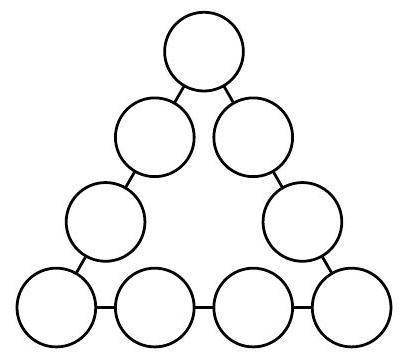
Each of the numbers $1,2, \ldots, 9$ is to be written into one of these circles, so that each circle contains exactly one of these numbers and
(i) the sums of the four numbers on each side of the triangle are equal;
(ii) the sums of squares of the four numbers on each side of the triangle are equal.
Find all ways in which this can be done.
Answer: The only solutions are
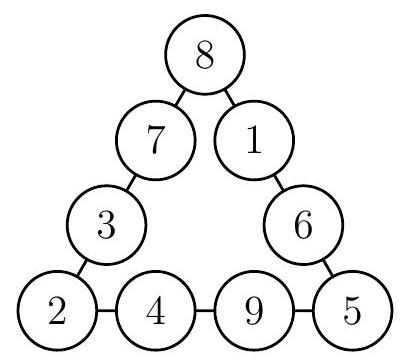
and the ones generated by permuting the vertices, adjusting sides and exchanging the two middle numbers on each side.
|
Let $a, b$, and $c$ be the numbers in the vertices of the triangular arrangement. Let $s$ be the sum of the numbers on each side and $t$ be the sum of the squares of the numbers on each side. Summing the numbers (or their squares) on the three sides repeats each once the numbers on the vertices (or their squares):
$$
\begin{gathered}
3 s=a+b+c+(1+2+\cdots+9)=a+b+c+45 \\
3 t=a^{2}+b^{2}+c^{2}+\left(1^{2}+2^{2}+\cdots+9^{2}\right)=a^{2}+b^{2}+c^{2}+285
\end{gathered}
$$
At any rate, $a+b+c$ and $a^{2}+b^{2}+c^{2}$ are both multiples of 3 . Since $x^{2} \equiv 0,1(\bmod 3)$, either $a, b, c$ are all multiples of 3 or none is a multiple of 3 . If two of them are $1,2 \bmod 3$ then $a+b+c \equiv 0(\bmod 3)$ implies that the other should be a multiple of 3 , which is not possible. Thus $a, b, c$ are all congruent modulo 3 , that is,
$$
\{a, b, c\}=\{3,6,9\}, \quad\{1,4,7\}, \quad \text { or } \quad\{2,5,8\}
$$
Case 1: $\{a, b, c\}=\{3,6,9\}$. Then $3 t=3^{2}+6^{2}+9^{2}+285 \Longleftrightarrow t=137$.
In this case $x^{2}+y^{2}+3^{2}+9^{2}=137 \Longleftrightarrow x^{2}+y^{2}=47$. However, 47 cannot be written as the sum of two squares. One can check manually, or realize that $47 \equiv 3(\bmod 4)$, and since $x^{2}, y^{2} \equiv 0,1(\bmod 4), x^{2}+y^{2} \equiv 0,1,2(\bmod 4)$ cannot be 47.
Hence there are no solutions in this case.
Case 2: $\{a, b, c\}=\{1,4,7\}$. Then $3 t=1^{2}+4^{2}+7^{2}+285 \Longleftrightarrow t=117$.
In this case $x^{2}+y^{2}+1^{2}+7^{2}=117 \Longleftrightarrow x^{2}+y^{2}=67 \equiv 3(\bmod 4)$, and as in the previous case there are no solutions.
Case 3: $\{a, b, c\}=\{2,5,8\}$. Then $3 t=2^{2}+5^{2}+8^{2}+285 \Longleftrightarrow t=126$.
Then
$$
\left\{\begin{array} { c }
{ x ^ { 2 } + y ^ { 2 } + 2 ^ { 2 } + 8 ^ { 2 } = 1 2 6 } \\
{ t ^ { 2 } + u ^ { 2 } + 2 ^ { 2 } + 5 ^ { 2 } = 1 2 6 } \\
{ m ^ { 2 } + n ^ { 2 } + 5 ^ { 2 } + 8 ^ { 2 } = 1 2 6 }
\end{array} \Longleftrightarrow \left\{\begin{array}{c}
x^{2}+y^{2}=58 \\
t^{2}+u^{2}=97 \\
m^{2}+n^{2}=37
\end{array}\right.\right.
$$
The only solutions to $t^{2}+u^{2}=97$ and $m^{2}+n^{2}=37$ are $\{t, u\}=\{4,9\}$ and $\{m, n\}=\{1,6\}$, respectively (again, one can check manually.) Then $\{x, y\}=\{3,7\}$, and the solutions are
and the ones generated by permuting the vertices, adjusting sides and exchanging the two middle numbers on each side. There are $3!\cdot 2^{3}=48$ such solutions.
|
{
"problem_match": "# Problem 2",
"resource_path": "APMO/segmented/en-apmo2000_sol.jsonl",
"solution_match": "# Solution\n\n"
}
| 264
| 1,062
|
2000
|
T1
|
3
| null |
APMO
|
Let $A B C$ be a triangle. Let $M$ and $N$ be the points in which the median and angle bisector, respectively, at $A$ meet the side $B C$. Let $Q$ and $P$ be the points in which the perpendicular at $N$ to $N A$ meets $M A$ and $B A$, respectively, and $O$ be the point in which the perpendicular at $P$ to $B A$ meets $A N$ produced. Prove that $Q O$ is perpendicular to $B C$.
|
Consider a cartesian plane with $A=(0,0)$ as the origin and the bisector $A N$ as $x$-axis. Thus $A B$ has equation $y=m x$ and $A C$ has equation $y=-m x$. Let $B=(b, m b)$ and $C=(c,-m c)$. By symmetry, the problem is immediate if $A B=A C$, that is, if $b=c$. Suppose that $b \neq c$ from now on. Line $B C$ has slope $\frac{m b-(-m c)}{b-c}=\frac{m(b+c)}{b-c}$. Let $N=(n, 0)$.
Point $M$ is the midpoint $\left(\frac{b+c}{2}, \frac{m b-m c}{2}\right)$ of $B C$, so $A M$ has slope $\frac{m(b-c)}{b+c}$.
The line through $N$ that is perpendicular to the $x$-axis $A N$ is $x=n$. Therefore
$$
P=(n, m n) \quad \text { and } \quad Q=\left(n, \frac{m(b-c) n}{b+c}\right) .
$$
In the right triangle $A P O$, with altitude $A N, A N \cdot A O=A P^{2}$. Thus
$$
n \cdot A O=(0-n)^{2}+(0-m n)^{2} \Longleftrightarrow A O=n\left(m^{2}+1\right) \Longrightarrow O=\left(n\left(m^{2}+1\right), 0\right)
$$
Finally, the slope of $O Q$ is
$$
\frac{\frac{m(b-c) n}{b+c}-0}{n-n\left(m^{2}+1\right)}=-\frac{b-c}{(b+c) m}
$$
Since the product of the slopes of $O Q$ and $B C$ is
$$
-\frac{b-c}{(b+c) m} \cdot \frac{m(b+c)}{b-c}=-1
$$
$O Q$ and $B C$ are perpendicular, and we are done.
Comment: The second solution shows that $N$ can be any point in the bisector of $\angle A$. In fact, if we move $N$ in the bisector and construct $O, P$ and $Q$ accordingly, then all lines $O Q$ obtained are parallel: just consider a homothety with center $A$ and variable ratios.
|
{
"problem_match": "# Problem 3",
"resource_path": "APMO/segmented/en-apmo2000_sol.jsonl",
"solution_match": "# Solution 2"
}
| 120
| 563
|
2000
|
T1
|
4
| null |
APMO
|
Let $n, k$ be given positive integers with $n>k$. Prove that
$$
\frac{1}{n+1} \cdot \frac{n^{n}}{k^{k}(n-k)^{n-k}}<\frac{n!}{k!(n-k)!}<\frac{n^{n}}{k^{k}(n-k)^{n-k}} .
$$
|
The inequality is equivalent to
$$
\frac{n^{n}}{n+1}<\binom{n}{k} k^{k}(n-k)^{n-k}<n^{n}
$$
which suggests investigating the binomial expansion of
$$
n^{n}=((n-k)+k)^{n}=\sum_{i=0}^{n}\binom{n}{i}(n-k)^{n-i} k^{i}
$$
The $(k+1)$ th term $T_{k+1}$ of the expansion is $\binom{n}{k} k^{k}(n-k)^{n-k}$, and all terms in the expansion are positive, which implies the right inequality.
Now, for $1 \leq i \leq n$,
$$
\frac{T_{i+1}}{T_{i}}=\frac{\binom{n}{i}(n-k)^{n-i} k^{i}}{\binom{n}{i-1}(n-k)^{n-i+1} k^{i-1}}=\frac{(n-i+1) k}{i(n-k)}
$$
and
$$
\frac{T_{i+1}}{T_{i}}>1 \Longleftrightarrow(n-i+1) k>i(n-k) \Longleftrightarrow i<k+\frac{k}{n} \Longleftrightarrow i \leq k
$$
This means that
$$
T_{1}<T_{2}<\cdots<T_{k+1}>T_{k+2}>\cdots>T_{n+1}
$$
that is, $T_{k+1}=\binom{n}{k} k^{k}(n-k)^{n-k}$ is the largest term in the expansion. The maximum term is greater that the average, which is the sum $n^{n}$ divided by the quantity $n+1$, therefore
$$
\binom{n}{k} k^{k}(n-k)^{n-k}>\frac{n^{n}}{n+1}
$$
as required.
Comment: If we divide further by $n^{n}$ one finds
$$
\frac{1}{n+1}<\binom{n}{k}\left(\frac{k}{n}\right)^{k}\left(1-\frac{k}{n}\right)^{n-k}<1
$$
The middle term is the probability $P(X=k)$ of $k$ successes in a binomial distribution with $n$ trials and success probability $p=\frac{k}{n}$. The right inequality is immediate from the fact that $P(X=k)$ is not the only possible event in this distribution, and the left inequality comes from the fact that the mode of the binomial distribution are given by $\lfloor(n+1) p\rfloor=\left\lfloor(n+1) \frac{k}{n}\right\rfloor=k$ and $\lceil(n+1) p-1\rceil=k$. However, the proof of this fact is identical to the above solution.
|
{
"problem_match": "# Problem 4",
"resource_path": "APMO/segmented/en-apmo2000_sol.jsonl",
"solution_match": "# Solution\n\n"
}
| 82
| 639
|
2000
|
T1
|
5
| null |
APMO
|
Given a permutation $\left(a_{0}, a_{1}, \ldots, a_{n}\right)$ of the sequence $0,1, \ldots, n$. A transposition of $a_{i}$ with $a_{j}$ is called legal if $a_{i}=0$ for $i>0$, and $a_{i-1}+1=a_{j}$. The permutation $\left(a_{0}, a_{1}, \ldots, a_{n}\right)$ is called regular if after a number of legal transpositions it becomes $(1,2, \ldots, n, 0)$. For which numbers $n$ is the permutation $(1, n, n-1, \ldots, 3,2,0)$ regular?
Answer: $n=2$ and $n=2^{k}-1, k$ positive integer.
|
A legal transposition consists of looking at the number immediately before 0 and exchanging 0 and its successor; therefore, we can perform at most one legal transposition to any permutation, and a legal transposition is not possible only and if only 0 is preceded by $n$.
If $n=1$ or $n=2$ there is nothing to do, so $n=1=2^{1}-1$ and $n=2$ are solutions. Suppose that $n>3$ in the following.
Call a pass a maximal sequence of legal transpositions that move 0 to the left. We first illustrate what happens in the case $n=15$, which is large enough to visualize what is going on. The first pass is
$$
\begin{aligned}
& (1,15,14,13,12,11,10,9,8,7,6,5,4,3,2,0) \\
& (1,15,14,13,12,11,10,9,8,7,6,5,4,0,2,3) \\
& (1,15,14,13,12,11,10,9,8,7,6,0,4,5,2,3) \\
& (1,15,14,13,12,11,10,9,8,0,6,7,4,5,2,3) \\
& (1,15,14,13,12,11,10,0,8,9,6,7,4,5,2,3) \\
& (1,15,14,13,12,0,10,11,8,9,6,7,4,5,2,3) \\
& (1,15,14,0,12,13,10,11,8,9,6,7,4,5,2,3) \\
& (1,0,14,15,12,13,10,11,8,9,6,7,4,5,2,3)
\end{aligned}
$$
After exchanging 0 and 2, the second pass is
$$
\begin{aligned}
& (1,2,14,15,12,13,10,11,8,9,6,7,4,5,0,3) \\
& (1,2,14,15,12,13, \mathbf{1 0}, 11,8,9,0,7,4,5,6,3) \\
& (1,2, \mathbf{1 4}, 15,12,13,0,11,8,9,10,7,4,5,6,3) \\
& (1,2,0,15,12,13,14,11,8,9,10,7,4,5,6,3)
\end{aligned}
$$
After exchanging 0 and 3 , the third pass is
$$
\begin{aligned}
& (1,2,3,15,12,13,14,11,8,9,10,7,4,5,6,0) \\
& (1,2,3,15,12,13,14,11,8,9,10,0,4,5,6,7) \\
& (1,2,3,15,12,13,14,0,8,9,10,11,4,5,6,7) \\
& (1,2,3,0,12,13,14,15,8,9,10,11,4,5,6,7)
\end{aligned}
$$
After exchanging 0 and 4, the fourth pass is
$$
\begin{aligned}
& (1,2,3,4,12,13,14,15,8,9,10,11,0,5,6,7) \\
& (1,2,3,4,0,13,14,15,8,9,10,11,12,5,6,7)
\end{aligned}
$$
And then one can successively perform the operations to eventually find
$$
(1,2,3,4,5,6,7,0,8,9,10,11,12,13,14,15)
$$
after which 0 will move one unit to the right with each transposition, and $n=15$ is a solution. The general case follows.
Case 1: $n>2$ even: After the first pass, in which 0 is transposed successively with $3,5, \ldots, n-1$, after which 0 is right after $n$, and no other legal transposition can be performed. So $n$ is not a solution in this case.
Case 2: $n=2^{k}-1$ : Denote $N=n+1, R=2^{r},[a: b]=(a, a+1, a+2, \ldots, b)$, and concatenation by a comma. Let $P_{r}$ be the permutation
$$
[1: R-1],(0),[N-R: N-1],[N-2 R: N-R-1], \ldots,[2 R: 3 R-1],[R: 2 R-1]
$$
$P_{r}$ is formed by the blocks $[1: R-1],(0)$, and other $2^{k-r}-1$ blocks of size $R=2^{r}$ with consecutive numbers, beginning with $t R$ and finishing with $(t+1) R-1$, in decreasing order of $t$. Also define $P_{0}$ as the initial permutation.
Then it can be verified that $P_{r+1}$ is obtained from $P_{r}$ after a number of legal transpositions: it can be easily verified that $P_{0}$ leads to $P_{1}$, as 0 is transposed successively with $3,5, \ldots, n-1$, shifting cyclically all numbers with even indices; this is $P_{1}$.
Starting from $P_{r}, r>0$, 0 is successively transposed with $R, 3 R, \ldots, N-R$. The numbers $0, N-R, N-3 R, \ldots, 3 R, R$ are cyclically shifted. This means that $R$ precedes 0 , and the blocks become
$$
\begin{gathered}
{[1: R],(0),[N-R+1: N-1],[N-2 R: N-R],[N-3 R+1: N-2 R-1], \ldots,} \\
{[3 R+1: 4 R-1],[2 R: 3 R],[R+1: 2 R-1]}
\end{gathered}
$$
Note that the first block and the ones on even positions greater than 2 have one more number and the other blocks have one less number.
Now $0, N-R+1, N-3 R+1, \ldots, 3 R+1, R+1$ are shifted. Note that, for every $i$ th block, $i$ odd greater than 1 , the first number is cyclically shifted, and the blocks become
$$
\begin{gathered}
{[1: R+1],(0),[N-R+2: N-1],[N-2 R: N-R+1],[N-3 R+2: N-2 R-1], \ldots,} \\
{[3 R+1: 4 R-1],[2 R: 3 R+1],[R+2: 2 R-1]}
\end{gathered}
$$
The same phenomenom happened: the first block and the ones on even positions greater than 2 have one more number and the other blocks have one less number. This pattern continues: $0, N-R+u, N-3 R+u, \ldots, R+u$ are shifted, $u=0,1,2, \ldots, R-1$, the first block and the ones on even positions greater than 2 have one more number and the other blocks have one less number, until they vanish. We finish with
$$
[1: 2 R-1],(0),[N-2 R: N-1], \ldots,[2 R: 4 R-1]
$$
which is precisely $P_{r+1}$.
Since $P_{k}=[1: N-1],(0), n=2^{k}-1$ is a solution.
Case 3: $n$ is odd, but is not of the form $2^{k}-1$. Write $n+1$ as $n+1=2^{a}(2 b+1), b \geq 1$, and define $P_{0}, \ldots, P_{a}$ as in the previous case. Since $2^{a}$ divides $N=n+1$, the same rules apply, and we obtain $P_{a}$ :
$$
\left[1: 2^{a}-1\right],(0),\left[N-2^{a}: N-1\right],\left[N-2^{a+1}: N-2^{a}-1\right], \ldots,\left[2^{a+1}: 3 \cdot 2^{a}-1\right],\left[2^{a}: 2^{a+1}-1\right]
$$
But then 0 is transposed with $2^{a}, 3 \cdot 2^{a}, \ldots,(2 b-1) \cdot 2^{a}=N-2^{a+1}$, after which 0 is put immediately after $N-1=n$, and cannot be transposed again. Therefore, $n$ is not a solution. All cases were studied, and so we are done.
Comment: The general problem of finding the number of regular permutations for any $n$ seems to be difficult. A computer finds the first few values
$$
1,2,5,14,47,189,891,4815,29547
$$
which is not catalogued at oeis.org.
|
{
"problem_match": "# Problem 5",
"resource_path": "APMO/segmented/en-apmo2000_sol.jsonl",
"solution_match": "# Solution\n\n"
}
| 187
| 2,361
|
2002
|
T1
|
1
| null |
APMO
|
Let $a_{1}, a_{2}, a_{3}, \ldots, a_{n}$ be a sequence of non-negative integers, where $n$ is a positive integer.
Let
$$
A_{n}=\frac{a_{1}+a_{2}+\cdots+a_{n}}{n}
$$
Prove that
$$
a_{1}!a_{2}!\ldots a_{n}!\geq\left(\left\lfloor A_{n}\right\rfloor!\right)^{n}
$$
where $\left\lfloor A_{n}\right\rfloor$ is the greatest integer less than or equal to $A_{n}$, and $a!=1 \times 2 \times \cdots \times a$ for $a \geq 1$ (and $0!=1$ ). When does equality hold?
|
Assume without loss of generality that $a_{1} \geq a_{2} \geq \cdots \geq a_{n} \geq 0$, and let $s=\left\lfloor A_{n}\right\rfloor$. Let $k$ be any (fixed) index for which $a_{k} \geq s \geq a_{k+1}$.
Our inequality is equivalent to proving that
$$
\frac{a_{1}!}{s!} \cdot \frac{a_{2}!}{s!} \cdot \ldots \cdot \frac{a_{k}!}{s!} \geq \frac{s!}{a_{k+1}!} \cdot \frac{s!}{a_{k+2}!} \cdot \ldots \cdot \frac{s!}{a_{n}!}
$$
Now for $i=1,2, \ldots, k, a_{i}!/ s!$ is the product of $a_{i}-s$ factors. For example, 9!/5! $=9 \cdot 8 \cdot 7 \cdot 6$. The left side of inequality (1) therefore is the product of $A=a_{1}+a_{2}+\cdots+a_{k}-k s$ factors, all of which are greater than $s$. Similarly, the right side of (1) is the product of $B=(n-k) s-$ $\left(a_{k+1}+a_{k+2}+\cdots+a_{n}\right)$ factors, all of which are at most $s$. Since $\sum_{i=1}^{n} a_{i}=n A_{n} \geq n s, A \geq B$. This proves the inequality. [ 5 marks to here.]
Equality in (1) holds if and only if either:
(i) $A=B=0$, that is, both sides of (1) are the empty product, which occurs if and only if $a_{1}=a_{2}=\cdots=a_{n}$; or
(ii) $a_{1}=1$ and $s=0$, that is, the only factors on either side of (1) are 1 's, which occurs if and only if $a_{i} \in\{0,1\}$ for all $i$. [2 marks for both (i) and (ii), no marks for (i) only.]
|
{
"problem_match": "\n1. ",
"resource_path": "APMO/segmented/en-apmo2002_sol.jsonl",
"solution_match": "# Solution 1."
}
| 189
| 537
|
2002
|
T1
|
1
| null |
APMO
|
Let $a_{1}, a_{2}, a_{3}, \ldots, a_{n}$ be a sequence of non-negative integers, where $n$ is a positive integer.
Let
$$
A_{n}=\frac{a_{1}+a_{2}+\cdots+a_{n}}{n}
$$
Prove that
$$
a_{1}!a_{2}!\ldots a_{n}!\geq\left(\left\lfloor A_{n}\right\rfloor!\right)^{n}
$$
where $\left\lfloor A_{n}\right\rfloor$ is the greatest integer less than or equal to $A_{n}$, and $a!=1 \times 2 \times \cdots \times a$ for $a \geq 1$ (and $0!=1$ ). When does equality hold?
|
Assume without loss of generality that $0 \leq a_{1} \leq a_{2} \leq \cdots \leq a_{n}$. Let $d=a_{n}-a_{1}$ and $m=\left|\left\{i: a_{i}=a_{1}\right\}\right|$. Our proof is by induction on $d$.
We first do the case $d=a_{n}-a_{1}=0$ or 1 separately. Then $a_{1}=a_{2}=\cdots=a_{m}=a$ and $a_{m+1}=\cdots=a_{n}=a+1$ for some $1 \leq m \leq n$ and $a \geq 0$. In this case we have $\left\lfloor A_{n}\right\rfloor=a$, so the inequality to be proven is just $a_{1}!a_{2}!\ldots a_{n}!\geq(a!)^{n}$, which is obvious. Equality holds if and only if either $m=n$, that is, $a_{1}=a_{2}=\cdots=a_{n}=a$; or if $a=0$, that is, $a_{1}=\cdots=a_{m}=0$ and $a_{m+1}=\cdots=a_{n}=1$. [ 2 marks to here.]
So assume that $d=a_{n}-a_{1} \geq 2$ and that the inequality holds for all sequences with smaller values of $d$, or with the same value of $d$ and smaller values of $m$. Then the sequence
$$
a_{1}+1, a_{2}, a_{3}, \ldots, a_{n-1}, a_{n}-1
$$
though not necessarily in non-decreasing order any more, does have either a smaller value of $d$, or the same value of $d$ and a smaller value of $m$, but in any case has the same value of $A_{n}$. Thus, by induction and since $a_{n}>a_{1}+1$,
$$
\begin{aligned}
a_{1}!a_{2}!\ldots a_{n}! & =\left(a_{1}+1\right)!a_{2}!\ldots a_{n-1}!\left(a_{n}-1\right)!\cdot \frac{a_{n}}{a_{1}+1} \\
& \geq\left(\left\lfloor A_{n}\right\rfloor!\right)^{n} \cdot \frac{a_{n}}{a_{1}+1} \\
& >\left(\left\lfloor A_{n}\right\rfloor!\right)^{n}
\end{aligned}
$$
which completes the proof. Equality cannot hold in this case.
|
{
"problem_match": "\n1. ",
"resource_path": "APMO/segmented/en-apmo2002_sol.jsonl",
"solution_match": "\nSolution 2."
}
| 189
| 628
|
2002
|
T1
|
2
| null |
APMO
|
Find all positive integers $a$ and $b$ such that
$$
\frac{a^{2}+b}{b^{2}-a} \text { and } \frac{b^{2}+a}{a^{2}-b}
$$
are both integers.
|
By the symmetry of the problem, we may suppose that $a \leq b$. Notice that $b^{2}-a \geq 0$, so that if $\frac{a^{2}+b}{b^{2}-a}$ is a positive integer, then $a^{2}+b \geq b^{2}-a$. Rearranging this inequality and factorizing, we find that $(a+b)(a-b+1) \geq 0$. Since $a, b>0$, we must have $a \geq b-1$. [3 marks to here.] We therefore have two cases:
Case 1: $a=b$. Substituting, we have
$$
\frac{a^{2}+a}{a^{2}-a}=\frac{a+1}{a-1}=1+\frac{2}{a-1},
$$
which is an integer if and only if $(a-1) \mid 2$. As $a>0$, the only possible values are $a-1=1$ or 2. Hence, $(a, b)=(2,2)$ or $(3,3)$. [1 mark.]
Case 2: $a=b-1$. Substituting, we have
$$
\frac{b^{2}+a}{a^{2}-b}=\frac{(a+1)^{2}+a}{a^{2}-(a+1)}=\frac{a^{2}+3 a+1}{a^{2}-a-1}=1+\frac{4 a+2}{a^{2}-a-1} .
$$
Once again, notice that $4 a+2>0$, and hence, for $\frac{4 a+2}{a^{2}-a-1}$ to be an integer, we must have $4 a+2 \geq a^{2}-a-1$, that is, $a^{2}-5 a-3 \leq 0$. Hence, since $a$ is an integer, we can bound $a$ by $1 \leq \bar{a} \leq 5$. Checking all the ordered pairs $(a, b)=(1,2),(2,3), \ldots,(5,6)$, we find that only $(1,2)$ and $(2,3)$ satisfy the given conditions. [3 marks.]
Thus, the ordered pairs that work are
$$
(2,2),(3,3),(1,2),(2,3),(2,1),(3,2)
$$
where the last two pairs follow by symmetry. [2 marks if these solutions are found without proof that there are no others.]
|
{
"problem_match": "\n2. ",
"resource_path": "APMO/segmented/en-apmo2002_sol.jsonl",
"solution_match": "\nSolution."
}
| 59
| 570
|
2002
|
T1
|
3
| null |
APMO
|
Let $A B C$ be an equilateral triangle. Let $P$ be a point on the side $A C$ and $Q$ be a point on the side $A B$ so that both triangles $A B P$ and $A C Q$ are acute. Let $R$ be the orthocentre of triangle $A B P$ and $S$ be the orthocentre of triangle $A C Q$. Let $T$ be the point common to the segments $B P$ and $C Q$. Find all possible values of $\angle C B P$ and $\angle B C Q$ such that triangle $T R S$ is equilateral.
|
We are going to show that this can only happen when
$$
\angle C B P=\angle B C Q=15^{\circ} .
$$
Lemma. If $\angle C B P>\angle B C Q$, then $R T>S T$.
Proof. Let $A D, B E$ and $C F$ be the altitudes of triangle $A B C$ concurrent at its centre $G$. Then $P$ lies on $C E, Q$ lies on $B F$, and thus $T$ lies in triangle $B D G$.
Note that -
$$
\angle F A S=\angle F C Q=30^{\circ}-\angle B C Q>30^{\circ}-\angle C B P=\angle E B P=\angle E A R
$$
Since $A F=A E$, we have $F S>E R$ so that
$$
G S=G F-F S<G E-E R=G R .
$$
Let $T_{x}$ be the projection of $T$ onto $B C$ and $T_{y}$ be the projection of $T$ onto $A D$, and similarly for $R$ and $S$. We have
$$
R_{x} T_{x}=D R_{x}+D T_{x}>\left|D S_{x}-D T_{x}\right|=S_{x} T_{x}
$$
and
$$
R_{y} T_{y}=G R_{y}+G T_{y}>G S_{y}+G T_{y}=S_{y} T_{y}
$$
It follows that $R T>S T$.
[1 mark for stating the Lemma, 3 marks for proving it.]
Thus, if $\triangle T R S$ is equilateral, we must have $\angle C B P=\angle B C Q$.
It is clear from the symmetry of the figure that $T R=T S$, so $\triangle T R S$ is equilateral if and only if $\angle R T A=30^{\circ}$. Now, as $B R$ is an altitude of the triangle $A B C, \angle R B A=30^{\circ}$. So $\triangle T R S$ is equilateral if and only if $R T B A$ is a cyclic quadrilateral. Therefore, $\triangle T R S$ is equilateral if and only if $\angle T B R=\angle T A R$. But
$$
\begin{aligned}
90^{\circ} & =\angle T B A+\angle B A R \\
& =(\angle T B R+\angle R B A)+(\angle B A T+\angle T A R) \\
& =\left(\angle T B R+30^{\circ}\right)+\left(30^{\circ}+\angle T A R\right)
\end{aligned}
$$
and so
$$
30^{\circ}=\angle T A R+\angle T B R
$$
But these angles must be equal, so $\angle T A R=\angle T B R=15^{\circ}$. Therefore $\angle C B P=\angle B C Q=15^{\circ}$. [3 marks for finishing the proof with the assumption that $\angle C B P=\angle B C Q$.]
|
{
"problem_match": "\n3. ",
"resource_path": "APMO/segmented/en-apmo2002_sol.jsonl",
"solution_match": "# Solution."
}
| 140
| 714
|
2002
|
T1
|
4
| null |
APMO
|
Let $x, y, z$ be positive numbers such that
$$
\frac{1}{x}+\frac{1}{y}+\frac{1}{z}=1
$$
Show that
$$
\sqrt{x+y z}+\sqrt{y+z x}+\sqrt{z+x y} \geq \sqrt{x y z}+\sqrt{x}+\sqrt{y}+\sqrt{z}
$$
|
This is another way of presenting the idea in the first solution.
Using the condition $\frac{1}{x}+\frac{1}{y}+\frac{1}{z}=1$ and the AM-GM inequality, we have
$$
\begin{aligned}
x+y z-\left(\sqrt{\frac{y z}{x}}+\sqrt{x}\right)^{2} & =y z\left(1-\frac{1}{x}\right)-2 \sqrt{y z} \\
& =y z\left(\frac{1}{y}+\frac{1}{z}\right)-2 \sqrt{y z}=y+z-2 \sqrt{y z} \geq 0
\end{aligned}
$$
which gives
$$
\sqrt{x+y z} \geq \sqrt{\frac{y z}{x}}+\sqrt{x} . \quad[3 \text { marks. }]
$$
Similarly, we have
$$
\sqrt{y+z x} \geq \sqrt{\frac{z x}{y}}+\sqrt{y} \text { and } \sqrt{z+x y} \geq \sqrt{\frac{x y}{z}}+\sqrt{z}
$$
Addition yields
$$
\sqrt{x+y z}+\sqrt{y+z x}+\sqrt{z+x y} \geq \sqrt{\frac{y z}{x}}+\sqrt{\frac{z x}{y}}+\sqrt{\frac{x y}{z}}+\sqrt{x}+\sqrt{y}+\sqrt{z}
$$
[2 marks.] Using the condition $\frac{1}{x}+\frac{1}{y}+\frac{1}{z}=1$ again, we have
$$
\sqrt{\frac{y z}{x}}+\sqrt{\frac{z x}{y}}+\sqrt{\frac{x y}{z}}=\sqrt{x y z}\left(\frac{1}{x}+\frac{1}{y}+\frac{1}{z}\right)=\sqrt{x y z}, \quad[1 \text { mark. }]
$$
and thus
$$
\sqrt{x+y z}+\sqrt{y+z x}+\sqrt{z+x y} \geq \sqrt{x y z}+\sqrt{x}+\sqrt{y}+\sqrt{z} . \quad[1 \text { mark. }]
$$
|
{
"problem_match": "\n4. ",
"resource_path": "APMO/segmented/en-apmo2002_sol.jsonl",
"solution_match": "\nSolution 3."
}
| 90
| 509
|
2002
|
T1
|
4
| null |
APMO
|
Let $x, y, z$ be positive numbers such that
$$
\frac{1}{x}+\frac{1}{y}+\frac{1}{z}=1
$$
Show that
$$
\sqrt{x+y z}+\sqrt{y+z x}+\sqrt{z+x y} \geq \sqrt{x y z}+\sqrt{x}+\sqrt{y}+\sqrt{z}
$$
|
This is also another way of presenting the idea in the first solution.
We make the substitution $a=\frac{1}{x}, b=\frac{1}{y}, c=\frac{1}{z}$. Then it is enough to show that
$$
\sqrt{\frac{1}{a}+\frac{1}{b c}}+\sqrt{\frac{1}{b}+\frac{1}{c a}}+\sqrt{\frac{1}{c}+\frac{1}{a b}} \geq \sqrt{\frac{1}{a b c}}+\sqrt{\frac{1}{a}}+\sqrt{\frac{1}{b}}+\sqrt{\frac{1}{c}},
$$
where $a+b+c=1$. Multiplying this inequality by $\sqrt{a b c}$, we find that it can be written
$$
\sqrt{a+b c}+\sqrt{b+c a}+\sqrt{c+a b} \geq 1+\sqrt{b c}+\sqrt{c a}+\sqrt{a b} . \quad[1 \text { mark. }]
$$
This is equivalent to
$$
\begin{aligned}
& \sqrt{a(a+b+c)+b c}+\sqrt{b(a+b+c)+c a}+\sqrt{c(a+b+c)+a b} \\
& \geq a+b+c+\sqrt{b c}+\sqrt{c a}+\sqrt{a b}, \quad[1 \text { mark. }]
\end{aligned}
$$
which in turn is equivalent to
$$
\sqrt{(a+b)(a+c)}+\sqrt{(b+c)(b+a)}+\sqrt{(c+a)(c+b)} \geq a+b+c+\sqrt{b c}+\sqrt{c a}+\sqrt{a b}
$$
[1 mark.] (This is a homogeneous version of the original inequality.) By the Cauchy-Schwarz inequality (or since $b+c \geq 2 \sqrt{b c}$ ), we have
$$
\left[(\sqrt{a})^{2}+(\sqrt{b})^{2}\right]\left[(\sqrt{a})^{2}+(\sqrt{c})^{2}\right] \geq(\sqrt{a} \sqrt{a}+\sqrt{b} \sqrt{c})^{2}
$$
or
$$
\sqrt{(a+b)(a+c)} \geq a+\sqrt{b c} . \quad[2 \text { marks. }]
$$
Taking the cyclic sum of this inequality over $a, b, c$, we get the desired inequality. [2 marks.]
|
{
"problem_match": "\n4. ",
"resource_path": "APMO/segmented/en-apmo2002_sol.jsonl",
"solution_match": "# Solution 4."
}
| 90
| 564
|
2002
|
T1
|
5
| null |
APMO
|
Let R denote the set of all real numbers. Find all functions $f$ from R to R satisfying:
(i) there are only finitely many $s$ in R such that $f(s)=0$, and
(ii) $f\left(x^{4}+y\right)=x^{3} f(x)+f(f(y))$ for all $x, y$ in $\mathbf{R}$.
|
The only such function is the identity function on $R$.
Setting $(x, y)=(1,0)$ in the given functional equation (ii), we have $f(f(0))=0$. Setting $x=0$ in (ii), we find
$$
f(y)=f(f(y))
$$
[1 mark.] and thus $f(0)=f(f(0))=0$ [1 mark.]. It follows from (ii) that $f\left(x^{4}+y\right)=$ $x^{3} f(x)+f(y)$ for all $x, y \in \mathbf{R}$. Set $y=0$ to obtain
$$
f\left(x^{4}\right)=x^{3} f(x)
$$
for all $x \in \mathrm{R}$, and so
$$
f\left(x^{4}+y\right)=f\left(x^{4}\right)+f(y)
$$
for all $x, y \in \mathbf{R}$. The functional equation (3) suggests that $f$ is additive, that is, $f(a+b)=$ $f(a)+f(b)$ for all $a, b \in \mathbf{R}$. [1 mark.] We now show this.
First assume that $a \geq 0$ and $b \in R$. It follows from (3) that
$$
f(a+b)=f\left(\left(a^{1 / 4}\right)^{4}+b\right)=f\left(\left(a^{1 / 4}\right)^{4}\right)+f(b)=f(a)+f(b)
$$
We next note that $f$ is an odd function, since from (2)
$$
f(-x)=\frac{f\left(x^{4}\right)}{(-x)^{3}}=\frac{f\left(x^{4}\right)}{-x^{3}}=-f(x), \quad x \neq 0
$$
Since $f$ is odd, we have that, for $a<0$ and $b \in R$,
$$
\begin{aligned}
f(a+b) & =-f((-a)+(-b))=-(f(-a)+f(-b)) \\
& =-(-f(a)-f(b))=f(a)+f(b)
\end{aligned}
$$
Therefore, we conclude that $f(a+b)=f(a)+f(b)$ for all $a, b \in R$. [2 mers.].]
We now show that $\{s \in \mathrm{R} \mid f(s)=0\}=\{0\}$. Recall that $f(0)=0$. Assume that there is a nonzero $h \in \mathrm{R}$ such that $f(h)=0$. Then, using the fact that $f$ is additive, we inductively have $f(n h)=0$ or $n h \in\{s \in R \mid f(s)=0\}$ for all $n \in \mathbf{N}$. However, this is a contradiction to the given condition (i). [1 mark.]
It's now easy to check that $f$ is one-to-one. Assume that $f(a)=f^{\prime}(b)$ for some $a, b \in \mathbb{P}$. Then, we have $f(b)=f(a)=f(a-b)+f(b)$ or $f(a-b)=0$. This implies that $a-b \in\{s \in$ $\mathbf{R} \mid f(s)=0\}=\{0\}$ or $a=b$, as desired. From (1) and the fact that $f$ is one-to-one, we deduce that $f(x)=x$ for all $x \in \mathbf{R}$. [1 mark.] This completes the proof.
|
{
"problem_match": "\n5. ",
"resource_path": "APMO/segmented/en-apmo2002_sol.jsonl",
"solution_match": "# Solution 1."
}
| 88
| 842
|
2002
|
T1
|
5
| null |
APMO
|
Let R denote the set of all real numbers. Find all functions $f$ from R to R satisfying:
(i) there are only finitely many $s$ in R such that $f(s)=0$, and
(ii) $f\left(x^{4}+y\right)=x^{3} f(x)+f(f(y))$ for all $x, y$ in $\mathbf{R}$.
|
Again, the only such function is the identity function on R .
As in Solution 1, we first show that $f(f(y))=f(y), f(0)=0$, and $f\left(x^{4}\right)=x^{3} f(x)$. [2 marks.] From the latter follows
$$
f(x)=0 \Longrightarrow f\left(x^{4}\right)=0
$$
and from condition (i) we get that $f(x)=0$ only possibly for $x \in\{0,1,-1\}$. [1 mark.]
Next we prove
$$
f(a)=b \Longrightarrow f(\sqrt[4]{|a-b|})=0
$$
This is clear if $a=b$. If $a>b$ then
$$
\begin{aligned}
f(a) & =f((a-b)+b)=(a-b)^{3 / 4} f(\sqrt[4]{a-b})+f(f(b)) \\
& =(a-b)^{3 / 4} f(\sqrt[4]{a-b})+f(b) \\
& =(a-b)^{3 / 4} f(\sqrt[4]{a-b})+f(f(a)) \\
& =(a-b)^{3 / 4} f(\sqrt[4]{a-b})+f(a),
\end{aligned}
$$
so $(a-b)^{3 / 4} f(\sqrt[4]{a-b})=0$ which means $f(\sqrt[4]{|a-b|})=0$. If $a<b$ we get similarly
$$
\begin{aligned}
f(b) & =f((b-a)+a)=(b-a)^{3 / 4} f(\sqrt[4]{b-a})+f(f(a)) \\
& =(b-a)^{3 / 4} f(\sqrt[4]{b-a})+f(b)
\end{aligned}
$$
and again $f(\sqrt[4]{|a-b|})=0$. [2 marks.]
Thus $f(a)=b \Longrightarrow|a-b| \in\{0,1\}$. Suppose that $f(x)=x+b$ for some $x$, where $|b|=1$. Then from $f\left(x^{4}\right)=x^{3} f(x)$ and $f\left(x^{4}\right)=x^{4}+a$ for some $|a| \leq 1$ we get $x^{3}=a / b$, so $|x| \leq 1$. Thus $f(x)=x$ for all $x$ except possibly $x= \pm 1$. [ 1 mark.] But for example,
$$
f(1)=f\left(2^{4}-15\right)=2^{3} f(2)+f(f(-15))=2^{3} \cdot 2-15=1
$$
and
$$
f(-1)=f\left(2^{4}-17\right)=2^{3} f(2)+f(f(-17))=2^{3} \cdot 2-17=-1
$$
[1 mark.] This finishes the proof.
|
{
"problem_match": "\n5. ",
"resource_path": "APMO/segmented/en-apmo2002_sol.jsonl",
"solution_match": "# Solution 2."
}
| 88
| 693
|
2003
|
T1
|
1
| null |
APMO
|
Let $a, b, c, d, e, f$ be real numbers such that the polynomial
$$
p(x)=x^{8}-4 x^{7}+7 x^{6}+a x^{5}+b x^{4}+c x^{3}+d x^{2}+e x+f
$$
factorises into eight linear factors $x-x_{i}$, with $x_{i}>0$ for $i=1,2, \ldots, 8$. Determine all possible values of $f$.
|
From
$$
x^{8}-4 x^{7}+7 x^{6}+a x^{5}+b x^{4}+c x^{3}+d x^{2}+e x+f=\left(x-x_{1}\right)\left(x-x_{2}\right) \ldots\left(x-x_{8}\right)
$$
we have
$$
\sum_{i=1}^{8} x_{i}=4 \quad \text { and } \quad \sum x_{i} x_{j}=7
$$
where the second sum is over all pairs $(i, j)$ of integers where $1 \leq i<j \leq 8$. Since this sum can also be written
$$
\frac{1}{2}\left[\left(\sum_{i=1}^{8} x_{i}\right)^{2}-\sum_{i=1}^{8} x_{i}^{2}\right]
$$
we get
$$
14=\left(\sum_{i=1}^{8} x_{i}\right)^{2}-\sum_{i=1}^{8} x_{i}^{2}=16-\sum_{i=1}^{8} x_{i}^{2}
$$
so
$$
\sum_{i=1}^{8} x_{i}^{2}=2 \quad \text { while } \quad \sum_{i=1}^{8} x_{i}=4 . \quad[3 \text { marks }]
$$
Now
$$
\sum_{i=1}^{8}\left(2 x_{i}-1\right)^{2}=4 \sum_{i=1}^{8} x_{i}^{2}-4 \sum_{i=1}^{8} x_{i}+8=4(2)-4(4)+8=0
$$
which forces $x_{i}=1 / 2$ for all $i$. [3 marks] Therefore
$$
f=\prod_{i=1}^{8} x_{i}=\left(\frac{1}{2}\right)^{8}=\frac{1}{256} . \quad[1 m x]
$$
Alternate solution: After obtaining (1) [3 marks], use Cauchy's inequality to get
$$
16=\left(x_{1} \cdot 1+x_{2} \cdot 1+\cdots+x_{8} \cdot 1\right)^{2} \leq\left(x_{1}^{2-}+x_{2}^{2}+\cdots+x_{8}^{2}\right)\left(1^{2}+1^{2}+\cdots+1^{2}\right)=8 \cdot 2=16
$$
or the power mean inequality to get
$$
\frac{1}{2}=\frac{1}{8} \sum_{i=1}^{8} x_{i} \leq\left(\frac{1}{8} \sum_{i=1}^{8} x_{i}^{2}\right)^{1 / 2}=\frac{1}{2} . \quad[2 \text { marks }]
$$
Either way, equality must hold, which can only happen if all the terms $x_{i}$ are equal, that is, if $x_{i}=1 / 2$ for all $i$. [1 mark] Thus $f=1 / 256$ as above. [ 1 mark]
|
{
"problem_match": "\n1. ",
"resource_path": "APMO/segmented/en-apmo2003_sol.jsonl",
"solution_match": "# Solution."
}
| 117
| 769
|
2003
|
T1
|
2
| null |
APMO
|
Suppose $A B C D$ is a square piece of cardboard with side length $a$. On a plane are two parallel lines $\ell_{1}$ and $\ell_{2}$, which are also $a$ units apart. The square $A B C D$ is placed on the plane so that sides $A B$ and $A D$ intersect $\ell_{1}$ at $E$ and $F$ respectively. Also, sides $C B$ and $C D$ intersect $\ell_{2}$ at $G$ and $H$ respectively. Let the perimeters of $\triangle A E F$ and $\triangle C G H$ be $m_{1}$ and $m_{2}$ respectively. Prove that no matter how the square was placed, $m_{1}+m_{2}$ remains constant.
|
Without loss of generality, assume the square has side $a=1$. Let $\theta$ be the acute angle between $\ell_{1}$ (or $\ell_{2}$ ) and the sides $A B$ and $C D$ of the square. Then, letting $E F=x$ and $G H=y$, we have
$$
E A=x \cos \theta, \quad A F=x \sin \theta, \quad C H=y \cos \theta, \quad C G=y \sin \theta
$$
Thus
$$
m_{1}+m_{2}=(x+y)(\sin \theta+\cos \theta+1) . \quad[2 \text { marks }]
$$
Draw lines parallel to $\ell_{1}, \ell_{2}$ through $A$ and $C$ respectively. The distance between these lines is $\sin \theta+\cos \theta$ [1 mark], as can be seen by drawing a mutual perpendicular to these lines through $B$, say. Also, the altitudes from $A$ to $E F$ and from $C$ to $G H$ have lengths $x \sin \theta \cos \theta$ and $y \sin \theta \cos \theta$ respectively [ 1 mark]. Therefore the distance between $\ell_{1}$ and $\ell_{2}$ must be
$$
(\sin \theta+\cos \theta)-x \sin \theta \cos \theta-y \sin \theta \cos \theta
$$
But we are given that this distance is $a=1$, so
$$
(x+y) \sin \theta \cos \theta+1=\sin \theta+\cos \theta
$$
or
$$
x+y=\frac{\sin \theta+\cos \theta-1}{\sin \theta \cos \theta} \cdot \quad[1 \text { mark }]
$$
Therefore, by (1),
$$
\begin{aligned}
m_{1}+m_{2} & =\frac{(\sin \theta+\cos \theta-1)(\sin \theta+\cos \theta+1)}{\sin \theta \cos \theta} \\
& =\frac{\left(\sin ^{2} \theta+\cos ^{2} \theta+2 \sin \theta \cos \theta\right)-1}{\sin \theta \cos \theta} \\
& =\frac{1+2 \sin \theta \cos \theta-1}{\sin \theta \cos \theta}=2 . \quad[2 \text { marks }]
\end{aligned}
$$
|
{
"problem_match": "\n2. ",
"resource_path": "APMO/segmented/en-apmo2003_sol.jsonl",
"solution_match": "\nSolution 3."
}
| 173
| 552
|
2003
|
T1
|
3
| null |
APMO
|
Let $k \geq 14$ be an integer, and let $p_{k}$ be the largest prime number which is strictly less than $k$. You may assume that $p_{k} \geq 3 k / 4$. Let $n$ be a composite integer. Prove:
(a) if $n=2 p_{k}$, then $n$ does not divide $(n-k)$ !;
(b) if $n>2 p_{k}$, then $n$ divides $(n-k)$ !.
|
(a) Note that $n-k=2 p_{k}-k<2 p_{k}-p_{k}=p_{k}$, so $p_{k} \nmid(n-k)$ !, so $2 p_{k} \nless(n-k)$ !. [1 mark]
(b) Note that $n>2 p_{k} \geq 3 k / 2$ implies $k<2 n / 3$, so $n-k>n / 3$. So if we can find integers $a, b \geq 3$ such that $n=a b$ and $a \neq b$, then both $a$ and $b$ will appear separately in the product $(n-k)!=1 \times 2 \times \cdots \times(n-k)$, which means $n \mid(n-k)!$. Observe that $k \geq 14$ implies $p_{k} \geq 13$, so that $n>2 p_{k} \geq 26$.
If $n=2^{\alpha}$ for some integer $\alpha \geq 5$, then take $a=2^{2}, b=2^{\alpha-2}$. [ 1 mark] Otherwise, since $n \geq 26>16$, we can take $a$ to be an odd prime factor of $n$ and $b=n / a$ [1 mark], unless $b<3$ or $b=a$.
Case (i): $b<3$. Since $n$ is composite, this means $b=2$, so that $2 a=n>2 p_{k}$. As $a$ is a prime number and $p_{k}$ is the largest prime number which is strictly less than $k$, it follows that $a \geq k$. From $n-k=2 a-k \geq$ $2 a-a=a>2$ we see that $n=2 a$ divides into $(n-k)$. [ 2 marks]
Case (ii): $b=a$. Then $n=a^{2}$ and $a>6$ since $n \geq 26$. Thus $n-k>n / 3=a^{2} / 3>2 a$, so that both $a$ and $2 a$ appear among $\{1,2, \ldots, n-k\}$. Hence $n=a^{2}$ divides into $(n-k)!$. [2 marks]
|
{
"problem_match": "\n3. ",
"resource_path": "APMO/segmented/en-apmo2003_sol.jsonl",
"solution_match": "\nSolution."
}
| 113
| 530
|
2003
|
T1
|
4
| null |
APMO
|
Let $a, b, c$ be the sides of a triangle, with $a+b+c=1$, and let $n \geq 2$ be an integer. Show that
$$
\sqrt[n]{a^{n}+b^{n}}+\sqrt[n]{b^{n}+c^{n}}+\sqrt[n]{c^{n}+a^{n}}<1+\frac{\sqrt[n]{2}}{2}
$$
|
Without loss of generality, assume $a \leq b \leq c$. As $a+b>c$, we have
$$
\frac{\sqrt[n]{2}}{2}=\frac{\sqrt[n]{2}}{2}(a+b+c)>\frac{\sqrt[n]{2}}{2}(c+c)=\sqrt[n]{2 c^{n}} \geq \sqrt[n]{b^{n}+c^{n}} \quad \quad[2 \text { marks }]
$$
As $a \leq c$ and $n \geq 2$, we have
$$
\begin{aligned}
\left(c^{n}+a^{n}\right)-\left(c+\frac{a}{2}\right)^{n} & =a^{n}-\sum_{k=1}^{n}\binom{n}{k} c^{n-k}\left(\frac{a}{2}\right)^{k} \\
& \leq\left[1-\sum_{k=1}^{n}\binom{n}{k}\left(\frac{1}{2}\right)^{k}\right] a^{n} \quad\left(\text { since } c^{n-k} \geq a^{n-k}\right) \\
& =\left[\left(1-\frac{n}{2}\right)-\sum_{k=2}^{n}\binom{n}{k}\left(\frac{1}{2}\right)^{k}\right] a^{n}<0
\end{aligned}
$$
Thus
$$
\sqrt[n]{c^{n}+a^{n}}<c+\frac{a}{2} . \quad[3 \text { marks }]
$$
Likewise
$$
\sqrt[n]{b^{n}+a^{n}}<b+\frac{a}{2} \quad \quad[1 \text { mark }]
$$
Adding (1), (2) and (3), we get
$$
\sqrt[n]{a^{n}+b^{n}}+\sqrt[n]{b^{n}+c^{n}}+\sqrt[n]{c^{n}+a^{n}}<\frac{\sqrt[n]{2}}{2}+c+\frac{a}{2}+b+\frac{a}{2}=1+\frac{\sqrt[n]{2}}{2} . \quad[1 \text { mark }]
$$
|
{
"problem_match": "\n4. ",
"resource_path": "APMO/segmented/en-apmo2003_sol.jsonl",
"solution_match": "# Solution."
}
| 95
| 517
|
2003
|
T1
|
5
| null |
APMO
|
Given two positive integers $m$ and $n$, find the smallest positive integer $k$ such that among any $k$ people, either there are $2 m$ of them who form $m$ pairs of mutually acquainted people or there are $2 n$ of them forming $n$ pairs of mutually unacquainted people.
|
Let the smallest positive integer $k$ satisfying the condition of the problem be denoted $r(m, n)$. We shall show that
$$
r(m, n)=2(m+n)-\min \{m, n\}-1
$$
Observe that, by symmetry, $r(m, n)=r(n, m)$. Therefore it suffices to consider the case where $m \geq n$, and to prove that
$$
r(m, n)=2 m+n-1 . \quad[1 \text { mark }]
$$
First we prove that
$$
r(m, n) \geq 2 m+n-1
$$
by an example. Call a group of $k$ people, every two of whom are mutually acquainted, a $k$-clique. Consider a set of $2 m+n-2$ people consisting of a $(2 m-1)$-clique together with an additional $n-1$ people none of whom know anyone else. (Call such people isolated.) Then there are not $2 m$ people forming $m$ mutually acquainted pairs, and there also are not $2 n$ people forming $n$ mutually unacquainted pairs. Thus $r(m, n) \geq$ $(2 m-1)+(n-1)+1=2 m+n-1$ by the definition of $r(m, n)$. [1 mark]
To establish (1), we need to prove that $r(m, n) \leq 2 m+n-1$. To do this, we now show that
$$
r(m, n) \leq r(m-1, n-1)+3 \quad \text { for all } m \geq n \geq 2
$$
Let $G$ be a group of $t=r(m-1, n-1)+3$ people. Notice that
$$
t \geq 2(m-1)+(n-1)-1+3=2 m+n-1 \geq 2 m \geq 2 n
$$
If $G$ is a $t$-clique, then $G$ contains $2 m$ people forming $m$ mutually acquainted pairs, and if $G$ has only isolated people, then $G$ contains $2 n$ people forming $n$ mutually unacquainted pairs. Otherwise, there are three people in $G$, say $a, b$ and $c$, such that $a, b$ are acquainted but $a, c$ are not. Now consider the group $A$ obtained byremoving $a, b$ and $c$ from $G$. A has $t-3=r(m-1, n-1)$ people, so by the definition of $r(m-1, n-1)$, A either contains $2(m-1)$ people forming $m-1$ mutually acquainted pairs, or else contains $2(n-1)$ people forming $n-1$ mutually unacquainted pairs. In the former case, we add the acquainted pair $a, b$ to $A$ to form $m$ mutually acquainted pairs in $G$. In the latter case, we add the unacquainted pair $a, c$ to $A$ to form $n$ mutually unacquainted pairs in $G$. This proves (2). [3 marks]
Trivially, $r(s, 1)=2 s$ for all $s[\mathbf{1}$ mark], so $r(m, n) \leq 2 m+n-1$ holds whenever $n=1$. Proceeding by induction on $n$, by (2) we obtain
$$
r(m, n) \leq r(m-1, n-1)+3 \leq 2(m-1)+(n-1)-1+3=2 m+n-1
$$
which completes the proof. [1 mark]
Note. Give an additional 1 mark to any student who gets at most 5 marks by the above marking scheme, but in addition gives a valid argument that $r(2,2)=5$.
|
{
"problem_match": "\n5. ",
"resource_path": "APMO/segmented/en-apmo2003_sol.jsonl",
"solution_match": "# Solution."
}
| 69
| 878
|
2004
|
T1
|
2
| null |
APMO
|
Let $O$ be the circumcentre and $H$ the orthocentre of an acute triangle $A B C$. Prove that the area of one of the triangles $\mathrm{AOH}, \mathrm{BOH}$ and COH is equal to the sum of the areas of the other two.
|
One can use barycentric coordinates: it is well known that
$$
\begin{gathered}
A=(1: 0: 0), \quad B=(0: 1: 0), \quad C=(0: 0: 1), \\
O=(\sin 2 A: \sin 2 B: \sin 2 C) \quad \text { and } \quad H=(\tan A: \tan B: \tan C) .
\end{gathered}
$$
Then the (signed) area of $A O H$ is proportional to
$$
\left|\begin{array}{ccc}
1 & 0 & 0 \\
\sin 2 A & \sin 2 B & \sin 2 C \\
\tan A & \tan B & \tan C
\end{array}\right|
$$
Adding all three expressions we find that the sum of the signed sums of the areas is a constant times
$$
\left|\begin{array}{ccc}
1 & 0 & 0 \\
\sin 2 A & \sin 2 B & \sin 2 C \\
\tan A & \tan B & \tan C
\end{array}\right|+\left|\begin{array}{ccc}
0 & 1 & 0 \\
\sin 2 A & \sin 2 B & \sin 2 C \\
\tan A & \tan B & \tan C
\end{array}\right|+\left|\begin{array}{ccc}
0 & 0 & 1 \\
\sin 2 A & \sin 2 B & \sin 2 C \\
\tan A & \tan B & \tan C
\end{array}\right|
$$
By multilinearity of the determinant, this sum equals
$$
\left|\begin{array}{ccc}
1 & 1 & 1 \\
\sin 2 A & \sin 2 B & \sin 2 C \\
\tan A & \tan B & \tan C
\end{array}\right|
$$
which contains, in its rows, the coordinates of the centroid, the circumcenter, and the orthocenter. Since these three points lie in the Euler line of $A B C$, the signed sum of the areas is 0 , which means that one of the areas of $A O H, B O H, C O H$ is the sum of the other two areas.
Comment: Both solutions can be adapted to prove a stronger result: if the centroid $G$ of triangle $A B C$ belongs to line $X Y$ then one of the areas of triangles $A X Y, B X Y$, and $C X Y$ is equal to the sum of the other two.
|
{
"problem_match": "# Problem 2",
"resource_path": "APMO/segmented/en-apmo2004_sol.jsonl",
"solution_match": "# Solution 2"
}
| 63
| 583
|
2004
|
T1
|
3
| null |
APMO
|
Let a set $S$ of 2004 points in the plane be given, no three of which are collinear. Let $\mathcal{L}$ denote the set of all lines (extended indefinitely in both directions) determined by pairs of points from the set. Show that it is possible to colour the points of $S$ with at most two colours, such that for any points $p, q$ of $S$, the number of lines in $\mathcal{L}$ which separate $p$ from $q$ is odd if and only if $p$ and $q$ have the same colour.
Note: A line $\ell$ separates two points $p$ and $q$ if $p$ and $q$ lie on opposite sides of $\ell$ with neither point on $\ell$.
|
Choose any point $p$ from $S$ and color it, say, blue. Let $n(q, r)$ be the number of lines from $\mathcal{L}$ that separates $q$ and $r$. Then color any other point $q$ blue if $n(p, q)$ is odd and red if $n(p, q)$ is even.
Now it remains to show that $q$ and $r$ have the same color if and only if $n(q, r)$ is odd for all $q \neq p$ and $r \neq p$, which is equivalent to proving that $n(p, q)+n(p, r)+n(q, r)$ is always odd. For this purpose, consider the seven numbered regions defined by lines $p q$, $p r$, and $q r$ :
Any line that do not pass through any of points $p, q, r$ meets the sides $p q, q r, p r$ of triangle $p q r$ in an even number of points (two sides or no sides), so these lines do not affect the parity of $n(p, q)+n(p, r)+n(q, r)$. Hence the only lines that need to be considered are the ones that pass through one of vertices $p, q, r$ and cuts the opposite side in the triangle $p q r$.
Let $n_{i}$ be the number of points in region $i, p, q$, and $r$ excluded, as depicted in the diagram. Then the lines through $p$ that separate $q$ and $r$ are the lines passing through $p$ and points from regions 1,4 , and 7 . The same applies for $p, q$ and regions 2,5 , and 7 ; and $p, r$ and regions 3,6 , and 7. Therefore
$$
\begin{aligned}
n(p, q)+n(q, r)+n(p, r) & \equiv\left(n_{2}+n_{5}+n_{7}\right)+\left(n_{1}+n_{4}+n_{7}\right)+\left(n_{3}+n_{6}+n_{7}\right) \\
& \equiv n_{1}+n_{2}+n_{3}+n_{4}+n_{5}+n_{6}+n_{7}=2004-3 \equiv 1 \quad(\bmod 2)
\end{aligned}
$$
and the result follows.
Comment: The problem statement is also true if 2004 is replaced by any even number and is not true if 2004 is replaced by any odd number greater than 1.
|
{
"problem_match": "# Problem 3",
"resource_path": "APMO/segmented/en-apmo2004_sol.jsonl",
"solution_match": "# Solution\n\n"
}
| 167
| 585
|
2004
|
T1
|
4
| null |
APMO
|
For a real number $x$, let $\lfloor x\rfloor$ stand for the largest integer that is less than or equal to $x$. Prove that
$$
\left\lfloor\frac{(n-1)!}{n(n+1)}\right\rfloor
$$
is even for every positive integer $n$.
|
Consider four cases:
- $n \leq 5$. Then $\left\lfloor\frac{(n-1)!}{n(n+1)}\right\rfloor=0$ is an even number.
- $n$ and $n+1$ are both composite (in particular, $n \geq 8$ ). Then $n=a b$ and $n+1=c d$ for $a, b, c, d \geq 2$. Moreover, since $n$ and $n+1$ are coprime, $a, b, c, d$ are all distinct and smaller than $n$, and one can choose $a, b, c, d$ such that exactly one of these four numbers is even. Hence $\frac{(n-1)!}{n(n+1)}$ is an integer. As $n \geq 8>6,(n-1)!$ has at least three even factors, so $\frac{(n-1)!}{n(n+1)}$ is an even integer.
- $n \geq 7$ is an odd prime. By Wilson's theorem, $(n-1)!\equiv-1(\bmod n)$, that is, $\frac{(n-1)!+1}{n}$ is an integer, as $\frac{(n-1)!+n+1}{n}=\frac{(n-1)!+1}{n}+1$ is. As before, $\frac{(n-1)!}{n+1}$ is an even integer; therefore $\frac{(n-1)!+n+1}{n+1}=\frac{(n-1)!}{n+1}+1$ is an odd integer.
Also, $n$ and $n+1$ are coprime and $n$ divides the odd integer $\frac{(n-1)!+n+1}{n+1}$, so $\frac{(n-1)!+n+1}{n(n+1)}$ is also an odd integer. Then
$$
\left\lfloor\frac{(n-1)!}{n(n+1)}\right\rfloor=\frac{(n-1)!+n+1}{n(n+1)}-1
$$
is even.
- $n+1 \geq 7$ is an odd prime. Again, since $n$ is composite, $\frac{(n-1)!}{n}$ is an even integer, and $\frac{(n-1)!+n}{n}$ is an odd integer. By Wilson's theorem, $n!\equiv-1(\bmod n+1) \Longleftrightarrow(n-1)!\equiv 1$ $(\bmod n+1)$. This means that $n+1$ divides $(n-1)!+n$, and since $n$ and $n+1$ are coprime, $n+1$ also divides $\frac{(n-1)!+n}{n}$. Then $\frac{(n-1)!+n}{n(n+1)}$ is also an odd integer and
$$
\left\lfloor\frac{(n-1)!}{n(n+1)}\right\rfloor=\frac{(n-1)!+n}{n(n+1)}-1
$$
is even.
|
{
"problem_match": "# Problem 4",
"resource_path": "APMO/segmented/en-apmo2004_sol.jsonl",
"solution_match": "# Solution\n\n"
}
| 72
| 702
|
2004
|
T1
|
5
| null |
APMO
|
Prove that
$$
\left(a^{2}+2\right)\left(b^{2}+2\right)\left(c^{2}+2\right) \geq 9(a b+b c+c a)
$$
for all real numbers $a, b, c>0$.
|
Let $p=a+b+c, q=a b+b c+c a$, and $r=a b c$. The inequality simplifies to
$$
a^{2} b^{2} c^{2}+2\left(a^{2} b^{2}+b^{2} c^{2}+c^{2} a^{2}\right)+4\left(a^{2}+b^{2}+c^{2}\right)+8-9(a b+b c+c a) \geq 0
$$
Since $a^{2} b^{2}+b^{2} c^{2}+c^{2} a^{2}=q^{2}-2 p r$ and $a^{2}+b^{2}+c^{2}=p^{2}-2 q$,
$$
r^{2}+2 q^{2}-4 p r+4 p^{2}-8 q+8-9 q \geq 0
$$
which simplifies to
$$
r^{2}+2 q^{2}+4 p^{2}-17 q-4 p r+8 \geq 0
$$
Bearing in mind that equality occurs for $a=b=c=1$, which means that, for instance, $p=3 r$, one can rewrite $(I)$ as
$$
\left(r-\frac{p}{3}\right)^{2}-\frac{10}{3} p r+\frac{35}{9} p^{2}+2 q^{2}-17 q+8 \geq 0
$$
Since $(a b-b c)^{2}+(b c-c a)^{2}+(c a-a b)^{2} \geq 0$ is equivalent to $q^{2} \geq 3 p r$, rewrite $(I I)$ as
$$
\left(r-\frac{p}{3}\right)^{2}+\frac{10}{9}\left(q^{2}-3 p r\right)+\frac{35}{9} p^{2}+\frac{8}{9} q^{2}-17 q+8 \geq 0
$$
Finally, $a=b=c=1$ implies $q=3$; then rewrite (III) as
$$
\left(r-\frac{p}{3}\right)^{2}+\frac{10}{9}\left(q^{2}-3 p r\right)+\frac{35}{9}\left(p^{2}-3 q\right)+\frac{8}{9}(q-3)^{2} \geq 0
$$
This final inequality is true because $q^{2} \geq 3 p r$ and $p^{2}-3 q=\frac{1}{2}\left[(a-b)^{2}+(b-c)^{2}+(c-a)^{2}\right] \geq 0$.
|
{
"problem_match": "# Problem 5",
"resource_path": "APMO/segmented/en-apmo2004_sol.jsonl",
"solution_match": "# Solution 1"
}
| 64
| 633
|
2004
|
T1
|
5
| null |
APMO
|
Prove that
$$
\left(a^{2}+2\right)\left(b^{2}+2\right)\left(c^{2}+2\right) \geq 9(a b+b c+c a)
$$
for all real numbers $a, b, c>0$.
|
We prove the stronger inequality
$$
\left(a^{2}+2\right)\left(b^{2}+2\right)\left(c^{2}+2\right) \geq 3(a+b+c)^{2}
$$
which implies the proposed inequality because $(a+b+c)^{2} \geq 3(a b+b c+c a)$ is equivalent to $(a-b)^{2}+(b-c)^{2}+(c-a)^{2} \geq 0$, which is immediate.
The inequality $(*)$ is equivalent to
$$
\left(\left(b^{2}+2\right)\left(c^{2}+2\right)-3\right) a^{2}-6(b+c) a+2\left(b^{2}+2\right)\left(c^{2}+2\right)-3(b+c)^{2} \geq 0
$$
Seeing this inequality as a quadratic inequality in $a$ with positive leading coefficient $\left(b^{2}+2\right)\left(c^{2}+\right.$ 2) $-3=b^{2} c^{2}+2 b^{2}+2 c^{2}+1$, it suffices to prove that its discriminant is non-positive, which is equivalent to
$$
(3(b+c))^{2}-\left(\left(b^{2}+2\right)\left(c^{2}+2\right)-3\right)\left(2\left(b^{2}+2\right)\left(c^{2}+2\right)-3(b+c)^{2}\right) \leq 0
$$
This simplifies to
$$
-2\left(b^{2}+2\right)\left(c^{2}+2\right)+3(b+c)^{2}+6 \leq 0
$$
Now we look $(* *)$ as a quadratic inequality in $b$ with negative leading coefficient $-2 c^{2}-1$ :
$$
\left(-2 c^{2}-1\right) b^{2}+6 c b-c^{2}-2 \leq 0
$$
If suffices to show that the discriminant of $(* *)$ is non-positive, which is equivalent to
$$
9 c^{2}-\left(2 c^{2}+1\right)\left(c^{2}+2\right) \leq 0
$$
It simplifies to $-2\left(c^{2}-1\right)^{2} \leq 0$, which is true. The equality occurs for $c^{2}=1$, that is, $c=1$, for which $b=\frac{6 c}{2\left(2 c^{2}+1\right)}=1$, and $a=\frac{6(b+c)}{2\left(\left(b^{2}+2\right)\left(c^{2}+2\right)-3\right)}=1$.
|
{
"problem_match": "# Problem 5",
"resource_path": "APMO/segmented/en-apmo2004_sol.jsonl",
"solution_match": "# Solution 2"
}
| 64
| 647
|
2004
|
T1
|
5
| null |
APMO
|
Prove that
$$
\left(a^{2}+2\right)\left(b^{2}+2\right)\left(c^{2}+2\right) \geq 9(a b+b c+c a)
$$
for all real numbers $a, b, c>0$.
|
Let $A, B, C$ angles in $(0, \pi / 2)$ such that $a=\sqrt{2} \tan A, b=\sqrt{2} \tan B$, and $c=\sqrt{2} \tan C$. Then the inequality is equivalent to
$$
4 \sec ^{2} A \sec ^{2} B \sec ^{2} C \geq 9(\tan A \tan B+\tan B \tan C+\tan C \tan A)
$$
Substituting $\sec x=\frac{1}{\cos x}$ for $x \in\{A, B, C\}$ and clearing denominators, the inequality is equivalent to
$$
\cos A \cos B \cos C(\sin A \sin B \cos C+\cos A \sin B \sin C+\sin A \cos B \sin C) \leq \frac{4}{9}
$$
Since
$$
\begin{aligned}
& \cos (A+B+C)=\cos A \cos (B+C)-\sin A \sin (B+C) \\
= & \cos A \cos B \cos C-\cos A \sin B \sin C-\sin A \cos B \sin C-\sin A \sin B \cos C,
\end{aligned}
$$
we rewrite our inequality as
$$
\cos A \cos B \cos C(\cos A \cos B \cos C-\cos (A+B+C)) \leq \frac{4}{9}
$$
The cosine function is concave down on $(0, \pi / 2)$. Therefore, if $\theta=\frac{A+B+C}{3}$, by the AM-GM inequality and Jensen's inequality,
$$
\cos A \cos B \cos C \leq\left(\frac{\cos A+\cos B+\cos C}{3}\right)^{3} \leq \cos ^{3} \frac{A+B+C}{3}=\cos ^{3} \theta
$$
Therefore, since $\cos A \cos B \cos C-\cos (A+B+C)=\sin A \sin B \cos C+\cos A \sin B \sin C+$ $\sin A \cos B \sin C>0$, and recalling that $\cos 3 \theta=4 \cos ^{3} \theta-3 \cos \theta$,
$\cos A \cos B \cos C(\cos A \cos B \cos C-\cos (A+B+C)) \leq \cos ^{3} \theta\left(\cos ^{3} \theta-\cos 3 \theta\right)=3 \cos ^{4} \theta\left(1-\cos ^{2} \theta\right)$. Finally, by AM-GM (notice that $1-\cos ^{2} \theta=\sin ^{2} \theta>0$ ),
$3 \cos ^{4} \theta\left(1-\cos ^{2} \theta\right)=\frac{3}{2} \cos ^{2} \theta \cdot \cos ^{2} \theta\left(2-2 \cos ^{2} \theta\right) \leq \frac{3}{2}\left(\frac{\cos ^{2} \theta+\cos ^{2} \theta+\left(2-2 \cos ^{2} \theta\right)}{3}\right)^{3}=\frac{4}{9}$,
and the result follows.
|
{
"problem_match": "# Problem 5",
"resource_path": "APMO/segmented/en-apmo2004_sol.jsonl",
"solution_match": "# Solution 3"
}
| 64
| 759
|
2005
|
T1
|
2
| null |
APMO
|
Let $a, b$ and $c$ be positive real numbers such that $a b c=8$. Prove that
$$
\frac{a^{2}}{\sqrt{\left(1+a^{3}\right)\left(1+b^{3}\right)}}+\frac{b^{2}}{\sqrt{\left(1+b^{3}\right)\left(1+c^{3}\right)}}+\frac{c^{2}}{\sqrt{\left(1+c^{3}\right)\left(1+a^{3}\right)}} \geq \frac{4}{3} .
$$
|
Observe that
$$
\frac{1}{\sqrt{1+x^{3}}} \geq \frac{2}{2+x^{2}}
$$
In fact, this is equivalent to $\left(2+x^{2}\right)^{2} \geq 4\left(1+x^{3}\right)$, or $x^{2}(x-2)^{2} \geq 0$. Notice that equality holds in (1) if and only if $x=2$.
We substitute $x$ by $a, b, c$ in (1), respectively, to find
$$
\begin{gathered}
\frac{a^{2}}{\sqrt{\left(1+a^{3}\right)\left(1+b^{3}\right)}}+\frac{b^{2}}{\sqrt{\left(1+b^{3}\right)\left(1+c^{3}\right)}}+\frac{c^{2}}{\sqrt{\left(1+c^{3}\right)\left(1+a^{3}\right)}} \\
\geq \frac{4 a^{2}}{\left(2+a^{2}\right)\left(2+b^{2}\right)}+\frac{4 b^{2}}{\left(2+b^{2}\right)\left(2+c^{2}\right)}+\frac{4 c^{2}}{\left(2+c^{2}\right)\left(2+a^{2}\right)}
\end{gathered}
$$
We combine the terms on the right hand side of (2) to obtain
$$
\text { Left hand side of }(2) \geq \frac{2 S(a, b, c)}{36+S(a, b, c)}=\frac{2}{1+36 / S(a, b, c)}
$$
where $S(a, b, c):=2\left(a^{2}+b^{2}+c^{2}\right)+(a b)^{2}+(b c)^{2}+(c a)^{2}$. By AM-GM inequality, we have
$$
\begin{aligned}
a^{2}+b^{2}+c^{2} & \geq 3 \sqrt[3]{(a b c)^{2}}=12 \\
(a b)^{2}+(b c)^{2}+(c a)^{2} & \geq 3 \sqrt[3]{(a b c)^{4}}=48
\end{aligned}
$$
Note that the equalities holds if and only if $a=b=c=2$. The above inequalities yield
$$
S(a, b, c)=2\left(a^{2}+b^{2}+c^{2}\right)+(a b)^{2}+(b c)^{2}+(c a)^{2} \geq 72
$$
Therefore
$$
\frac{2}{1+36 / S(a, b, c)} \geq \frac{2}{1+36 / 72}=\frac{4}{3}
$$
which is the required inequality.
|
{
"problem_match": "\nProblem 2.",
"resource_path": "APMO/segmented/en-apmo2005_sol.jsonl",
"solution_match": "(Solution)"
}
| 125
| 670
|
2005
|
T1
|
4
| null |
APMO
|
In a small town, there are $n \times n$ houses indexed by $(i, j)$ for $1 \leq i, j \leq n$ with $(1,1)$ being the house at the top left corner, where $i$ and $j$ are the row and column indices, respectively. At time 0 , a fire breaks out at the house indexed by $(1, c)$, where $c \leq \frac{n}{2}$. During each subsequent time interval $[t, t+1]$, the fire fighters defend a house which is not yet on fire while the fire spreads to all undefended neighbors of each house which was on fire at time $t$. Once a house is defended, it remains so all the time. The process ends when the fire can no longer spread. At most how many houses can be saved by the fire fighters? A house indexed by $(i, j)$ is a neighbor of a house indexed by $(k, \ell)$ if $|i-k|+|j-\ell|=1$.
|
At most $n^{2}+c^{2}-n c-c$ houses can be saved. This can be achieved under the following order of defending:
$$
\begin{gathered}
(2, c),(2, c+1) ;(3, c-1),(3, c+2) ;(4, c-2),(4, c+3) ; \ldots \\
(c+1,1),(c+1,2 c) ;(c+1,2 c+1), \ldots,(c+1, n)
\end{gathered}
$$
Under this strategy, there are
2 columns (column numbers $c, c+1$ ) at which $n-1$ houses are saved
2 columns (column numbers $c-1, c+2$ ) at which $n-2$ houses are saved
...
2 columns (column numbers $1,2 c$ ) at which $n-c$ houses are saved
$n-2 c$ columns (column numbers $n-2 c+1, \ldots, n$ ) at which $n-c$ houses are saved
Adding all these we obtain :
$$
2[(n-1)+(n-2)+\cdots+(n-c)]+(n-2 c)(n-c)=n^{2}+c^{2}-c n-c
$$
We say that a house indexed by $(i, j)$ is at level $t$ if $|i-1|+|j-c|=t$. Let $d(t)$ be the number of houses at level $t$ defended by time $t$, and $p(t)$ be the number of houses at levels greater than $t$ defended by time $t$. It is clear that
$$
p(t)+\sum_{i=1}^{t} d(i) \leq t \text { and } p(t+1)+d(t+1) \leq p(t)+1
$$
Let $s(t)$ be the number of houses at level $t$ which are not burning at time $t$. We prove that
$$
s(t) \leq t-p(t) \leq t
$$
for $1 \leq t \leq n-1$ by induction. It is obvious when $t=1$. Assume that it is true for $t=k$. The union of the neighbors of any $k-p(k)+1$ houses at level $k+1$ contains at least $k-p(k)+1$ vertices at level $k$. Since $s(k) \leq k-p(k)$, one of these houses at level $k$ is burning. Therefore, at most $k-p(k)$ houses at level $k+1$ have no neighbor burning. Hence we have
$$
\begin{aligned}
s(k+1) & \leq k-p(k)+d(k+1) \\
& =(k+1)-(p(k)+1-d(k+1)) \\
& \leq(k+1)-p(k+1)
\end{aligned}
$$
We now prove that the strategy given above is optimal. Since
$$
\sum_{t=1}^{n-1} s(t) \leq\binom{ n}{2}
$$
the maximum number of houses at levels less than or equal to $n-1$, that can be saved under any strategy is at most $\binom{n}{2}$, which is realized by the strategy above. Moreover, at levels bigger than $n-1$, every house is saved under the strategy above.
The following is an example when $n=11$ and $c=4$. The houses with $\bigcirc$ mark are burned. The houses with $\otimes$ mark are blocked ones and hence those and the houses below them are saved.
|
{
"problem_match": "\nProblem 4.",
"resource_path": "APMO/segmented/en-apmo2005_sol.jsonl",
"solution_match": "(Solution)"
}
| 221
| 808
|
2005
|
T1
|
5
| null |
APMO
|
In a triangle $A B C$, points $M$ and $N$ are on sides $A B$ and $A C$, respectively, such that $M B=B C=C N$. Let $R$ and $r$ denote the circumradius and the inradius of the triangle $A B C$, respectively. Express the ratio $M N / B C$ in terms of $R$ and $r$.
|
Let $\omega, O$ and $I$ be the circumcircle, the circumcenter and the incenter of $A B C$, respectively. Let $D$ be the point of intersection of the line $B I$ and the circle $\omega$ such that $D \neq B$. Then $D$ is the midpoint of the arc $A C$. Hence $O D \perp C N$ and $O D=R$.
We first show that triangles $M N C$ and $I O D$ are similar. Because $B C=B M$, the line $B I$ (the bisector of $\angle M B C$ ) is perpendicular to the line $C M$. Because $O D \perp C N$ and $I D \perp M C$, it follows that
$$
\angle O D I=\angle N C M
$$
Let $\angle A B C=2 \beta$. In the triangle $B C M$, we have
$$
\frac{C M}{N C}=\frac{C M}{B C}=2 \sin \beta
$$
Since $\angle D I C=\angle D C I$, we have $I D=C D=A D$. Let $E$ be the point of intersection of the line $D O$ and the circle $\omega$ such that $E \neq D$. Then $D E$ is a diameter of $\omega$ and $\angle D E C=\angle D B C=\beta$. Thus we have
$$
\frac{D I}{O D}=\frac{C D}{O D}=\frac{2 R \sin \beta}{R}=2 \sin \beta .
$$
Combining equations (8), (9), and (10) shows that triangles $M N C$ and $I O D$ are similar. It follows that
$$
\frac{M N}{B C}=\frac{M N}{N C}=\frac{I O}{O D}=\frac{I O}{R} .
$$
The well-known Euler's formula states that
$$
O I^{2}=R^{2}-2 R r .
$$
Therefore,
$$
\frac{M N}{B C}=\sqrt{1-\frac{2 r}{R}}
$$
(Alternative Solution) Let $a$ (resp., $b, c$ ) be the length of $B C$ (resp., $A C, A B$ ). Let $\alpha$ (resp., $\beta, \gamma$ ) denote the angle $\angle B A C$ (resp., $\angle A B C, \angle A C B$ ). By introducing coordinates $B=(0,0), C=(a, 0)$, it is immediate that the coordinates of $M$ and $N$ are
$$
M=(a \cos \beta, a \sin \beta), \quad N=(a-a \cos \gamma, a \sin \gamma)
$$
respectively. Therefore,
$$
\begin{aligned}
(M N / B C)^{2} & =\left[(a-a \cos \gamma-a \cos \beta)^{2}+(a \sin \gamma-a \sin \beta)^{2}\right] / a^{2} \\
& =(1-\cos \gamma-\cos \beta)^{2}+(\sin \gamma-\sin \beta)^{2} \\
& =3-2 \cos \gamma-2 \cos \beta+2(\cos \gamma \cos \beta-\sin \gamma \sin \beta) \\
& =3-2 \cos \gamma-2 \cos \beta+2 \cos (\gamma+\beta) \\
& =3-2 \cos \gamma-2 \cos \beta-2 \cos \alpha \\
& =3-2(\cos \gamma+\cos \beta+\cos \alpha) .
\end{aligned}
$$
Now we claim
$$
\cos \gamma+\cos \beta+\cos \alpha=\frac{r}{R}+1
$$
From
$$
\begin{aligned}
& a=b \cos \gamma+c \cos \beta \\
& b=c \cos \alpha+a \cos \gamma \\
& c=a \cos \beta+b \cos \alpha
\end{aligned}
$$
we get
$$
a(1+\cos \alpha)+b(1+\cos \beta)+c(1+\cos \gamma)=(a+b+c)(\cos \alpha+\cos \beta+\cos \gamma)
$$
Thus
$$
\begin{aligned}
& \cos \alpha+\cos \beta+\cos \gamma \\
& =\frac{1}{a+b+c}(a(1+\cos \alpha)+b(1+\cos \beta)+c(1+\cos \gamma)) \\
& =\frac{1}{a+b+c}\left(a\left(1+\frac{b^{2}+c^{2}-a^{2}}{2 b c}\right)+b\left(1+\frac{a^{2}+c^{2}-b^{2}}{2 a c}\right)+c\left(1+\frac{a^{2}+b^{2}-c^{2}}{2 a b}\right)\right) \\
& =\frac{1}{a+b+c}\left(a+b+c+\frac{a^{2}\left(b^{2}+c^{2}-a^{2}\right)+b^{2}\left(a^{2}+c^{2}-b^{2}\right)+c^{2}\left(a^{2}+b^{2}-c^{2}\right)}{2 a b c}\right) \\
& =1+\frac{2 a^{2} b^{2}+2 b^{2} c^{2}+2 c^{2} a^{2}-a^{4}-b^{4}-c^{4}}{2 a b c(a+b+c)}
\end{aligned}
$$
On the other hand, from $R=\frac{a}{2 \sin \alpha}$ it follows that
$$
\begin{aligned}
R^{2} & =\frac{a^{2}}{4\left(1-\cos ^{2} \alpha\right)}=\frac{a^{2}}{4\left(1-\left(\frac{b^{2}+c^{2}-a^{2}}{2 b c}\right)^{2}\right)} \\
& =\frac{a^{2} b^{2} c^{2}}{2 a^{2} b^{2}+2 b^{2} c^{2}+2 c^{2} a^{2}-a^{4}-b^{4}-c^{4}}
\end{aligned}
$$
Also from $\frac{1}{2}(a+b+c) r=\frac{1}{2} b c \sin \alpha$, it follows that
$$
\begin{aligned}
r^{2} & =\frac{b^{2} c^{2}\left(1-\cos ^{2} \alpha\right)}{(a+b+c)^{2}}=\frac{b^{2} c^{2}\left(1-\left(\frac{b^{2}+c^{2}-a^{2}}{2 b c}\right)^{2}\right)}{(a+b+c)^{2}} \\
& =\frac{2 a^{2} b^{2}+2 b^{2} c^{2}+2 c^{2} a^{2}-a^{4}-b^{4}-c^{4}}{4(a+b+c)^{2}}
\end{aligned}
$$
Combining (19), (20) and (21), we get (16) as desired.
Finally, by (15) and (16) we have
$$
\frac{M N}{B C}=\sqrt{1-\frac{2 r}{R}}
$$
Another proof of (16) from R.A. Johnson's "Advanced Euclidean Geometry" ${ }^{1}$ :
Construct the perpendicular bisectors $O D, O E, O F$, where $D, E, F$ are the midpoints of $B C, C A, A B$, respectively. By Ptolemy's Theorem applied to the cyclic quadrilateral $O E A F$, we get
$$
\frac{a}{2} \cdot R=\frac{b}{2} \cdot O F+\frac{c}{2} \cdot O E
$$
Similarly
$$
\frac{b}{2} \cdot R=\frac{c}{2} \cdot O D+\frac{a}{2} \cdot O F, \quad \frac{c}{2} \cdot R=\frac{a}{2} \cdot O E+\frac{b}{2} \cdot O D .
$$
Adding, we get
$$
s R=O D \cdot \frac{b+c}{2}+O E \cdot \frac{c+a}{2}+O F \cdot \frac{a+b}{2}
$$
where $s$ is the semiperimeter. But also, the area of triangle $O B C$ is $O D \cdot \frac{a}{2}$, and adding similar formulas for the areas of triangles $O C A$ and $O A B$ gives
$$
r s=\triangle A B C=O D \cdot \frac{a}{2}+O E \cdot \frac{b}{2}+O F \cdot \frac{c}{2}
$$
Adding (23) and (24) gives $s(R+r)=s(O D+O E+O F)$, or
$$
O D+O E+O F=R+r .
$$
Since $O D=R \cos A$ etc., (16) follows.
[^0]
[^0]: ${ }^{1}$ This proof was introduced to the coordinating country by Professor Bill Sands of Canada.
|
{
"problem_match": "\nProblem 5.",
"resource_path": "APMO/segmented/en-apmo2005_sol.jsonl",
"solution_match": "(Solution)"
}
| 86
| 2,138
|
2006
|
T1
|
2
| null |
APMO
|
Prove that every positive integer can be written as a finite sum of distinct integral powers of the golden mean $\tau=\frac{1+\sqrt{5}}{2}$. Here, an integral power of $\tau$ is of the form $\tau^{i}$, where $i$ is an integer (not necessarily positive).
|
We will prove this statement by induction using the equality
$$
\tau^{2}=\tau+1
$$
If $n=1$, then $1=\tau^{0}$. Suppose that $n-1$ can be written as a finite sum of integral powers of $\tau$, say
$$
n-1=\sum_{i=-k}^{k} a_{i} \tau^{i}
$$
where $a_{i} \in\{0,1\}$ and $n \geq 2$. We will write (1) as
$$
n-1=a_{k} \cdots a_{1} a_{0} \cdot a_{-1} a_{-2} \cdots a_{-k}
$$
For example,
$$
1=1.0=0.11=0.1011=0.101011
$$
Firstly, we will prove that we may assume that in (2) we have $a_{i} a_{i+1}=0$ for all $i$ with $-k \leq i \leq k-1$. Indeed, if we have several occurrences of 11 , then we take the leftmost such occurrence. Since we may assume that it is preceded by a 0 , we can replace 011 with 100 using the identity $\tau^{i+1}+\tau^{i}=\tau^{i+2}$. By doing so repeatedly, if necessary, we will eliminate all occurrences of two 1's standing together. Now we have the representation
$$
n-1=\sum_{i=-K}^{K} b_{i} \tau^{i}
$$
where $b_{i} \in\{0,1\}$ and $b_{i} b_{i+1}=0$.
If $b_{0}=0$ in (3), then we just add $1=\tau^{0}$ to both sides of (3) and we are done.
Suppose now that there is 1 in the unit position of (3), that is $b_{0}=1$. If there are two 0 's to the right of it, i.e.
$$
n-1=\cdots 1.00 \cdots
$$
then we can replace 1.00 with 0.11 because $1=\tau^{-1}+\tau^{-2}$, and we are done because we obtain 0 in the unit position. Thus we may assume that
$$
n-1=\cdots 1.010 \cdots
$$
Again, if we have $n-1=\cdots 1.0100 \cdots$, we may rewrite it as
$$
n-1=\cdots 1.0100 \cdots=\cdots 1.0011 \cdots=\cdots 0.1111 \cdots
$$
and obtain 0 in the unit position. Therefore, we may assume that
$$
n-1=\cdots 1.01010 \cdots
$$
Since the number of 1's is finite, eventually we will obtain an occurrence of 100 at the end, i.e.
$$
n-1=\cdots 1.01010 \cdots 100
$$
Then we can shift all 1's to the right to obtain 0 in the unit position, i.e.
$$
n-1=\cdots 0.11 \cdots 11
$$
and we are done.
|
{
"problem_match": "\nProblem 2.",
"resource_path": "APMO/segmented/en-apmo2006_sol.jsonl",
"solution_match": "(Solution)"
}
| 67
| 782
|
2006
|
T1
|
3
| null |
APMO
|
Let $p \geq 5$ be a prime and let $r$ be the number of ways of placing $p$ checkers on a $p \times p$ checkerboard so that not all checkers are in the same row (but they may all be in the same column). Show that $r$ is divisible by $p^{5}$. Here, we assume that all the checkers are identical.
|
Note that $r=\binom{p^{2}}{p}-p$. Hence, it suffices to show that
$$
\left(p^{2}-1\right)\left(p^{2}-2\right) \cdots\left(p^{2}-(p-1)\right)-(p-1)!\equiv 0 \quad\left(\bmod p^{4}\right)
$$
Now, let
$$
f(x):=(x-1)(x-2) \cdots(x-(p-1))=x^{p-1}+s_{p-2} x^{p-2}+\cdots+s_{1} x+s_{0} .
$$
Then the congruence equation (1) is same as $f\left(p^{2}\right)-s_{0} \equiv 0\left(\bmod p^{4}\right)$. Therefore, it suffices to show that $s_{1} p^{2} \equiv 0\left(\bmod p^{4}\right)$ or $s_{1} \equiv 0\left(\bmod p^{2}\right)$.
Since $a^{p-1} \equiv 1(\bmod p)$ for all $1 \leq a \leq p-1$, we can factor
$$
x^{p-1}-1 \equiv(x-1)(x-2) \cdots(x-(p-1)) \quad(\bmod p)
$$
Comparing the coefficients of the left hand side of (3) with those of the right hand side of (2), we obtain $p \mid s_{i}$ for all $1 \leq i \leq p-2$ and $s_{0} \equiv-1(\bmod p)$. On the other hand, plugging $p$ for $x$ in (2), we get
$$
f(p)=(p-1)!=s_{0}=p^{p-1}+s_{p-2} p^{p-2}+\cdots+s_{1} p+s_{0}
$$
which implies
$$
p^{p-1}+s_{p-2} p^{p-2}+\cdots+s_{2} p^{2}=-s_{1} p
$$
Since $p \geq 5, p \mid s_{2}$ and hence $s_{1} \equiv 0\left(\bmod p^{2}\right)$ as desired.
|
{
"problem_match": "\nProblem 3.",
"resource_path": "APMO/segmented/en-apmo2006_sol.jsonl",
"solution_match": "(Solution)"
}
| 87
| 534
|
2006
|
T1
|
4
| null |
APMO
|
Let $A, B$ be two distinct points on a given circle $O$ and let $P$ be the midpoint of the line segment $A B$. Let $O_{1}$ be the circle tangent to the line $A B$ at $P$ and tangent to the circle $O$. Let $\ell$ be the tangent line, different from the line $A B$, to $O_{1}$ passing through $A$. Let $C$ be the intersection point, different from $A$, of $\ell$ and $O$. Let $Q$ be the midpoint of the line segment $B C$ and $O_{2}$ be the circle tangent to the line $B C$ at $Q$ and tangent to the line segment $A C$. Prove that the circle $O_{2}$ is tangent to the circle $O$.
|
Let $S$ be the tangent point of the circles $O$ and $O_{1}$ and let $T$ be the intersection point, different from $S$, of the circle $O$ and the line $S P$. Let $X$ be the tangent point of $\ell$ to $O_{1}$ and let $M$ be the midpoint of the line segment $X P$. Since $\angle T B P=\angle A S P$, the triangle $T B P$ is similar to the triangle $A S P$. Therefore,
$$
\frac{P T}{P B}=\frac{P A}{P S}
$$
Since the line $\ell$ is tangent to the circle $O_{1}$ at $X$, we have
$$
\angle S P X=90^{\circ}-\angle X S P=90^{\circ}-\angle A P M=\angle P A M
$$
which implies that the triangle $P A M$ is similar to the triangle $S P X$. Consequently,
$$
\frac{X S}{X P}=\frac{M P}{M A}=\frac{X P}{2 M A} \quad \text { and } \quad \frac{X P}{P S}=\frac{M A}{A P}
$$
From this and the above observation follows
$$
\frac{X S}{X P} \cdot \frac{P T}{P B}=\frac{X P}{2 M A} \cdot \frac{P A}{P S}=\frac{X P}{2 M A} \cdot \frac{M A}{X P}=\frac{1}{2} .
$$
Let $A^{\prime}$ be the intersection point of the circle $O$ and the perpendicular bisector of the chord $B C$ such that $A, A^{\prime}$ are on the same side of the line $B C$, and $N$ be the intersection point of the lines $A^{\prime} Q$ and $C T$. Since
$$
\angle N C Q=\angle T C B=\angle T C A=\angle T B A=\angle T B P
$$
and
$$
\angle C A^{\prime} Q=\frac{\angle C A B}{2}=\frac{\angle X A P}{2}=\angle P A M=\angle S P X,
$$
the triangle $N C Q$ is similar to the triangle $T B P$ and the triangle $C A^{\prime} Q$ is similar to the triangle $S P X$. Therefore
$$
\frac{Q N}{Q C}=\frac{P T}{P B} \quad \text { and } \quad \frac{Q C}{Q A^{\prime}}=\frac{X S}{X P} .
$$
and hence $Q A^{\prime}=2 Q N$ by (1). This implies that $N$ is the midpoint of the line segment $Q A^{\prime}$. Let the circle $O_{2}$ touch the line segment $A C$ at $Y$. Since
$$
\angle A C N=\angle A C T=\angle B C T=\angle Q C N
$$
and $|C Y|=|C Q|$, the triangles $Y C N$ and $Q C N$ are congruent and hence $N Y \perp A C$ and $N Y=N Q=N A^{\prime}$. Therefore, $N$ is the center of the circle $O_{2}$, which completes the proof.
Remark: Analytic solutions are possible: For example, one can prove for a triangle $A B C$ inscribed in a circle $O$ that $A B=k(2+2 t), A C=k(1+2 t), B C=k(1+4 t)$ for some positive numbers $k, t$ if and only if there exists a circle $O_{1}$ such that $O_{1}$ is tangent to the side $A B$ at its midpoint, the side $A C$ and the circle $O$.
One obtains $A B=k^{\prime}\left(1+4 t^{\prime}\right), A C=k^{\prime}\left(1+2 t^{\prime}\right), B C=k^{\prime}\left(2+2 t^{\prime}\right)$ by substituting $t=1 / 4 t^{\prime}$ and $k=2 k^{\prime} t^{\prime}$. So, there exists a circle $O_{2}$ such that $O_{2}$ is tangent to the side $B C$ at its midpoint, the side $A C$ and the circle $O$.
In the above, $t=\tan ^{2} \alpha$ and $k=\frac{4 R \tan \alpha}{\left(1+\tan ^{2} \alpha\right)\left(1+4 \tan ^{2} \alpha\right)}$, where $R$ is the radius of $O$ and $\angle A=2 \alpha$. Furthermore, $t^{\prime}=\tan ^{2} \gamma$ and $k^{\prime}=\frac{4 R \tan \gamma}{\left(1+\tan ^{2} \gamma\right)\left(1+4 \tan ^{2} \gamma\right)}$, where $\angle C=2 \gamma$. Observe that $\sqrt{t t^{\prime}}=\tan \alpha \cdot \tan \gamma=\frac{X S}{X P} \cdot \frac{P T}{P B}=\frac{1}{2}$, which implies $t t^{\prime}=\frac{1}{4}$. It is now routine easy to check that $k=2 k^{\prime} t^{\prime}$.
|
{
"problem_match": "\nProblem 4.",
"resource_path": "APMO/segmented/en-apmo2006_sol.jsonl",
"solution_match": "(Solution)"
}
| 176
| 1,259
|
2006
|
T1
|
5
| null |
APMO
|
In a circus, there are $n$ clowns who dress and paint themselves up using a selection of 12 distinct colours. Each clown is required to use at least five different colours. One day, the ringmaster of the circus orders that no two clowns have exactly the same set
of colours and no more than 20 clowns may use any one particular colour. Find the largest number $n$ of clowns so as to make the ringmaster's order possible.
|
Let $C$ be the set of $n$ clowns. Label the colours $1,2,3, \ldots, 12$. For each $i=1,2, \ldots, 12$, let $E_{i}$ denote the set of clowns who use colour $i$. For each subset $S$ of $\{1,2, \ldots, 12\}$, let $E_{S}$ be the set of clowns who use exactly those colours in $S$. Since $S \neq S^{\prime}$ implies $E_{S} \cap E_{S^{\prime}}=\emptyset$, we have
$$
\sum_{S}\left|E_{S}\right|=|C|=n
$$
where $S$ runs over all subsets of $\{1,2, \ldots, 12\}$. Now for each $i$,
$$
E_{S} \subseteq E_{i} \quad \text { if and only if } \quad i \in S
$$
and hence
$$
\left|E_{i}\right|=\sum_{i \in S}\left|E_{S}\right|
$$
By assumption, we know that $\left|E_{i}\right| \leq 20$ and that if $E_{S} \neq \emptyset$, then $|S| \geq 5$. From this we obtain
$$
20 \times 12 \geq \sum_{i=1}^{12}\left|E_{i}\right|=\sum_{i=1}^{12}\left(\sum_{i \in S}\left|E_{S}\right|\right) \geq 5 \sum_{S}\left|E_{S}\right|=5 n
$$
Therefore $n \leq 48$.
Now, define a sequence $\left\{c_{i}\right\}_{i=1}^{52}$ of colours in the following way:
$1234|5678| 9101112 \mid$
$4123|8567| 1291011 \mid$
$3412|7856| 1112910 \mid$
$2341|6785| 1011129 \mid 1234$
The first row lists $c_{1}, \ldots, c_{12}$ in order, the second row lists $c_{13}, \ldots, c_{24}$ in order, the third row lists $c_{25}, \ldots, c_{36}$ in order, and finally the last row lists $c_{37}, \ldots, c_{52}$ in order. For each $j, 1 \leq j \leq 48$, assign colours $c_{j}, c_{j+1}, c_{j+2}, c_{j+3}, c_{j+4}$ to the $j$-th clown. It is easy to check that this assignment satisfies all conditions given above. So, 48 is the largest for $n$.
Remark: The fact that $n \leq 48$ can be obtained in a much simpler observation that
$$
5 n \leq 12 \times 20=240
$$
There are many other ways of constructing 48 distinct sets consisting of 5 colours. For example, consider the sets
$$
\begin{array}{cccc}
\{1,2,3,4,5,6\}, & \{3,4,5,6,7,8\}, & \{5,6,7,8,9,10\}, & \{7,8,9,10,11,12\}, \\
\{9,10,11,12,1,2\}, & \{11,12,1,2,3,4\}, & \{1,2,5,6,9,10\}, & \{3,4,7,8,11,12\} .
\end{array}
$$
Each of the above 8 sets has 6 distinct subsets consisting of exactly 5 colours. It is easy to check that the 48 subsets obtained in this manner are all distinct.
|
{
"problem_match": "\nProblem 5.",
"resource_path": "APMO/segmented/en-apmo2006_sol.jsonl",
"solution_match": "(Solution)"
}
| 99
| 972
|
2007
|
T1
|
3
| null |
APMO
|
Consider $n$ disks $C_{1}, C_{2}, \ldots, C_{n}$ in a plane such that for each $1 \leq i<n$, the center of $C_{i}$ is on the circumference of $C_{i+1}$, and the center of $C_{n}$ is on the circumference of $C_{1}$. Define the score of such an arrangement of $n$ disks to be the number of pairs $(i, j)$ for which $C_{i}$ properly contains $C_{j}$. Determine the maximum possible score.
|
The answer is $(n-1)(n-2) / 2$.
Let's call a set of $n$ disks satisfying the given conditions an $n$-configuration. For an $n$ configuration $\mathcal{C}=\left\{C_{1}, \ldots, C_{n}\right\}$, let $S_{\mathcal{C}}=\left\{(i, j) \mid C_{i}\right.$ properly contains $\left.C_{j}\right\}$. So, the score of an $n$-configuration $\mathcal{C}$ is $\left|S_{\mathcal{C}}\right|$.
We'll show that (i) there is an $n$-configuration $\mathcal{C}$ for which $\left|S_{\mathcal{C}}\right|=(n-1)(n-2) / 2$, and that (ii) $\left|S_{\mathcal{C}}\right| \leq(n-1)(n-2) / 2$ for any $n$-configuration $\mathcal{C}$.
Let $C_{1}$ be any disk. Then for $i=2, \ldots, n-1$, take $C_{i}$ inside $C_{i-1}$ so that the circumference of $C_{i}$ contains the center of $C_{i-1}$. Finally, let $C_{n}$ be a disk whose center is on the circumference of $C_{1}$ and whose circumference contains the center of $C_{n-1}$. This gives $S_{\mathcal{C}}=\{(i, j) \mid 1 \leq i<j \leq n-1\}$ of size $(n-1)(n-2) / 2$, which proves (i).
For any $n$-configuration $\mathcal{C}, S_{\mathcal{C}}$ must satisfy the following properties:
(1) $(i, i) \notin S_{\mathcal{C}}$,
(2) $(i+1, i) \notin S_{\mathcal{C}},(1, n) \notin S_{\mathcal{C}}$,
(3) if $(i, j),(j, k) \in S_{\mathcal{C}}$, then $(i, k) \in S_{\mathcal{C}}$,
(4) if $(i, j) \in S_{\mathcal{C}}$, then $(j, i) \notin S_{\mathcal{C}}$.
Now we show that a set $G$ of ordered pairs of integers between 1 and $n$, satisfying the conditions $(1) \sim(4)$, can have no more than $(n-1)(n-2) / 2$ elements. Suppose that there exists a set $G$ that satisfies the conditions (1) $\sim(4)$, and has more than $(n-1)(n-2) / 2$ elements. Let $n$ be the least positive integer with which there exists such a set $G$. Note that $G$ must have $(i, i+1)$ for some $1 \leq i \leq n$ or $(n, 1)$, since otherwise $G$ can have at most
$$
\binom{n}{2}-n=\frac{n(n-3)}{2}<\frac{(n-1)(n-2)}{2}
$$
elements. Without loss of generality we may assume that $(n, 1) \in G$. Then $(1, n-1) \notin G$, since otherwise the condition (3) yields $(n, n-1) \in G$ contradicting the condition (2). Now let $G^{\prime}=\{(i, j) \in G \mid 1 \leq i, j \leq n-1\}$, then $G^{\prime}$ satisfies the conditions (1) (4), with $n-1$.
We now claim that $\left|G-G^{\prime}\right| \leq n-2$ :
Suppose that $\left|G-G^{\prime}\right|>n-2$, then $\left|G-G^{\prime}\right|=n-1$ and hence for each $1 \leq i \leq n-1$, either $(i, n)$ or $(n, i)$ must be in $G$. We already know that $(n, 1) \in G$ and $(n-1, n) \in G$ (because $(n, n-1) \notin G$ ) and this implies that $(n, n-2) \notin G$ and $(n-2, n) \in G$. If we keep doing this process, we obtain $(1, n) \in G$, which is a contradiction.
Since $\left|G-G^{\prime}\right| \leq n-2$, we obtain
$$
\left|G^{\prime}\right| \geq \frac{(n-1)(n-2)}{2}-(n-2)=\frac{(n-2)(n-3)}{2}
$$
This, however, contradicts the minimality of $n$, and hence proves (ii).
|
{
"problem_match": "\nProblem 3.",
"resource_path": "APMO/segmented/en-apmo2007_sol.jsonl",
"solution_match": "\nSolution."
}
| 122
| 1,143
|
2007
|
T1
|
4
| null |
APMO
|
Let $x, y$ and $z$ be positive real numbers such that $\sqrt{x}+\sqrt{y}+\sqrt{z}=1$. Prove that
$$
\frac{x^{2}+y z}{\sqrt{2 x^{2}(y+z)}}+\frac{y^{2}+z x}{\sqrt{2 y^{2}(z+x)}}+\frac{z^{2}+x y}{\sqrt{2 z^{2}(x+y)}} \geq 1
$$
|
We first note that
$$
\begin{aligned}
\frac{x^{2}+y z}{\sqrt{2 x^{2}(y+z)}} & =\frac{x^{2}-x(y+z)+y z}{\sqrt{2 x^{2}(y+z)}}+\frac{x(y+z)}{\sqrt{2 x^{2}(y+z)}} \\
& =\frac{(x-y)(x-z)}{\sqrt{2 x^{2}(y+z)}}+\sqrt{\frac{y+z}{2}} \\
& \geq \frac{(x-y)(x-z)}{\sqrt{2 x^{2}(y+z)}}+\frac{\sqrt{y}+\sqrt{z}}{2} .
\end{aligned}
$$
Similarly, we have
$$
\begin{aligned}
& \frac{y^{2}+z x}{\sqrt{2 y^{2}(z+x)}} \geq \frac{(y-z)(y-x)}{\sqrt{2 y^{2}(z+x)}}+\frac{\sqrt{z}+\sqrt{x}}{2}, \\
& \frac{z^{2}+x y}{\sqrt{2 z^{2}(x+y)}} \geq \frac{(z-x)(z-y)}{\sqrt{2 z^{2}(x+y)}}+\frac{\sqrt{x}+\sqrt{y}}{2} .
\end{aligned}
$$
We now add (1) (3) to get
$$
\begin{aligned}
& \frac{x^{2}+y z}{\sqrt{2 x^{2}(y+z)}}+\frac{y^{2}+z x}{\sqrt{2 y^{2}(z+x)}}+\frac{z^{2}+x y}{\sqrt{2 z^{2}(x+y)}} \\
& \geq \frac{(x-y)(x-z)}{\sqrt{2 x^{2}(y+z)}}+\frac{(y-z)(y-x)}{\sqrt{2 y^{2}(z+x)}}+\frac{(z-x)(z-y)}{\sqrt{2 z^{2}(x+y)}}+\sqrt{x}+\sqrt{y}+\sqrt{z} \\
& =\frac{(x-y)(x-z)}{\sqrt{2 x^{2}(y+z)}}+\frac{(y-z)(y-x)}{\sqrt{2 y^{2}(z+x)}}+\frac{(z-x)(z-y)}{\sqrt{2 z^{2}(x+y)}}+1 .
\end{aligned}
$$
Thus, it suffices to show that
$$
\frac{(x-y)(x-z)}{\sqrt{2 x^{2}(y+z)}}+\frac{(y-z)(y-x)}{\sqrt{2 y^{2}(z+x)}}+\frac{(z-x)(z-y)}{\sqrt{2 z^{2}(x+y)}} \geq 0 .
$$
Now, assume without loss of generality, that $x \geq y \geq z$. Then we have
$$
\frac{(x-y)(x-z)}{\sqrt{2 x^{2}(y+z)}} \geq 0
$$
and
$$
\begin{aligned}
& \frac{(z-x)(z-y)}{\sqrt{2 z^{2}(x+y)}}+\frac{(y-z)(y-x)}{\sqrt{2 y^{2}(z+x)}}=\frac{(y-z)(x-z)}{\sqrt{2 z^{2}(x+y)}}-\frac{(y-z)(x-y)}{\sqrt{2 y^{2}(z+x)}} \\
& \geq \frac{(y-z)(x-y)}{\sqrt{2 z^{2}(x+y)}}-\frac{(y-z)(x-y)}{\sqrt{2 y^{2}(z+x)}}=(y-z)(x-y)\left(\frac{1}{\sqrt{2 z^{2}(x+y)}}-\frac{1}{\sqrt{2 y^{2}(z+x)}}\right)
\end{aligned}
$$
The last quantity is non-negative due to the fact that
$$
y^{2}(z+x)=y^{2} z+y^{2} x \geq y z^{2}+z^{2} x=z^{2}(x+y)
$$
This completes the proof.
|
{
"problem_match": "\nProblem 4.",
"resource_path": "APMO/segmented/en-apmo2007_sol.jsonl",
"solution_match": "\nSolution."
}
| 110
| 913
|
2007
|
T1
|
4
| null |
APMO
|
Let $x, y$ and $z$ be positive real numbers such that $\sqrt{x}+\sqrt{y}+\sqrt{z}=1$. Prove that
$$
\frac{x^{2}+y z}{\sqrt{2 x^{2}(y+z)}}+\frac{y^{2}+z x}{\sqrt{2 y^{2}(z+x)}}+\frac{z^{2}+x y}{\sqrt{2 z^{2}(x+y)}} \geq 1
$$
|
By Cauchy-Schwarz inequality,
$$
\begin{aligned}
& \left(\frac{x^{2}}{\sqrt{2 x^{2}(y+z)}}+\frac{y^{2}}{\sqrt{2 y^{2}(z+x)}}+\frac{z^{2}}{\sqrt{2 z^{2}(x+y)}}\right) \\
& \quad \times(\sqrt{2(y+z)}+\sqrt{2(z+x)}+\sqrt{2(x+y)}) \geq(\sqrt{x}+\sqrt{y}+\sqrt{z})^{2}=1
\end{aligned}
$$
and
$$
\begin{aligned}
& \left(\frac{y z}{\sqrt{2 x^{2}(y+z)}}+\frac{z x}{\sqrt{2 y^{2}(z+x)}}+\frac{x y}{\sqrt{2 z^{2}(x+y)}}\right) \\
& \quad \times(\sqrt{2(y+z)}+\sqrt{2(z+x)}+\sqrt{2(x+y)}) \geq\left(\sqrt{\frac{y z}{x}}+\sqrt{\frac{z x}{y}}+\sqrt{\frac{x y}{z}}\right)^{2}
\end{aligned}
$$
We now combine (5) and (6) to find
$$
\begin{aligned}
& \left(\frac{x^{2}+y z}{\sqrt{2 x^{2}(y+z)}}+\frac{y^{2}+z x}{\sqrt{2 y^{2}(z+x)}}+\frac{z^{2}+x y}{\sqrt{2 z^{2}(x+y)}}\right) \\
& \quad \times(\sqrt{2(x+y)}+\sqrt{2(y+z)}+\sqrt{2(z+x)}) \\
& \geq 1+\left(\sqrt{\frac{y z}{x}}+\sqrt{\frac{z x}{y}}+\sqrt{\frac{x y}{z}}\right)^{2} \geq 2\left(\sqrt{\frac{y z}{x}}+\sqrt{\frac{z x}{y}}+\sqrt{\frac{x y}{z}}\right) .
\end{aligned}
$$
Thus, it suffices to show that
$$
2\left(\sqrt{\frac{y z}{x}}+\sqrt{\frac{z x}{y}}+\sqrt{\frac{x y}{z}}\right) \geq \sqrt{2(y+z)}+\sqrt{2(z+x)}+\sqrt{2(x+y)}
$$
Consider the following inequality using AM-GM inequality
$$
\left[\sqrt{\frac{y z}{x}}+\left(\frac{1}{2} \sqrt{\frac{z x}{y}}+\frac{1}{2} \sqrt{\frac{x y}{z}}\right)\right]^{2} \geq 4 \sqrt{\frac{y z}{x}}\left(\frac{1}{2} \sqrt{\frac{z x}{y}}+\frac{1}{2} \sqrt{\frac{x y}{z}}\right)=2(y+z)
$$
or equivalently
$$
\sqrt{\frac{y z}{x}}+\left(\frac{1}{2} \sqrt{\frac{z x}{y}}+\frac{1}{2} \sqrt{\frac{x y}{z}}\right) \geq \sqrt{2(y+z)} .
$$
Similarly, we have
$$
\begin{aligned}
& \sqrt{\frac{z x}{y}}+\left(\frac{1}{2} \sqrt{\frac{x y}{z}}+\frac{1}{2} \sqrt{\frac{y z}{x}}\right) \geq \sqrt{2(z+x)} \\
& \sqrt{\frac{x y}{z}}+\left(\frac{1}{2} \sqrt{\frac{y z}{x}}+\frac{1}{2} \sqrt{\frac{z x}{y}}\right) \geq \sqrt{2(x+y)}
\end{aligned}
$$
Adding the last three inequalities, we get
$$
2\left(\sqrt{\frac{y z}{x}}+\sqrt{\frac{z x}{y}}+\sqrt{\frac{x y}{z}}\right) \geq \sqrt{2(y+z)}+\sqrt{2(z+x)}+\sqrt{2(x+y)} .
$$
This completes the proof.
|
{
"problem_match": "\nProblem 4.",
"resource_path": "APMO/segmented/en-apmo2007_sol.jsonl",
"solution_match": "\nSecond solution."
}
| 110
| 960
|
2007
|
T1
|
5
| null |
APMO
|
A regular $(5 \times 5)$-array of lights is defective, so that toggling the switch for one light causes each adjacent light in the same row and in the same column as well as the light itself to change state, from on to off, or from off to on. Initially all the lights are switched off. After a certain number of toggles, exactly one light is switched on. Find all the possible positions of this light.
|
We assign the following first labels to the 25 positions of the lights:
| 1 | 1 | 0 | 1 | 1 |
| :--- | :--- | :--- | :--- | :--- |
| 0 | 0 | 0 | 0 | 0 |
| 1 | 1 | 0 | 1 | 1 |
| 0 | 0 | 0 | 0 | 0 |
| 1 | 1 | 0 | 1 | 1 |
For each on-off combination of lights in the array, define its first value to be the sum of the first labels of those positions at which the lights are switched on. It is easy to check that toggling any switch always leads to an on-off combination of lights whose first value has the same parity(the remainder when divided by 2) as that of the previous on-off combination.
The $90^{\circ}$ rotation of the first labels gives us another labels (let us call it the second labels) which also makes the parity of the second value(the sum of the second labels of those positions at which the lights are switched on) invariant under toggling.
| 1 | 0 | 1 | 0 | 1 |
| :--- | :--- | :--- | :--- | :--- |
| 1 | 0 | 1 | 0 | 1 |
| 0 | 0 | 0 | 0 | 0 |
| 1 | 0 | 1 | 0 | 1 |
| 1 | 0 | 1 | 0 | 1 |
Since the parity of the first and the second values of the initial status is 0 , after certain number of toggles the parity must remain unchanged with respect to the first labels and the second labels as well. Therefore, if exactly one light is on after some number of toggles, the label of that position must be 0 with respect to both labels. Hence according to the above pictures, the possible positions are the ones marked with $*_{i}$ 's in the following picture:
| | | | | |
| :--- | :--- | :--- | :--- | :--- |
| | $*_{2}$ | | $*_{1}$ | |
| | | $*_{0}$ | | |
| | $*_{3}$ | | $*_{4}$ | |
| | | | | |
Now we demonstrate that all five positions are possible:
Toggling the positions checked by t (the order of toggling is irrelevant) in the first picture makes the center $\left(*_{0}\right)$ the only position with light on and the second picture makes the position $*_{1}$ the only position with light on. The other $*_{i}$ 's can be obtained by rotating the second picture appropriately.
| | t | | t | |
| :---: | :---: | :---: | :---: | :---: |
| t | t | | t | t |
| | t | | | |
| | | t | t | t |
| | | | t | |
|
{
"problem_match": "\nProblem 5.",
"resource_path": "APMO/segmented/en-apmo2007_sol.jsonl",
"solution_match": "\nSolution."
}
| 91
| 660
|
2008
|
T1
|
1
| null |
APMO
|
Let $A B C$ be a triangle with $\angle A<60^{\circ}$. Let $X$ and $Y$ be the points on the sides $A B$ and $A C$, respectively, such that $C A+A X=C B+B X$ and $B A+A Y=B C+C Y$. Let $P$ be the point in the plane such that the lines $P X$ and $P Y$ are perpendicular to $A B$ and $A C$, respectively. Prove that $\angle B P C<120^{\circ}$.
|
Let $I$ be the incenter of $\triangle A B C$, and let the feet of the perpendiculars from $I$ to $A B$ and to $A C$ be $D$ and $E$, respectively. (Without loss of generality, we may assume that $A C$ is the longest side. Then $X$ lies on the line segment $A D$. Although $P$ may or may not lie inside $\triangle A B C$, the proof below works for both cases. Note that $P$ is on the line perpendicular to $A B$ passing through $X$.) Let $O$ be the midpoint of $I P$, and let the feet of the perpendiculars from $O$ to $A B$ and to $A C$ be $M$ and $N$, respectively. Then $M$ and $N$ are the midpoints of $D X$ and $E Y$, respectively.
The conditions on the points $X$ and $Y$ yield the equations
$$
A X=\frac{A B+B C-C A}{2} \quad \text { and } \quad A Y=\frac{B C+C A-A B}{2} .
$$
From $A D=A E=\frac{C A+A B-B C}{2}$, we obtain
$$
B D=A B-A D=A B-\frac{C A+A B-B C}{2}=\frac{A B+B C-C A}{2}=A X .
$$
Since $M$ is the midpoint of $D X$, it follows that $M$ is the midpoint of $A B$. Similarly, $N$ is the midpoint of $A C$. Therefore, the perpendicular bisectors of $A B$ and $A C$ meet at $O$, that is, $O$ is the circumcenter of $\triangle A B C$. Since $\angle B A C<60^{\circ}, O$ lies on the same side of $B C$ as the point $A$ and
$$
\angle B O C=2 \angle B A C
$$
We can compute $\angle B I C$ as follows:
$$
\begin{aligned}
\angle B I C & =180^{\circ}-\angle I B C-\angle I C B=180^{\circ}-\frac{1}{2} \angle A B C-\frac{1}{2} \angle A C B \\
& =180^{\circ}-\frac{1}{2}(\angle A B C+\angle A C B)=180^{\circ}-\frac{1}{2}\left(180^{\circ}-\angle B A C\right)=90^{\circ}+\frac{1}{2} \angle B A C
\end{aligned}
$$
It follows from $\angle B A C<60^{\circ}$ that
$$
2 \angle B A C<90^{\circ}+\frac{1}{2} \angle B A C, \quad \text { i.e., } \quad \angle B O C<\angle B I C \text {. }
$$
From this it follows that $I$ lies inside the circumcircle of the isosceles triangle $B O C$ because $O$ and $I$ lie on the same side of $B C$. However, as $O$ is the midpoint of $I P, P$ must lie outside the circumcircle of triangle $B O C$ and on the same side of $B C$ as $O$. Therefore
$$
\angle B P C<\angle B O C=2 \angle B A C<120^{\circ} .
$$
Remark. If one assumes that $\angle A$ is smaller than the other two, then it is clear that the line $P X$ (or the line perpendicular to $A B$ at $X$ if $P=X$ ) runs through the excenter $I_{C}$ of the excircle tangent to the side $A B$. Since $2 \angle A C I_{C}=\angle A C B$ and $B C<A C$, we have $2 \angle P C B>\angle C$. Similarly, $2 \angle P B C>\angle B$. Therefore,
$$
\angle B P C=180^{\circ}-(\angle P B C+\angle P C B)<180^{\circ}-\left(\frac{\angle B+\angle C}{2}\right)=90+\frac{\angle A}{2}<120^{\circ}
$$
In this way, a special case of the problem can be easily proved.
|
{
"problem_match": "\nProblem 1.",
"resource_path": "APMO/segmented/en-apmo2008_sol.jsonl",
"solution_match": "(Solution)"
}
| 123
| 998
|
2008
|
T1
|
4
| null |
APMO
|
Consider the function $f: \mathbb{N}_{0} \rightarrow \mathbb{N}_{0}$, where $\mathbb{N}_{0}$ is the set of all non-negative integers, defined by the following conditions:
(i) $f(0)=0$,
(ii) $f(2 n)=2 f(n)$ and
(iii) $f(2 n+1)=n+2 f(n)$ for all $n \geq 0$.
(a) Determine the three sets $L:=\{n \mid f(n)<f(n+1)\}, E:=\{n \mid f(n)=f(n+1)\}$, and $G:=\{n \mid f(n)>f(n+1)\}$.
(b) For each $k \geq 0$, find a formula for $a_{k}:=\max \left\{f(n): 0 \leq n \leq 2^{k}\right\}$ in terms of $k$.
|
(a) Let
$$
L_{1}:=\{2 k: k>0\}, \quad E_{1}:=\{0\} \cup\{4 k+1: k \geq 0\}, \quad \text { and } G_{1}:=\{4 k+3: k \geq 0\} .
$$
We will show that $L_{1}=L, E_{1}=E$, and $G_{1}=G$. It suffices to verify that $L_{1} \subseteq E, E_{1} \subseteq E$, and $G_{1} \subseteq G$ because $L_{1}, E_{1}$, and $G_{1}$ are mutually disjoint and $L_{1} \cup E_{1} \cup G_{1}=\mathbb{N}_{0}$.
Firstly, if $k>0$, then $f(2 k)-f(2 k+1)=-k<0$ and therefore $L_{1} \subseteq L$.
Secondly, $f(0)=0$ and
$$
\begin{aligned}
& f(4 k+1)=2 k+2 f(2 k)=2 k+4 f(k) \\
& f(4 k+2)=2 f(2 k+1)=2(k+2 f(k))=2 k+4 f(k)
\end{aligned}
$$
for all $k \geq 0$. Thus, $E_{1} \subseteq E$.
Lastly, in order to prove $G_{1} \subset G$, we claim that $f(n+1)-f(n) \leq n$ for all $n$. (In fact, one can prove a stronger inequality : $f(n+1)-f(n) \leq n / 2$.) This is clearly true for even $n$ from the definition since for $n=2 t$,
$$
f(2 t+1)-f(2 t)=t \leq n
$$
If $n=2 t+1$ is odd, then (assuming inductively that the result holds for all nonnegative $m<n$ ), we have
$$
\begin{aligned}
f(n+1)-f(n) & =f(2 t+2)-f(2 t+1)=2 f(t+1)-t-2 f(t) \\
& =2(f(t+1)-f(t))-t \leq 2 t-t=t<n .
\end{aligned}
$$
For all $k \geq 0$,
$$
\begin{aligned}
& f(4 k+4)-f(4 k+3)=f(2(2 k+2))-f(2(2 k+1)+1) \\
& =4 f(k+1)-(2 k+1+2 f(2 k+1))=4 f(k+1)-(2 k+1+2 k+4 f(k)) \\
& =4(f(k+1)-f(k))-(4 k+1) \leq 4 k-(4 k+1)<0 .
\end{aligned}
$$
This proves $G_{1} \subseteq G$.
(b) Note that $a_{0}=a_{1}=f(1)=0$. Let $k \geq 2$ and let $N_{k}=\left\{0,1,2, \ldots, 2^{k}\right\}$. First we claim that the maximum $a_{k}$ occurs at the largest number in $G \cap N_{k}$, that is, $a_{k}=f\left(2^{k}-1\right)$. We use mathematical induction on $k$ to prove the claim. Note that $a_{2}=f(3)=f\left(2^{2}-1\right)$.
Now let $k \geq 3$. For every even number $2 t$ with $2^{k-1}+1<2 t \leq 2^{k}$,
$$
f(2 t)=2 f(t) \leq 2 a_{k-1}=2 f\left(2^{k-1}-1\right)
$$
by induction hypothesis. For every odd number $2 t+1$ with $2^{k-1}+1 \leq 2 t+1<2^{k}$,
$$
\begin{aligned}
f(2 t+1) & =t+2 f(t) \leq 2^{k-1}-1+2 f(t) \\
& \leq 2^{k-1}-1+2 a_{k-1}=2^{k-1}-1+2 f\left(2^{k-1}-1\right)
\end{aligned}
$$
again by induction hypothesis. Combining ( $\dagger$ ), ( $\ddagger$ ) and
$$
f\left(2^{k}-1\right)=f\left(2\left(2^{k-1}-1\right)+1\right)=2^{k-1}-1+2 f\left(2^{k-1}-1\right)
$$
we may conclude that $a_{k}=f\left(2^{k}-1\right)$ as desired.
Furthermore, we obtain
$$
a_{k}=2 a_{k-1}+2^{k-1}-1
$$
for all $k \geq 3$. Note that this recursive formula for $a_{k}$ also holds for $k \geq 0,1$ and 2 . Unwinding this recursive formula, we finally get
$$
\begin{aligned}
a_{k} & =2 a_{k-1}+2^{k-1}-1=2\left(2 a_{k-2}+2^{k-2}-1\right)+2^{k-1}-1 \\
& =2^{2} a_{k-2}+2 \cdot 2^{k-1}-2-1=2^{2}\left(2 a_{k-3}+2^{k-3}-1\right)+2 \cdot 2^{k-1}-2-1 \\
& =2^{3} a_{k-3}+3 \cdot 2^{k-1}-2^{2}-2-1 \\
& \vdots \\
& =2^{k} a_{0}+k 2^{k-1}-2^{k-1}-2^{k-2}-\ldots-2-1 \\
& =k 2^{k-1}-2^{k}+1 \quad \text { for all } k \geq 0 .
\end{aligned}
$$
|
{
"problem_match": "\nProblem 4.",
"resource_path": "APMO/segmented/en-apmo2008_sol.jsonl",
"solution_match": "(Solution)"
}
| 214
| 1,458
|
2009
|
T1
|
2
| null |
APMO
|
Let $a_{1}, a_{2}, a_{3}, a_{4}, a_{5}$ be real numbers satisfying the following equations:
$$
\frac{a_{1}}{k^{2}+1}+\frac{a_{2}}{k^{2}+2}+\frac{a_{3}}{k^{2}+3}+\frac{a_{4}}{k^{2}+4}+\frac{a_{5}}{k^{2}+5}=\frac{1}{k^{2}} \text { for } k=1,2,3,4,5
$$
Find the value of $\frac{a_{1}}{37}+\frac{a_{2}}{38}+\frac{a_{3}}{39}+\frac{a_{4}}{40}+\frac{a_{5}}{41}$. (Express the value in a single fraction.)
|
Let $R(x):=\frac{a_{1}}{x^{2}+1}+\frac{a_{2}}{x^{2}+2}+\frac{a_{3}}{x^{2}+3}+\frac{a_{4}}{x^{2}+4}+\frac{a_{5}}{x^{2}+5}$. Then $R( \pm 1)=1$, $R( \pm 2)=\frac{1}{4}, R( \pm 3)=\frac{1}{9}, R( \pm 4)=\frac{1}{16}, R( \pm 5)=\frac{1}{25}$ and $R(6)$ is the value to be found. Let's put $P(x):=\left(x^{2}+1\right)\left(x^{2}+2\right)\left(x^{2}+3\right)\left(x^{2}+4\right)\left(x^{2}+5\right)$ and $Q(x):=R(x) P(x)$. Then for $k= \pm 1, \pm 2, \pm 3, \pm 4, \pm 5$, we get $Q(k)=R(k) P(k)=\frac{P(k)}{k^{2}}$, that is, $P(k)-k^{2} Q(k)=0$. Since $P(x)-x^{2} Q(x)$ is a polynomial of degree 10 with roots $\pm 1, \pm 2, \pm 3, \pm 4, \pm 5$, we get
$$
P(x)-x^{2} Q(x)=A\left(x^{2}-1\right)\left(x^{2}-4\right)\left(x^{2}-9\right)\left(x^{2}-16\right)\left(x^{2}-25\right)
$$
Putting $x=0$, we get $A=\frac{P(0)}{(-1)(-4)(-9)(-16)(-25)}=-\frac{1}{120}$. Finally, dividing both sides of $(*)$ by $P(x)$ yields
$$
1-x^{2} R(x)=1-x^{2} \frac{Q(x)}{P(x)}=-\frac{1}{120} \cdot \frac{\left(x^{2}-1\right)\left(x^{2}-4\right)\left(x^{2}-9\right)\left(x^{2}-16\right)\left(x^{2}-25\right)}{\left(x^{2}+1\right)\left(x^{2}+2\right)\left(x^{2}+3\right)\left(x^{2}+4\right)\left(x^{2}+5\right)}
$$
and hence that
$$
1-36 R(6)=-\frac{35 \times 32 \times 27 \times 20 \times 11}{120 \times 37 \times 38 \times 39 \times 40 \times 41}=-\frac{3 \times 7 \times 11}{13 \times 19 \times 37 \times 41}=-\frac{231}{374699}
$$
which implies $R(6)=\frac{187465}{6744582}$.
Remark. We can get $a_{1}=\frac{1105}{72}, a_{2}=-\frac{2673}{40}, a_{3}=\frac{1862}{15}, a_{4}=-\frac{1885}{18}, a_{5}=\frac{1323}{40}$ by solving the given system of linear equations, which is extremely messy and takes a lot of time.
|
{
"problem_match": "\nProblem 2.",
"resource_path": "APMO/segmented/en-apmo2009_sol.jsonl",
"solution_match": "(Solution)"
}
| 204
| 869
|
2009
|
T1
|
3
| null |
APMO
|
Let three circles $\Gamma_{1}, \Gamma_{2}, \Gamma_{3}$, which are non-overlapping and mutually external, be given in the plane. For each point $P$ in the plane, outside the three circles, construct six points $A_{1}, B_{1}, A_{2}, B_{2}, A_{3}, B_{3}$ as follows: For each $i=1,2,3, A_{i}, B_{i}$ are distinct points on the circle $\Gamma_{i}$ such that the lines $P A_{i}$ and $P B_{i}$ are both tangents to $\Gamma_{i}$. Call the point $P$ exceptional if, from the construction, three lines $A_{1} B_{1}, A_{2} B_{2}, A_{3} B_{3}$ are concurrent. Show that every exceptional point of the plane, if exists, lies on the same circle.
|
Let $O_{i}$ be the center and $r_{i}$ the radius of circle $\Gamma_{i}$ for each $i=1,2,3$. Let $P$ be an exceptional point, and let the three corresponding lines $A_{1} B_{1}, A_{2} B_{2}, A_{3} B_{3}$ concur at $Q$. Construct the circle with diameter $P Q$. Call the circle $\Gamma$, its center $O$ and its radius $r$. We now claim that all exceptional points lie on $\Gamma$.
Let $P O_{1}$ intersect $A_{1} B_{1}$ in $X_{1}$. As $P O_{1} \perp A_{1} B_{1}$, we see that $X_{1}$ lies on $\Gamma$. As $P A_{1}$ is a tangent to $\Gamma_{1}$, triangle $P A_{1} O_{1}$ is right-angled and similar to triangle $A_{1} X_{1} O_{1}$. It follows that
$$
\frac{O_{1} X_{1}}{O_{1} A_{1}}=\frac{O_{1} A_{1}}{O_{1} P}, \quad \text { i.e., } \quad O_{1} X_{1} \cdot O_{1} P=O_{1} A_{1}^{2}=r_{1}^{2}
$$
On the other hand, $O_{1} X_{1} \cdot O_{1} P$ is also the power of $O_{1}$ with respect to $\Gamma$, so that
$$
r_{1}^{2}=O_{1} X_{1} \cdot O_{1} P=\left(O_{1} O-r\right)\left(O_{1} O+r\right)=O_{1} O^{2}-r^{2}
$$
and hence
$$
r^{2}=O O_{1}^{2}-r_{1}^{2}=\left(O O_{1}-r_{1}\right)\left(O O_{1}+r_{1}\right)
$$
Thus, $r^{2}$ is the power of $O$ with respect to $\Gamma_{1}$. By the same token, $r^{2}$ is also the power of $O$ with respect to $\Gamma_{2}$ and $\Gamma_{3}$. Hence $O$ must be the radical center of the three given circles. Since $r$, as the square root of the power of $O$ with respect to the three given circles, does not depend on $P$, it follows that all exceptional points lie on $\Gamma$.
Remark. In the event of the radical point being at infinity (and hence the three radical axes being parallel), there are no exceptional points in the plane, which is consistent with the statement of the problem.
|
{
"problem_match": "\nProblem 3.",
"resource_path": "APMO/segmented/en-apmo2009_sol.jsonl",
"solution_match": "(Solution)"
}
| 199
| 623
|
2009
|
T1
|
4
| null |
APMO
|
Prove that for any positive integer $k$, there exists an arithmetic sequence
$$
\frac{a_{1}}{b_{1}}, \quad \frac{a_{2}}{b_{2}}, \ldots, \quad \frac{a_{k}}{b_{k}}
$$
of rational numbers, where $a_{i}, b_{i}$ are relatively prime positive integers for each $i=1,2, \ldots, k$, such that the positive integers $a_{1}, b_{1}, a_{2}, b_{2}, \ldots, a_{k}, b_{k}$ are all distinct.
|
For $k=1$, there is nothing to prove. Henceforth assume $k \geq 2$.
Let $p_{1}, p_{2}, \ldots, p_{k}$ be $k$ distinct primes such that
$$
k<p_{k}<\cdots<p_{2}<p_{1}
$$
and let $N=p_{1} p_{2} \cdots p_{k}$. By Chinese Remainder Theorem, there exists a positive integer $x$ satisfying
$$
x \equiv-i \quad\left(\bmod p_{i}\right)
$$
for all $i=1,2, \ldots, k$ and $x>N^{2}$. Consider the following sequence:
$$
\frac{x+1}{N}, \frac{x+2}{N}, \quad, \ldots, \frac{x+k}{N}
$$
This sequence is obviously an arithmetic sequence of positive rational numbers of length $k$. For each $i=1,2, \ldots, k$, the numerator $x+i$ is divisible by $p_{i}$ but not by $p_{j}$ for $j \neq i$, for otherwise $p_{j}$ divides $|i-j|$, which is not possible because $p_{j}>k>|i-j|$. Let
$$
a_{i}:=\frac{x+i}{p_{i}}, \quad b_{i}:=\frac{N}{p_{i}} \quad \text { for all } i=1,2, \ldots, k
$$
Then
$$
\frac{x+i}{N}=\frac{a_{i}}{b_{i}}, \quad \operatorname{gcd}\left(a_{i}, b_{i}\right)=1 \quad \text { for all } i=1,2, \ldots, k
$$
and all $b_{i}$ 's are distinct from each other. Moreover, $x>N^{2}$ implies
$$
a_{i}=\frac{x+i}{p_{i}}>\frac{N^{2}}{p_{i}}>N>\frac{N}{p_{j}}=b_{j} \quad \text { for all } i, j=1,2, \ldots, k
$$
and hence all $a_{i}$ 's are distinct from $b_{i}$ 's. It only remains to show that all $a_{i}$ 's are distinct from each other. This follows from
$$
a_{j}=\frac{x+j}{p_{j}}>\frac{x+i}{p_{j}}>\frac{x+i}{p_{i}}=a_{i} \quad \text { for all } i<j
$$
by our choice of $p_{1}, p_{2}, \ldots, p_{k}$. Thus, the arithmetic sequence
$$
\frac{a_{1}}{b_{1}}, \quad \frac{a_{2}}{b_{2}}, \ldots, \quad \frac{a_{k}}{b_{k}}
$$
of positive rational numbers satisfies the conditions of the problem.
Remark. Here is a much easier solution :
For any positive integer $k \geq 2$, consider the sequence
$$
\frac{(k!)^{2}+1}{k!}, \frac{(k!)^{2}+2}{k!}, \ldots, \frac{(k!)^{2}+k}{k!}
$$
Note that $\operatorname{gcd}\left(k!,(k!)^{2}+i\right)=i$ for all $i=1,2, \ldots, k$. So, taking
$$
a_{i}:=\frac{(k!)^{2}+i}{i}, \quad b_{i}:=\frac{k!}{i} \quad \text { for all } i=1,2, \ldots, k
$$
we have $\operatorname{gcd}\left(a_{i}, b_{i}\right)=1$ and
$$
a_{i}=\frac{(k!)^{2}+i}{i}>a_{j}=\frac{(k!)^{2}+j}{j}>b_{i}=\frac{k!}{i}>b_{j}=\frac{k!}{j}
$$
for any $1 \leq i<j \leq k$. Therefore this sequence satisfies every condition given in the problem.
|
{
"problem_match": "\nProblem 4.",
"resource_path": "APMO/segmented/en-apmo2009_sol.jsonl",
"solution_match": "(Solution)"
}
| 136
| 959
|
2009
|
T1
|
5
| null |
APMO
|
Larry and Rob are two robots travelling in one car from Argovia to Zillis. Both robots have control over the steering and steer according to the following algorithm: Larry makes a $90^{\circ}$ left turn after every $\ell$ kilometer driving from start; Rob makes a $90^{\circ}$ right turn after every $r$ kilometer driving from start, where $\ell$ and $r$ are relatively prime positive integers. In the event of both turns occurring simultaneously, the car will keep going without changing direction. Assume that the ground is flat and the car can move in any direction.
Let the car start from Argovia facing towards Zillis. For which choices of the pair $(\ell, r)$ is the car guaranteed to reach Zillis, regardless of how far it is from Argovia?
|
Let Zillis be $d$ kilometers away from Argovia, where $d$ is a positive real number. For simplicity, we will position Argovia at $(0,0)$ and Zillis at $(d, 0)$, so that the car starts out facing east. We will investigate how the car moves around in the period of travelling the first $\ell r$ kilometers, the second $\ell r$ kilometers, ..., and so on. We call each period of travelling $\ell r$ kilometers a section. It is clear that the car will have identical behavior in every section except the direction of the car at the beginning.
Case 1: $\underline{\ell-r \equiv 2(\bmod 4)}$. After the first section, the car has made $\ell-1$ right turns and $r-1$ left turns, which is a net of $2(\equiv \ell-r(\bmod 4))$ right turns. Let the displacement vector for the first section be $(x, y)$. Since the car has rotated $180^{\circ}$, the displacement vector for the second section will be $(-x,-y)$, which will take the car back to $(0,0)$ facing east again. We now have our original situation, and the car has certainly never travelled further than lr kilometers from Argovia. So, the car cannot reach Zillis if it is further apart from Argovia.
Case 2: $\ell-r \equiv 1(\bmod 4)$. After the first section, the car has made a net of 1 right turn. Let the displacement vector for the first section again be $(x, y)$. This time the car has rotated $90^{\circ}$ clockwise. We can see that the displacements for the second, third and fourth section will be $(y,-x),(-x,-y)$ and $(-y, x)$, respectively, so after four sections the car is back at $(0,0)$ facing east. Since the car has certainly never travelled further than $2 \ell r$ kilometers from Argovia, the car cannot reach Zillis if it is further apart from Argovia.
Case 3: $\quad \ell-r \equiv 3(\bmod 4)$. An argument similar to that in Case 2 (switching the roles of left and right) shows that the car cannot reach Zillis if it is further apart from Argovia.
Case 4: $\quad \ell \equiv r(\bmod 4)$. The car makes a net turn of $0^{\circ}$ after each section, so it must be facing east. We are going to show that, after traversing the first section, the car will be at $(1,0)$. It will be useful to interpret the Cartesian plane as the complex plane, i.e. writing $x+i y$ for $(x, y)$, where $i=\sqrt{-1}$. We will denote the $k$-th kilometer of movement by $m_{k-1}$,
which takes values from the set $\{1, i,-1,-i\}$, depending on the direction. We then just have to show that
$$
\sum_{k=0}^{\ell r-1} m_{k}=1
$$
which implies that the car will get to Zillis no matter how far it is apart from Argovia.
Case $4 \mathrm{a}: \underline{\ell \equiv r \equiv 1(\bmod 4)}$. First note that for $k=0,1, \ldots, \ell r-1$,
$$
m_{k}=i^{\lfloor k / \ell\rfloor}(-i)^{\lfloor k / r\rfloor}
$$
since $\lfloor k / \ell\rfloor$ and $\lfloor k / r\rfloor$ are the exact numbers of left and right turns before the $(k+1)$ st kilometer, respectively. Let $a_{k}(\equiv k(\bmod \ell))$ and $b_{k}(\equiv k(\bmod r))$ be the remainders of $k$ when divided by $\ell$ and $r$, respectively. Then, since
$$
a_{k}=k-\left\lfloor\frac{k}{\ell}\right\rfloor \ell \equiv k-\left\lfloor\frac{k}{\ell}\right\rfloor \quad(\bmod 4) \quad \text { and } \quad b_{k}=k-\left\lfloor\frac{k}{r}\right\rfloor r \equiv k-\left\lfloor\frac{k}{r}\right\rfloor \quad(\bmod 4),
$$
we have $\lfloor k / \ell\rfloor \equiv k-a_{k}(\bmod 4)$ and $\lfloor k / r\rfloor \equiv k-b_{k}(\bmod 4)$. We therefore have
$$
m_{k}=i^{k-a_{k}}(-i)^{k-b_{k}}=\left(-i^{2}\right)^{k} i^{-a_{k}}(-i)^{-b_{k}}=(-i)^{a_{k}} i^{b_{k}} .
$$
As $\ell$ and $r$ are relatively prime, by Chinese Remainder Theorem, there is a bijection between pairs $\left(a_{k}, b_{k}\right)=(k(\bmod \ell), k(\bmod r))$ and the numbers $k=0,1,2, \ldots, \ell r-1$. Hence
$$
\sum_{k=0}^{\ell r-1} m_{k}=\sum_{k=0}^{\ell r-1}(-i)^{a_{k}} i^{b_{k}}=\left(\sum_{k=0}^{\ell-1}(-i)^{a_{k}}\right)\left(\sum_{k=0}^{r-1} i^{b_{k}}\right)=1 \times 1=1
$$
as required because $\ell \equiv r \equiv 1(\bmod 4)$.
Case $4 \mathrm{~b}: \underline{\ell \equiv r \equiv 3(\bmod 4)}$. In this case, we get
$$
m_{k}=i^{a_{k}}(-i)^{b_{k}}
$$
where $a_{k}(\equiv k(\bmod \ell))$ and $b_{k}(\equiv k(\bmod r))$ for $k=0,1, \ldots, \ell r-1$. Then we can proceed analogously to Case 4a to obtain
$$
\sum_{k=0}^{\ell r-1} m_{k}=\sum_{k=0}^{\ell r-1}(-i)^{a_{k}} i^{b_{k}}=\left(\sum_{k=0}^{\ell-1}(-i)^{a_{k}}\right)\left(\sum_{k=0}^{r-1} i^{b_{k}}\right)=i \times(-i)=1
$$
as required because $\ell \equiv r \equiv 3(\bmod 4)$.
Now clearly the car traverses through all points between $(0,0)$ and $(1,0)$ during the first section and, in fact, covers all points between $(n-1,0)$ and $(n, 0)$ during the $n$-th section. Hence it will eventually reach $(d, 0)$ for any positive $d$.
To summarize: $(\ell, r)$ satisfies the required conditions if and only if
$$
\ell \equiv r \equiv 1 \quad \text { or } \quad \ell \equiv r \equiv 3 \quad(\bmod 4)
$$
Remark. In case $\operatorname{gcd}(\ell, r)=d \neq 1$, the answer is :
$$
\frac{\ell}{d} \equiv \frac{r}{d} \equiv 1 \quad \text { or } \quad \frac{\ell}{d} \equiv \frac{r}{d} \equiv 3 \quad(\bmod 4)
$$
|
{
"problem_match": "\nProblem 5.",
"resource_path": "APMO/segmented/en-apmo2009_sol.jsonl",
"solution_match": "(Solution)"
}
| 171
| 1,791
|
2010
|
T1
|
3
| null |
APMO
|
Let $n$ be a positive integer. $n$ people take part in a certain party. For any pair of the participants, either the two are acquainted with each other or they are not. What is the maximum possible number of the pairs for which the two are not acquainted but have a common acquaintance among the participants?
|
When 1 participant, say the person $A$, is mutually acquainted with each of the remaining $n-1$ participants, and if there are no other acquaintance relationships among the participants, then for any pair of participants not involving $A$, the two are not mutual acquaintances, but they have a common acquaintance, namely $A$, so any such pair satisfies the requirement. Thus, the number desired in this case is $\frac{(n-1)(n-2)}{2}=\frac{n^{2}-3 n+2}{2}$.
Let us show that $\frac{n^{2}-3 n+2}{2}$ is the maximum possible number of the pairs satisfying the requirement of the problem. First, let us observe that in the process of trying to find the maximum possible number of such pairs, if we split the participants into two non-empty subsets $T$ and $S$ which are disjoint, we may assume that there is a pair consisting of one person chosen from $T$ and the other chosen from $S$ who are mutual acquaintances. This is so, since if there are no such pair for some splitting $T$ and $S$, then among the pairs consisting of one person chosen from $T$ and the other chosen from $S$, there is no pair for which the two have a common acquaintance among participants, and therefore, if we arbitrarily choose a person $A \in T$ and $B \in S$ and declare that $A$ and $B$ are mutual acquaintances, the number of the pairs satisfying the requirement of the problem does not decrease.
Let us now call a set of participants a group if it satisfies the following 2 conditions:
- One can connect any person in the set with any other person in the set by tracing a chain of mutually acquainted pairs. More precisely, for any pair of people $A, B$ in the set there exists a sequence of people $A_{0}, A_{1}, \cdots, A_{n}$ for which $A_{0}=A, A_{n}=B$ and, for each $i: 0 \leq i \leq n-1, A_{i}$ and $A_{i+1}$ are mutual acquaintances.
- No person in this set can be connected with a person not belonging to this set by tracing a chain of mutually acquainted pairs.
In view of the discussions made above, we may assume that the set of all the participants to the party forms a group of $n$ people. Let us next consider the following lemma.
Lemma. In a group of $n$ people, there are at least $n-1$ pairs of mutual acquaintances.
Proof: If you choose a mutually acquainted pair in a group and declare the two in the pair are not mutually acquainted, then either the group stays the same or splits into 2 groups. This means that by changing the status of a mutually acquainted pair in a group to that of a non-acquainted pair, one can increase the number of groups at most by 1 . Now if in a group of $n$ people you change the status of all of the mutually acquainted pairs to that of non-acquainted pairs, then obviously, the number of groups increases from 1 to $n$. Therefore, there must be at least $n-1$ pairs of mutually acquainted pairs in a group consisting of $n$ people.
The lemma implies that there are at most $\frac{n(n-1)}{2}-(n-1)=\frac{n^{2}-3 n+2}{2}$ pairs satisfying the condition of the problem. Thus the desired maximum number of pairs satisfying the requirement of the problem is $\frac{n^{2}-3 n+2}{2}$.
Remark: One can give a somewhat different proof by separating into 2 cases depending on whether there are at least $n-1$ mutually acquainted pairs, or at most $n-2$ such pairs. In the former case, one can argue in the same way as the proof above, while in the latter case, the Lemma above implies that there would be 2 or more groups to start with, but then, in view of the comment made before the definition of a group above, these groups can be combined to form one group, thereby one can reduce the argument to the former case.
Alternate Solution 1: The construction of an example for the case for which the number $\frac{n^{2}-3 n+2}{2}$ appears, and the argument for the case where there is only 1 group would be the same as in the preceding proof.
Suppose, then, $n$ participants are separated into $k(k \geq 2)$ groups, and the number of people in each group is given by $a_{i}, i=1, \cdots, k$. In such a case, the number of pairs for which paired people are not mutually acquainted but have a common acquaintance is at most $\sum_{i=1}^{k} a_{i} C_{2}$, where we set ${ }_{1} C_{2}=0$ for convenience. Since ${ }_{a} C_{2}+{ }_{b} C_{2} \leq{ }_{a+b} C_{2}$ holds for any pair of positive integers $a, b$, we have $\sum_{i=1}^{k} a_{i} C_{2} \leq{ }_{a_{1}} C_{2}+{ }_{n-a_{1}} C_{2}$. From
$$
{ }_{a_{1}} C_{2}+{ }_{n-a_{1}} C_{2}=a_{1}^{2}-n a_{1}+\frac{n^{2}-n}{2}=\left(a_{1}-\frac{n}{2}\right)^{2}+\frac{n^{2}-2 n}{4}
$$
it follows that ${ }_{a} C_{2}+{ }_{n-a_{1}} C_{2}$ takes its maximum value when $a_{1}=1, n-1$. Therefore, we have $\sum_{i=1}^{k}{ }_{a} C_{2} \leq{ }_{n-1} C_{2}$, which shows that in the case where the number of groups are 2 or more, the number of the pairs for which paired people are not mutually acquainted but have a common acquaintance is at most ${ }_{n-1} C_{2}=\frac{n^{2}-3 n+2}{2}$, and hence the desired maximum number of the pairs satisfying the requirement is $\frac{n^{2}-3 n+2}{2}$.
Alternate Solution 2: Construction of an example would be the same as the preceding proof.
For a participant, say $A$, call another participant, say $B$, a familiar face if $A$ and $B$ are not mutually acquainted but they have a common acquaintance among the participants, and in this case call the pair $A, B$ a familiar pair.
Suppose there is a participant $P$ who is mutually acquainted with $d$ participants. Denote by $S$ the set of these $d$ participants, and by $T$ the set of participants different from $P$ and not belonging to the set $S$. Suppose there are $e$ pairs formed by a person in $S$ and a person in $T$ who are mutually acquainted.
Then the number of participants who are familiar faces to $P$ is at most $e$. The number of pairs formed by two people belonging to the set $S$ and are mutually acquainted is at most ${ }_{d} C_{2}$. The number of familiar pairs formed by two people belonging to the set $T$ is at most ${ }_{n-d-1} C_{2}$. Since there are $e$ pairs formed by a person in the set $S$ and a person in the set $T$ who are mutually acquainted (and so the pairs are not familiar pairs), we have at most $d(n-1-d)-e$ familiar pairs formed by a person chosen from $S$ and a person chosen from $T$. Putting these together we conclude that there are at most $e+{ }_{d} C_{2}+{ }_{n-1-d} C_{2}+d(n-1-d)-e$ familiar pairs. Since
$$
e+{ }_{d} C_{2}+{ }_{n-1-d} C_{2}+d(n-1-d)-e=\frac{n^{2}-3 n+2}{2}
$$
the number we seek is at most $\frac{n^{2}-3 n+2}{2}$, and hence this is the desired solution to the problem.
|
{
"problem_match": "\nProblem 3.",
"resource_path": "APMO/segmented/en-apmo2010_sol.jsonl",
"solution_match": "\nSolution:"
}
| 65
| 1,842
|
2010
|
T1
|
4
| null |
APMO
|
Let $A B C$ be an acute triangle satisfying the condition $A B>B C$ and $A C>B C$. Denote by $O$ and $H$ the circumcenter and the orthocenter, respectively, of the triangle $A B C$. Suppose that the circumcircle of the triangle $A H C$ intersects the line $A B$ at $M$ different from $A$, and that the circumcircle of the triangle $A H B$ intersects the line $A C$ at $N$ different from $A$. Prove that the circumcenter of the triangle $M N H$ lies on the line $O H$.
|
In the sequel, we denote $\angle B A C=\alpha, \angle C B A=\beta, \angle A C B=\gamma$. Let $O^{\prime}$ be the circumcenter of the triangle $M N H$. The lengths of line segments starting from the point $H$ will be treated as signed quantities.
Let us denote by $M^{\prime}, N^{\prime}$ the point of intersection of $C H, B H$, respectively, with the circumcircle of the triangle $A B C$ (distinct from $C, B$, respectively.) From the fact that 4 points $A, M, H, C$ lie on the same circle, we see that $\angle M H M^{\prime}=\alpha$ holds. Furthermore, $\angle B M^{\prime} C, \angle B N^{\prime} C$ and $\alpha$ are all subtended by the same arc $\widehat{B C}$ of the circumcircle of the triangle $A B C$ at points on the circle, and therefore, we have $\angle B M^{\prime} C=\alpha$, and $\angle B N^{\prime} C=\alpha$ as well. We also have $\angle A B H=\angle A C N^{\prime}$ as they are subtended by the same $\operatorname{arc} A N^{\prime}$ of the circumcircle of the triangle $A B C$ at points on the circle. Since $H M^{\prime} \perp B M, H N^{\prime} \perp A C$, we conclude that
$$
\angle M^{\prime} H B=90^{\circ}-\angle A B H=90^{\circ}-\angle A C N^{\prime}=\alpha
$$
is valid as well. Putting these facts together, we obtain the fact that the quadrilateral $H B M^{\prime} M$ is a rhombus. In a similar manner, we can conclude that the quadrilateral $H C N^{\prime} N$ is also a rhombus. Since both of these rhombuses are made up of 4 right triangles with an angle of magnitude $\alpha$, we also see that these rhombuses are similar.
Let us denote by $P, Q$ the feet of the perpendicular lines on $H M$ and $H N$, respectively, drawn from the point $O^{\prime}$. Since $O^{\prime}$ is the circumcenter of the triangle $M N H, P, Q$ are respectively, the midpoints of the line segments $H M, H N$. Furthermore, if we denote by $R, S$ the feet of the perpendicular lines on $H M$ and $H N$, respectively, drawn from the point $O$, then since $O$ is the circumcenter of both the triangle $M^{\prime} B C$ and the triangle $N^{\prime} B C$, we see that $R$ is the intersection point of $H M$ and the perpendicular bisector of $B M^{\prime}$, and $S$ is the intersection point of $H N$ and the perpendicular bisector of $C N^{\prime}$.
We note that the similarity map $\phi$ between the rhombuses $H B M^{\prime} M$ and $H C N^{\prime} N$ carries the perpendicular bisector of $B M^{\prime}$ onto the perpendicular bisector of $C N^{\prime}$, and straight line $H M$ onto the straight line $H N$, and hence $\phi$ maps $R$ onto $S$, and $P$ onto $Q$. Therefore, we get $H P: H R=H Q: H S$. If we now denote by $X, Y$ the intersection points of the line $H O^{\prime}$ with the line through $R$ and perpendicular to $H P$, and with the line through $S$ and perpendicular to $H Q$, respectively, then we get
$$
H O^{\prime}: H X=H P: H R=H Q: H S=H O^{\prime}: H Y
$$
so that we must have $H X=H Y$, and therefore, $X=Y$. But it is obvious that the point of intersection of the line through $R$ and perpendicular to $H P$ with the line through $S$ and perpendicular to $H Q$ must be $O$, and therefore, we conclude that $X=Y=O$ and that the points $H, O^{\prime}, O$ are collinear.
Alternate Solution: Deduction of the fact that both of the quadrilaterals $H B M^{\prime} M$ and $H C N^{\prime} N$ are rhombuses is carried out in the same way as in the preceding proof.
We then see that the point $M$ is located in a symmetric position with the point $B$ with respect to the line $C H$, we conclude that we have $\angle C M B=\beta$. Similarly, we have $\angle C N B=\gamma$. If we now put $x=\angle A H O^{\prime}$, then we get
$$
\angle O^{\prime}=\beta-\alpha-x, \angle M N H=90^{\circ}-\beta-\alpha+x
$$
from which it follows that
$$
\angle A N M=180^{\circ}-\angle M N H-\left(90^{\circ}-\alpha\right)=\beta-x
$$
Similarly, we get
$$
\angle N M A=\gamma+x
$$
Using the laws of sines, we then get
$$
\begin{aligned}
\frac{\sin (\gamma+x)}{\sin (\beta-x)} & =\frac{A N}{A M}=\frac{A C}{A M} \cdot \frac{A B}{A C} \cdot \frac{A N}{A B} \\
& =\frac{\sin \beta}{\sin (\beta-\alpha)} \cdot \frac{\sin \gamma}{\sin \beta} \cdot \frac{\sin (\gamma-\alpha)}{\sin \gamma}=\frac{\sin (\gamma-\alpha)}{\sin (\beta-\alpha)}
\end{aligned}
$$
On the other hand, if we let $y=\angle A H O$, we then get
$$
\angle O H B=180^{\circ}-\gamma-y, \angle C H O=180^{\circ}-\beta+y,
$$
and since
$$
\angle H B O=\gamma-\alpha, \angle O C H=\beta-\alpha,
$$
using the laws of sines and observing that $O B=O C$, we get
$$
\begin{aligned}
\frac{\sin (\gamma-\alpha)}{\sin (\beta-\alpha)}=\frac{\sin \angle H B O}{\sin \angle O C H} & =\frac{\sin \left(180^{\circ}-\gamma-y\right) \cdot \frac{O H}{O B}}{\sin \left(180^{\circ}-\beta+y\right) \cdot \frac{O H}{O C}} \\
& =\frac{\sin \left(180^{\circ}-\gamma-y\right)}{\sin \left(180^{\circ}-\beta+y\right)}=\frac{\sin (\gamma+y)}{\sin (\beta-y)}
\end{aligned}
$$
We then get $\sin (\gamma+x) \sin (\beta-y)=\sin (\beta-x) \sin (\gamma+y)$. Expanding both sides of the last identity by using the addition formula for the sine function and after factoring and using again the addition formula we obtain that $\sin (x-y) \sin (\beta+\gamma)=0$. This implies that $x-y$ must be an integral multiple of $180^{\circ}$, and hence we conclude that $H, O, O^{\prime}$ are collinear.
|
{
"problem_match": "\nProblem 4.",
"resource_path": "APMO/segmented/en-apmo2010_sol.jsonl",
"solution_match": "\nSolution:"
}
| 135
| 1,732
|
2010
|
T1
|
5
| null |
APMO
|
Find all functions $f$ from the set $\mathbf{R}$ of real numbers into $\mathbf{R}$ which satisfy for all $x, y, z \in \mathbf{R}$ the identity
$$
f(f(x)+f(y)+f(z))=f(f(x)-f(y))+f(2 x y+f(z))+2 f(x z-y z) .
$$
|
It is clear that if $f$ is a constant function which satisfies the given equation, then the constant must be 0 . Conversely, $f(x)=0$ clearly satisfies the given equation, so, the identically 0 function is a solution. In the sequel, we consider the case where $f$ is not a constant function.
Let $t \in \mathbf{R}$ and substitute $(x, y, z)=(t, 0,0)$ and $(x, y, z)=(0, t, 0)$ into the given functional equation. Then, we obtain, respectively,
$$
\begin{aligned}
& f(f(t)+2 f(0))=f(f(t)-f(0))+f(f(0))+2 f(0), \\
& f(f(t)+2 f(0))=f(f(0)-f(t))+f(f(0))+2 f(0)
\end{aligned}
$$
from which we conclude that $f(f(t)-f(0))=f(f(0)-f(t))$ holds for all $t \in \mathbf{R}$. Now, suppose for some pair $u_{1}, u_{2}, f\left(u_{1}\right)=f\left(u_{2}\right)$ is satisfied. Then by substituting $(x, y, z)=\left(s, 0, u_{1}\right)$ and $(x, y, z)=\left(s, 0, u_{2}\right)$ into the functional equation and comparing the resulting identities, we can easily conclude that
$$
f\left(s u_{1}\right)=f\left(s u_{2}\right)
$$
holds for all $s \in \mathbf{R}$. Since $f$ is not a constant function there exists an $s_{0}$ such that $f\left(s_{0}\right)-f(0) \neq$ 0 . If we put $u_{1}=f\left(s_{0}\right)-f(0), u_{2}=-u_{1}$, then $f\left(u_{1}\right)=f\left(u_{2}\right)$, so we have by $(*)$
$$
f\left(s u_{1}\right)=f\left(s u_{2}\right)=f\left(-s u_{1}\right)
$$
for all $s \in \mathbf{R}$. Since $u_{1} \neq 0$, we conclude that
$$
f(x)=f(-x)
$$
holds for all $x \in \mathbf{R}$.
Next, if $f(u)=f(0)$ for some $u \neq 0$, then by $(*)$, we have $f(s u)=f(s 0)=f(0)$ for all $s$, which implies that $f$ is a constant function, contradicting our assumption. Therefore, we must have $f(s) \neq f(0)$ whenever $s \neq 0$.
We will now show that if $f(x)=f(y)$ holds, then either $x=y$ or $x=-y$ must hold. Suppose on the contrary that $f\left(x_{0}\right)=f\left(y_{0}\right)$ holds for some pair of non-zero numbers $x_{0}, y_{0}$ for which $x_{0} \neq y_{0}, x_{0} \neq-y_{0}$. Since $f\left(-y_{0}\right)=f\left(y_{0}\right)$, we may assume, by replacing $y_{0}$ by $-y_{0}$ if necessary, that $x_{0}$ and $y_{0}$ have the same sign. In view of $(*)$, we see that $f\left(s x_{0}\right)=f\left(s y_{0}\right)$ holds for all $s$, and therefore, there exists some $r>0, r \neq 1$ such that
$$
f(x)=f(r x)
$$
holds for all $x$. Replacing $x$ by $r x$ and $y$ by $r y$ in the given functional equation, we obtain
$$
f(f(r x)+f(r y)+f(z))=f(f(r x)-f(r y))+f\left(2 r^{2} x y+f(z)\right)+2 f(r(x-y) z)
$$
and replacing $x$ by $r^{2} x$ in the functional equation, we get
$$
f\left(f\left(r^{2} x\right)+f(y)+f(z)\right)=f\left(f\left(r^{2} x\right)-f(y)\right)+f\left(2 r^{2} x y+f(z)\right)+2 f\left(\left(r^{2} x-y\right) z\right)
$$
Since $f(r x)=f(x)$ holds for all $x \in \mathbf{R}$, we see that except for the last term on the right-hand side, all the corresponding terms appearing in the identities (i) and (ii) above are equal, and hence we conclude that
$$
\left.f(r(x-y) z)=f\left(\left(r^{2} x-y\right) z\right)\right)
$$
must hold for arbitrary choice of $x, y, z \in \mathbf{R}$. For arbitrarily fixed pair $u, v \in \mathbf{R}$, substitute $(x, y, z)=\left(\frac{v-u}{r^{2}-1}, \frac{v-r^{2} u}{r^{2}-1}, 1\right)$ into the identity (iii). Then we obtain $f(v)=f(r u)=f(u)$, since $x-y=u, r^{2} x-y=v, z=1$. But this implies that the function $f$ is a constant, contradicting our assumption. Thus we conclude that if $f(x)=f(y)$ then either $x=y$ or $x=-y$ must hold.
By substituting $z=0$ in the functional equation, we get
$$
f(f(x)+f(y)+f(0))=f(f(x)-f(y)+f(0))=f((f(x)-f(y))+f(2 x y+f(0))+2 f(0)
$$
Changing $y$ to $-y$ in the identity above and using the fact that $f(y)=f(-y)$, we see that all the terms except the second term on the right-hand side in the identity above remain the same. Thus we conclude that $f(2 x y+f(0))=f(-2 x y+f(0))$, from which we get either $2 x y+f(0)=-2 x y+f(0)$ or $2 x y+f(0)=2 x y-f(0)$ for all $x, y \in \mathbf{R}$. The first of these alternatives says that $4 x y=0$, which is impossible if $x y \neq 0$. Therefore the second alternative must be valid and we get that $f(0)=0$.
Finally, let us show that if $f$ satisfies the given functional equation and is not a constant function, then $f(x)=x^{2}$. Let $x=y$ in the functional equation, then since $f(0)=0$, we get
$$
f(2 f(x)+f(z))=f\left(2 x^{2}+f(z)\right)
$$
from which we conclude that either $2 f(x)+f(z)=2 x^{2}+f(z)$ or $2 f(x)+f(z)=-2 x^{2}-f(z)$ must hold. Suppose there exists $x_{0}$ for which $f\left(x_{0}\right) \neq x_{0}^{2}$, then from the second alternative, we see that $f(z)=-f\left(x_{0}\right)-x_{0}^{2}$ must hold for all $z$, which means that $f$ must be a constant function, contrary to our assumption. Therefore, the first alternative above must hold, and we have $f(x)=x^{2}$ for all $x$, establishing our claim.
It is easy to check that $f(x)=x^{2}$ does satisfy the given functional equation, so we conclude that $f(x)=0$ and $f(x)=x^{2}$ are the only functions that satisfy the requirement.
|
{
"problem_match": "\nProblem 5.",
"resource_path": "APMO/segmented/en-apmo2010_sol.jsonl",
"solution_match": "\nSolution:"
}
| 83
| 1,847
|
2013
|
T1
|
1
| null |
APMO
|
Let $A B C$ be an acute triangle with altitudes $A D, B E$ and $C F$, and let $O$ be the center of its circumcircle. Show that the segments $O A, O F, O B, O D, O C, O E$ dissect the triangle $A B C$ into three pairs of triangles that have equal areas.
|
Let $M$ and $N$ be midpoints of sides $B C$ and $A C$, respectively. Notice that $\angle M O C=\frac{1}{2} \angle B O C=\angle E A B, \angle O M C=90^{\circ}=\angle A E B$, so triangles $O M C$ and $A E B$ are similar and we get $\frac{O M}{A E}=\frac{O C}{A B}$. For triangles $O N A$ and $B D A$ we also have $\frac{O N}{B D}=\frac{O A}{B A}$. Then $\frac{O M}{A E}=\frac{O N}{B D}$ or $B D \cdot O M=A E \cdot O N$.
Denote by $S(\Phi)$ the area of the figure $\Phi$. So, we see that $S(O B D)=\frac{1}{2} B D \cdot O M=$ $\frac{1}{2} A E \cdot O N=S(O A E)$. Analogously, $S(O C D)=S(O A F)$ and $S(O C E)=S(O B F)$.
Alternative solution. Let $R$ be the circumradius of triangle $A B C$, and as usual write $A, B, C$ for angles $\angle C A B, \angle A B C, \angle B C A$ respectively, and $a, b, c$ for sides $B C, C A, A B$ respectively. Then the area of triangle $O C D$ is
$$
S(O C D)=\frac{1}{2} \cdot O C \cdot C D \cdot \sin (\angle O C D)=\frac{1}{2} R \cdot C D \cdot \sin (\angle O C D)
$$
Now $C D=b \cos C$, and
$$
\angle O C D=\frac{180^{\circ}-2 A}{2}=90^{\circ}-A
$$
(since triangle $O B C$ is isosceles, and $\angle B O C=2 A$ ). So
$$
S(O C D)=\frac{1}{2} R b \cos C \sin \left(90^{\circ}-A\right)=\frac{1}{2} R b \cos C \cos A
$$
A similar calculation gives
$$
\begin{aligned}
S(O A F) & =\frac{1}{2} O A \cdot A F \cdot \sin (\angle O A F) \\
& =\frac{1}{2} R \cdot(b \cos A) \sin \left(90^{\circ}-C\right) \\
& =\frac{1}{2} R b \cos A \cos C
\end{aligned}
$$
so $O C D$ and $O A F$ have the same area. In the same way we find that $O B D$ and $O A E$ have the same area, as do $O C E$ and $O B F$.
|
{
"problem_match": "\nProblem 1.",
"resource_path": "APMO/segmented/en-apmo2013_sol.jsonl",
"solution_match": "\nSolution."
}
| 79
| 678
|
2013
|
T1
|
2
| null |
APMO
|
Determine all positive integers $n$ for which $\frac{n^{2}+1}{[\sqrt{n}]^{2}+2}$ is an integer. Here $[r]$ denotes the greatest integer less than or equal to $r$.
|
We will show that there are no positive integers $n$ satisfying the condition of the problem.
Let $m=[\sqrt{n}]$ and $a=n-m^{2}$. We have $m \geq 1$ since $n \geq 1$. From $n^{2}+1=\left(m^{2}+a\right)^{2}+1 \equiv$ $(a-2)^{2}+1\left(\bmod \left(m^{2}+2\right)\right)$, it follows that the condition of the problem is equivalent to the fact that $(a-2)^{2}+1$ is divisible by $m^{2}+2$. Since we have
$$
0<(a-2)^{2}+1 \leq \max \left\{2^{2},(2 m-2)^{2}\right\}+1 \leq 4 m^{2}+1<4\left(m^{2}+2\right)
$$
we see that $(a-2)^{2}+1=k\left(m^{2}+2\right)$ must hold with $k=1,2$ or 3 . We will show that none of these can occur.
Case 1. When $k=1$. We get $(a-2)^{2}-m^{2}=1$, and this implies that $a-2= \pm 1, m=0$ must hold, but this contradicts with fact $m \geq 1$.
Case 2. When $k=2$. We have $(a-2)^{2}+1=2\left(m^{2}+2\right)$ in this case, but any perfect square is congruent to $0,1,4 \bmod 8$, and therefore, we have $(a-2)^{2}+1 \equiv 1,2,5(\bmod 8)$, while $2\left(m^{2}+2\right) \equiv 4,6(\bmod 8)$. Thus, this case cannot occur either.
Case 3. When $k=3$. We have $(a-2)^{2}+1=3\left(m^{2}+2\right)$ in this case. Since any perfect square is congruent to 0 or $1 \bmod 3$, we have $(a-2)^{2}+1 \equiv 1,2(\bmod 3)$, while $3\left(m^{2}+2\right) \equiv 0$ $(\bmod 3)$, which shows that this case cannot occur either.
|
{
"problem_match": "\nProblem 2.",
"resource_path": "APMO/segmented/en-apmo2013_sol.jsonl",
"solution_match": "\nSolution."
}
| 50
| 572
|
2013
|
T1
|
4
| null |
APMO
|
Let $a$ and $b$ be positive integers, and let $A$ and $B$ be finite sets of integers satisfying:
(i) $A$ and $B$ are disjoint;
(ii) if an integer $i$ belongs either to $A$ or to $B$, then $i+a$ belongs to $A$ or $i-b$ belongs to $B$.
Prove that $a|A|=b|B|$. (Here $|X|$ denotes the number of elements in the set $X$.)
|
Let $A^{*}=\{n-a: n \in A\}$ and $B^{*}=\{n+b: n \in B\}$. Then, by (ii), $A \cup B \subseteq A^{*} \cup B^{*}$ and by (i),
$$
|A \cup B| \leq\left|A^{*} \cup B^{*}\right| \leq\left|A^{*}\right|+\left|B^{*}\right|=|A|+|B|=|A \cup B|
$$
Thus, $A \cup B=A^{*} \cup B^{*}$ and $A^{*}$ and $B^{*}$ have no element in common. For each finite set $X$ of integers, let $\sum(X)=\sum_{x \in X} x$. Then
$$
\begin{aligned}
\sum(A)+\sum(B) & =\sum(A \cup B) \\
& =\sum\left(A^{*} \cup B^{*}\right)=\sum\left(A^{*}\right)+\sum\left(B^{*}\right) \\
& =\sum(A)-a|A|+\sum(B)+b|B|
\end{aligned}
$$
which implies $a|A|=b|B|$.
Alternative solution. Let us construct a directed graph whose vertices are labelled by the members of $A \cup B$ and such that there is an edge from $i$ to $j$ iff $j \in A$ and $j=i+a$ or $j \in B$ and $j=i-b$. From (ii), each vertex has out-degree $\geq 1$ and, from (i), each vertex has in-degree $\leq 1$. Since the sum of the out-degrees equals the sum of the in-degrees, each vertex has in-degree and out-degree equal to 1. This is only possible if the graph is the union of disjoint cycles, say $G_{1}, G_{2}, \ldots, G_{n}$. Let $\left|A_{k}\right|$ be the number of elements of $A$ in $G_{k}$ and $\left|B_{k}\right|$ be the number of elements of $B$ in $G_{k}$. The cycle $G_{k}$ will involve increasing vertex labels by $a$ a total of $\left|A_{k}\right|$ times and decreasing them by $b$ a total of $\left|B_{k}\right|$ times. Since it is a cycle, we have $a\left|A_{k}\right|=b\left|B_{k}\right|$. Summing over all cycles gives the result.
|
{
"problem_match": "\nProblem 4.",
"resource_path": "APMO/segmented/en-apmo2013_sol.jsonl",
"solution_match": "\nSolution."
}
| 111
| 589
|
End of preview. Expand
in Data Studio
README.md exists but content is empty.
- Downloads last month
- 37