
Spaces:
Runtime error

title: Agentic Code Analyser
emoji: 🐢
colorFrom: purple
colorTo: pink
sdk: docker
pinned: false
license: mit
tags:
  - agent-demo-track
  - mcp-server-track
  - custom-component-track
  - llamaindex
  - agents
  - modal
  - nebius
short_description: Multi agent code analyser using industry standard tools
Multi-Agent Code Analysis System
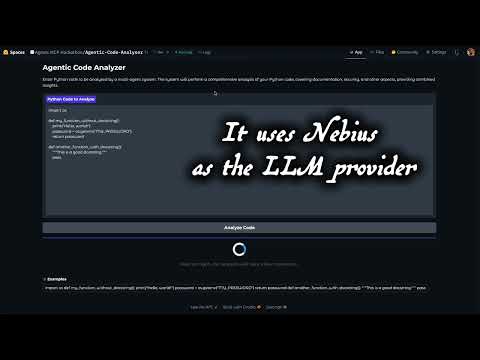
A sophisticated multi-agent system for intelligent, automated code analysis.
The Problem We Solve
In today's fast-paced development environments, maintaining high code quality, robust security, and comprehensive documentation is a significant challenge. Manual code reviews are essential but can be:
- Time-consuming: Taking valuable developer time away from feature development.
- Error-prone: Reviewers can miss subtle bugs or inconsistencies.
- Inconsistent: The depth and focus of reviews can vary between reviewers and over time.
- A Bottleneck: Slowing down deployment pipelines.
Neglecting these aspects leads to technical debt, security vulnerabilities, difficult onboarding, and increased maintenance costs.
This Solution: Intelligent Automated Analysis
The Multi-Agent Code Analysis System leverages a team of specialized AI agents to perform a thorough and consistent analysis of your codebase. It intelligently orchestrates these agents and aggregates their findings to provide actionable insights, helping you build better, safer, and more maintainable software.
Key components include:
- Orchestrator: An intelligent core that assesses the input code and decides the appropriate level of analysis and which specialized agents to deploy.
- DocAgent: Focuses on analyzing code for documentation quality, ensuring docstrings are present, informative, and up-to-date.
- SecurityAgent: Scans code for common security vulnerabilities, helping to proactively identify and mitigate risks.
- Aggregation Engine: Synthesizes the outputs from all active agents into a single, comprehensive report with clear findings, recommendations, and even potential code fixes.
Key Features
- Automated Documentation Analysis: Ensures code is well-commented and easy to understand.
- Automated Security Vulnerability Detection: Identifies potential security flaws before they reach production.
- Intelligent Orchestration: Dynamically determines the required analysis depth and deploys relevant agents.
- Comprehensive & Actionable Reporting: Provides clear summaries, lists of issues, and practical recommendations.
- LLM-Powered Insights: Utilizes Large Language Models for nuanced understanding and generation of analysis.
- Scalable Architecture: Designed to handle diverse code analysis tasks efficiently (with potential for scaling via technologies like Modal).
- User-Friendly Interface: Presents analysis results through a Gradio-based UI, including a specialized
gradio-codeanalysisviewer.
How It Works
The system follows a sophisticated workflow to analyze code:
 (the items in red color are planned to be implemented)
Workflow

- Code Input: The system receives the code to be analyzed.
- Initial Assessment: An LLM-powered orchestrator evaluates the code and determines the analysis strategy (e.g., depth, which agents to invoke).
- Agent Dispatch: Based on the assessment, tasks are dispatched to specialized agents (e.g.,
DocAgent,SecurityAgent). - Parallel Analysis: Agents perform their specific analysis tasks on the code.
- Results Collection: Findings from all active agents are collected.
- Final Aggregation: Another LLM-powered step synthesizes all collected data into a unified, actionable report.
- Report Output: The system presents a comprehensive report detailing issues, recommendations, and potentially suggested fixes.
Benefits for Your Business
- Increased Developer Productivity: Automates routine checks, freeing up developers to focus on complex problem-solving and innovation.
- Enhanced Code Quality & Maintainability: Enforces coding standards and documentation best practices, leading to cleaner, more understandable, and easier-to-maintain code.
- Improved Security & Compliance: Proactively identifies and helps remediate security vulnerabilities, reducing risk and aiding compliance efforts.
- Reduced Review Bottlenecks: Speeds up the code review process, enabling faster development cycles and quicker time-to-market.
- Consistent Standards: Ensures uniform application of coding and security standards across all projects and teams.
- Better Onboarding: Well-documented code makes it easier for new developers to get up to speed.
Technology Stack
- Python
- LlamaIndex: For LLM integration, agentic workflows, and core AI capabilities.
- Pydantic: For robust data validation and schema management
- Gradio: For building the interactive user interface.
- Modal (potential): For scalable cloud deployment and execution of analysis tasks.
- Nebius: For LLM endpoint.
Future Enhancements
- Support for more programming languages.
- Additional specialized agents (e.g., performance profiler, style checker, refactoring agent).
- Additional specialized tools for these agents via MCP.
- Customizable analysis rules and policies.